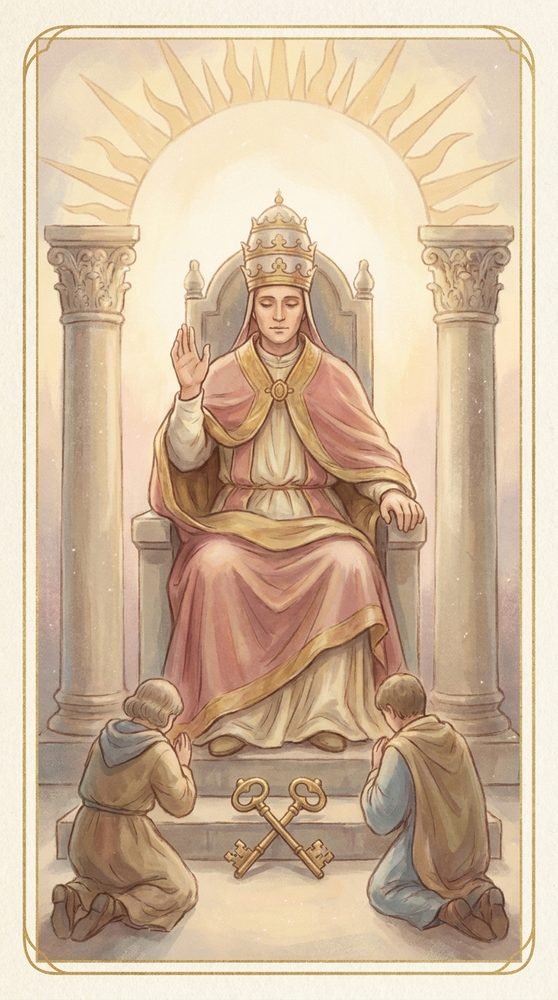
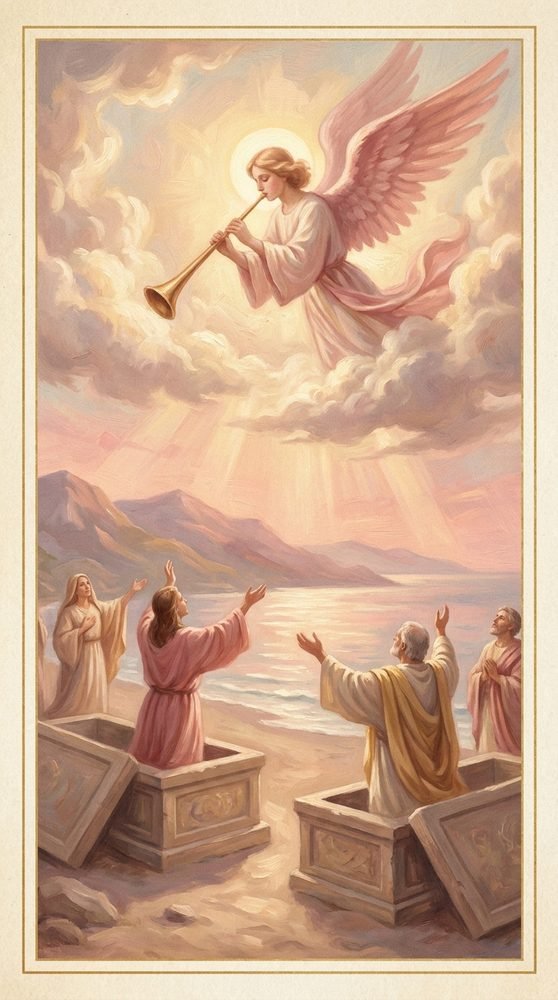
When The Hierophant lands beside Judgement, you are weighing what you were taught against what you would now choose. The Hierophant and Judgement tarot pairing sets a seated teacher between two pillars, with two students kneeling and a pair of crossed keys at his feet, next to an angel with a trumpet and a row of people standing up out of their boxes with their arms open.
Those two pictures make a neat pair of sounds. One is a lesson given quietly to people who came to be taught. The other is a note loud enough that everybody stands up at once. Between them sits the ordinary moment where an inherited way of doing things meets a person who has changed, and the useful work is deciding on purpose rather than by habit.
In love
In love, the hierophant and judgement tarot combination brings the inherited picture of a relationship up against the one you would pick today. The Hierophant carries shared values, the formal steps, and the shape of life you were shown growing up. Judgement carries the moment you see your own part in a pattern clearly, which is uncomfortable for about a day and useful for years.
The question this pair is actually asking is whether you would show up differently now, and what that would look like on a Tuesday rather than in theory. Second chances are possible here, and no card can say whether one arrives. What you can decide is which of the rules you were handed you still want to keep, and which you have only been obeying.
At work and with money
At work these two describe a direction that keeps calling and a method worth learning before you follow it. Judgement is the role you have outgrown or the work you keep drifting back toward, and it supports facing the thing you have been avoiding looking at. The Hierophant says if you are going to do it, do it properly: the training, the qualification, the person who will tell you honestly what the trade is like.
On money, The Hierophant and Judgement tarot pairing likes the conventional and the well understood, and it likes accuracy about where you actually stand. Open the statement, read the terms, then decide. Neither card predicts an outcome. Together they say a change made with the method learned tends to hold, and one made in reaction to the old rule tends to need repeating.
When one of them is reversed
With The Hierophant reversed, a rule you were taught no longer fits the person you have become, and following it now costs more than setting it down. Name the specific belief rather than the whole institution, because a change aimed at one clear thing usually survives, and a change aimed at everything usually does not.
With Judgement reversed, self criticism is doing the work that honest reflection should be doing, or you have heard the call and decided not to answer it yet. Both are worth saying plainly. Be as fair to yourself as you would be to a friend in the same position, and notice how differently the story reads when you use their tone of voice.
What to do with this pair
This week, write two short lists, what you were taught about this and what you would choose now, and then mark the one line on either side you still believe completely. That line is the thing to build on. Keeping a rule because you looked at it and meant it is a different life from keeping it because nobody ever opened the question.
Questions people ask
What do The Hierophant and Judgement mean together in love?
They bring the inherited picture of a relationship up against the one you would choose now. The Hierophant carries shared values and the formal steps, and Judgement carries the honest look at your own part in a pattern. The useful question is whether you would show up differently this time, and what that looks like.
What changes when one of these two is reversed?
The Hierophant reversed means a taught rule no longer fits and keeping it costs more than changing it. Judgement reversed means self criticism has taken over from reflection, or a call has been heard and quietly declined. Both ask for fairness toward yourself rather than a verdict on who you used to be.
Does this pair mean leaving a tradition behind?
Not automatically. It means looking at an inherited way of doing things and deciding on purpose rather than by habit. Plenty of people finish this pair by keeping what they were taught and meaning it for the first time, which is a different thing from never having examined it.