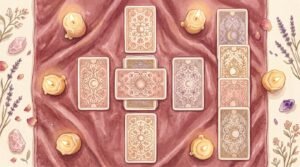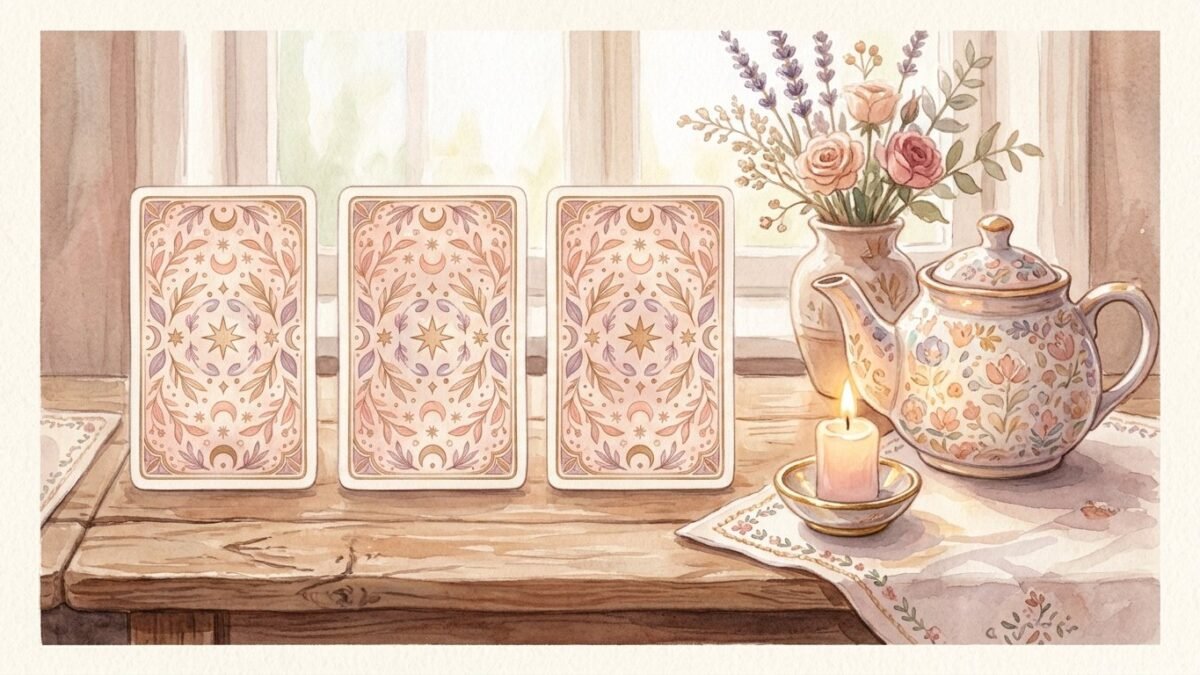
A three card tarot spread is three cards laid side by side and read as one short story: most often past, present and future, though the most useful version names the three positions around your own question before you draw. Read the middle card first, then let the cards on either side explain it. That is the whole method in two sentences; the rest of this page shows how it works in practice.
Three cards is the size most questions actually are. It is big enough to hold a situation with more than one moving part and small enough that you will still remember what came up two weeks later. A three card tarot reading takes about ten minutes and holds a good deal more than people expect of it.
The three positions
The three cards are dealt here as past, present and future, and each of those seats means something plainer than the label suggests. The past card is what you are bringing to this: the history, the assumption, the thing you had already decided without noticing. It is the card people most often skip past and it usually explains the other two.
The present card is what is actually true now, as distinct from the story about it. This is where a reading earns its keep, because most of us carry a description of our situation that is about eight months out of date.
The future card is the one to be careful with, and we read it as where this leans if nothing changes rather than as what is going to happen. No card can see what is coming. What it can show is what already has some movement in it from where you are standing, which is the more useful half anyway.
Why the third seat is not a prediction
Past, present and future is the shape almost everybody knows, and it is well known because it is easy to explain. The trouble is that the last seat quietly invites a forecast, and a forecast is the least honest thing in any reading, and it will take over the whole page if nobody stops it.
So the layout stays and the last chair changes jobs. If you are dealing for yourself, you can name the three seats in your own words instead: what is pulling me back, what is true now, what protects me. What I want, what is in the way, what would move it. Name them before you draw and the reading has a spine.
A worked example
Here is a real shape of question, the kind people bring on a weekday evening: should I sign up for the evening pottery course this winter, or keep my evenings free. Before drawing, the three seats were named out loud: what is pulling me back, what is true now, what would help.
The cards were the Four of Cups, the Eight of Pentacles and The Star.
I start in the middle. The Eight of Pentacles is someone at a bench, making the same thing again and getting a little better each time. As the card for what is true now, it says the wish to learn a craft with your hands is real and already present, not a passing idea. Then the left card explains what is in the way. The Four of Cups is someone sitting under a tree, arms folded, not quite looking at the cup being offered. That is not laziness. It is the tiredness of a long autumn, the feeling that anything new will be one more thing to keep up with. The Star on the right, in the seat of what would help, is a card of rest that refills you rather than drains you.
Read together, the three say something none of them says alone: the course is not one more obligation if you treat it as the thing that refills you. The reading did not decide anything. It changed the question from should I to how would I make this restful, and that is a question the person could answer that same evening.
Five three card spreads worth knowing
You can keep the same three cards and change only the names of the seats. These five cover most of what people actually ask.
For a decision: option one, option two, what you need to know before choosing. For a stuck situation: what keeps it in place, what is shifting, one thing you can do. For a relationship: you, the connection between you, what would help the connection. That last one reads your side and the space between you, never what the other person secretly feels. For a fresh start: what to keep, what to let go, what to begin. For a hard day: what hurts, what holds, what would comfort you tonight.
If you want to see how two cards talk to each other before you add a third, the guide to reading two tarot cards together walks through the method, and the tarot card combinations pages cover the pairs people ask about most.
When three cards is the right size
Decisions with two options. Situations that have been going on a few weeks. Anything where you want to be able to tell somebody afterward what the reading said without needing a diagram.
Use one card for a mood and the Celtic Cross for something you have been going round in circles about for months.
The mistake that makes three cards feel like three readings
The most common slip is to look up each card, read its meaning, and stop there. You end up with three separate paragraphs and no answer. Three cards are a sentence, not a list. After you know what each card means on its own, ask one more question: what is the middle card doing because of the left one, and what does the right one offer it. If you can say the reading in one sentence afterward, you have read the spread.
An honest note: three cards will not tell you what is going to happen, and they will not tell you what someone else is thinking. What they do very well is show you your own situation from three angles at once, which is often exactly what was missing.
Start a three card reading
Deal it at the three card spread, with your question written down first.
Three cards, ten minutes, one thing you can do afterward. That is a good evening’s work.
Questions people ask
Is three cards always past, present and future?
It is the best known set and rarely the most useful. What is pulling you back, what is true now, and what would help will tell you more about almost any real situation.
What if the three cards seem to contradict each other?
That usually means the situation does. Two cards pulling in different directions is often the most accurate thing a reading can show you, and forcing them into agreement is where readings go wrong.
How long should a three card reading take?
Ten to fifteen minutes if you are actually reading rather than looking things up. If it is taking an hour, the question was probably too big for three cards.
How do you read a three card tarot spread?
Name the three positions before you draw, lay the cards left to right, and read the middle card first. Then ask how the left card explains it and what the right card offers it. Finish by saying the whole reading in one sentence.
Can I do a three card spread for love?
Yes. A kind layout is you, the connection between you, and what would help the connection. It reads your side and the space between you, and leaves the other person’s feelings for them to tell you.
What is the best three card spread for beginners?
What is pulling me back, what is true now, what would help. It works for almost any question, it keeps the reading about your own choices, and it is easy to remember without notes.