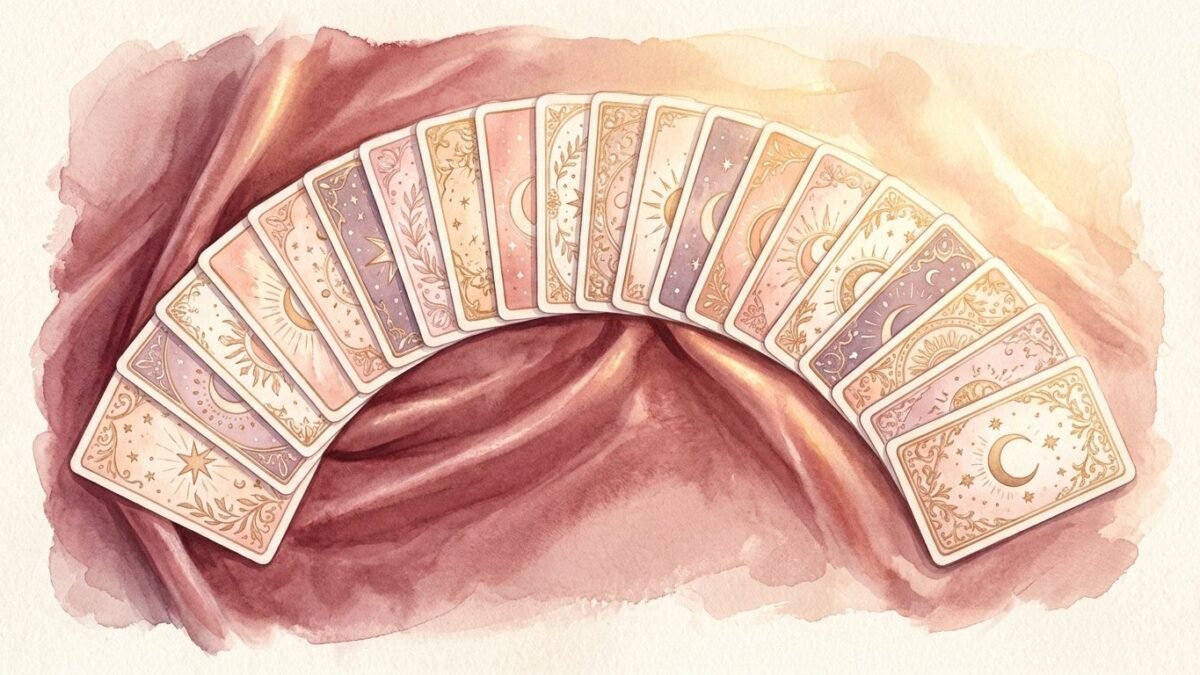
The major arcana cards are the twenty two named cards in a tarot deck, numbered zero to twenty one with the Fool first and the World last, and they are the half of the deck people remember, because something is plainly happening in every picture. They carry the big themes, the things that happen a few times in a life rather than a few times in a week, and when one lands in a reading the room goes quieter.
The plainest way to learn the major arcana cards is as one story told in order, about one person leaving home and coming back changed. Nobody lives it in sequence, and you will meet the Tower long before you are done with the Empress, but the order gives every card a place, and a card with a place is easier to read than a card with a keyword.
The story from the Fool to the World
The Fool steps off the edge at zero with a bundle on a stick and a dog at his heels. The Magician is what you can do with your hands, the High Priestess is what you know without being told, the Empress and the Emperor are the parent who feeds you and the parent who makes the rules, and the Hierophant is what you were taught by people who were sure. The Lovers is the first choice that costs you the other option, and the Chariot is leaving home.
Strength is the first hard thing done gently, and the Hermit is the walk taken alone because company stopped helping. The Wheel of Fortune is what happens to you rather than what you do, Justice is what follows from what you did, and the Hanged Man is waiting on purpose. Death, Temperance and the Devil are an ending, the slow mixing after it, and the habit you go back to when the mixing takes too long, and the Tower is what falls when a life was built on the habit.
The last stretch is the walk home. The Star is the quiet after the noise, a woman pouring water in the open, the Moon is the night when you cannot tell the path from the ditch, and the Sun is plain daylight, a child on a horse. Judgement is being called to stand up and say what you made of it all, and the World is the thing complete, a dancer inside a wreath, with the Fool’s bundle packed again just outside the picture.
What a major arcana card means among the minors
Most readings are a mix, and a major card among minor ones is the weather over a day of errands: it says what the week is about, and the minors around it say where your hands go, so the Hermit beside the Eight of Pentacles is a stretch of pulling back in which the work still gets done, which is a more useful sentence than either card makes alone. The major and minor arcana page has the structure of the deck if you want that first.
The twenty-two major arcana, in order
- The Fool new beginning, open road, trust
- The Magician resourcefulness, focus, skill
- The High Priestess intuition, stillness, inner knowing
- The Empress nurture, abundance, creativity
- The Emperor structure, authority, boundaries
- The Hierophant tradition, guidance, learning
- The Lovers choice, connection, alignment
- The Chariot momentum, determination, self control
- Strength patience, courage, compassion
- The Hermit solitude, reflection, guidance
- Wheel of Fortune change, turning point, luck
- Justice fairness, honesty, accountability
- The Hanged Man pause, new perspective, letting go
- Death ending, transformation, clearing out
- Temperance balance, moderation, patience
- The Devil attachment, habit, temptation
- The Tower sudden change, truth revealed, collapse
- The Star hope, healing, calm after difficulty
- The Moon uncertainty, intuition, anxiety
- The Sun clarity, warmth, success
- Judgement awakening, reckoning, a clear call
- The World completion, wholeness, arrival
Death, the Tower and the Devil, read honestly
Death is a skeleton in black armor on a white horse, and it does not predict anybody’s death, and we would sooner say that first than leave you wondering. It describes an ending already underway, the version of things that ended months back and still gets a place set at the table, and its plain question is what you would get back if you stopped.
The Tower is a crown knocked off a tower by lightning, with two people falling. It comes down on what was already leaning, because a sound structure does not come down in one strike, and what arrives after the fall is usually an honest look at what the thing was resting on, uncomfortable and cleaner than the years of propping.
The Devil is two figures chained to a block, and the chains would lift over their heads if they tried. The card is a habit or an arrangement that keeps you small and that you keep telling yourself you chose, and shame rather than the chain holds it in place, because once you can describe it out loud to one person the hold is already lighter. None of the three is a verdict on you. Each describes a situation, and a situation can be answered.
Reading a spread that is heavy with major arcana cards
Count the major arcana cards before you read a single one. Two out of three means the situation has outgrown the question, and the one minor card is where your part of it lives this week. Three out of three means you are inside a chapter rather than a problem, and an honest reading says so and then looks for the smallest thing still yours to do. Reading the majors in number order also helps, because the lowest is roughly where the story finds you and the highest is where it leans, which is bearings rather than a forecast.
Tonight, with the twenty two in a row
Lay the majors along the table in order, the Fool at the left and the World at the right, and look for the one that most resembles this month. Choose the true one rather than the one you would like, and write its name and one sentence about why. Then look at the card to its right, because that is where the story usually goes next, and knowing the next card is company rather than a promise.
Questions people ask
Does the Death card mean someone is going to die?
No, and no card in the deck does, on this site or anywhere honest. Death is a picture of an ending in your own life that is already underway, the arrangement or the version of yourself that finished a while ago and is still being kept up. If you are frightened for somebody’s health, their doctors know far more than any card, and we would rather say that plainly.
Which major arcana card is the worst one to draw?
None of them is a verdict, though the three people dread are Death, the Tower and the Devil. Each describes a situation rather than a sentence: an ending underway, a structure that was already leaning, a habit you keep telling yourself you chose. A situation can be answered, and an honest reading of any of the three ends with the small part that is still yours to do.
What does it mean when the same major arcana card keeps showing up?
Usually that you are inside the stretch it describes and have not yet done the thing it asks, so the deck keeps saying it. The Hermit four weeks running is a plain description of a month spent pulling back rather than an instruction to become a monk. Ask it one question in your notebook, which is what the card would have you do before Friday, and answer in a line.