What The Devil means
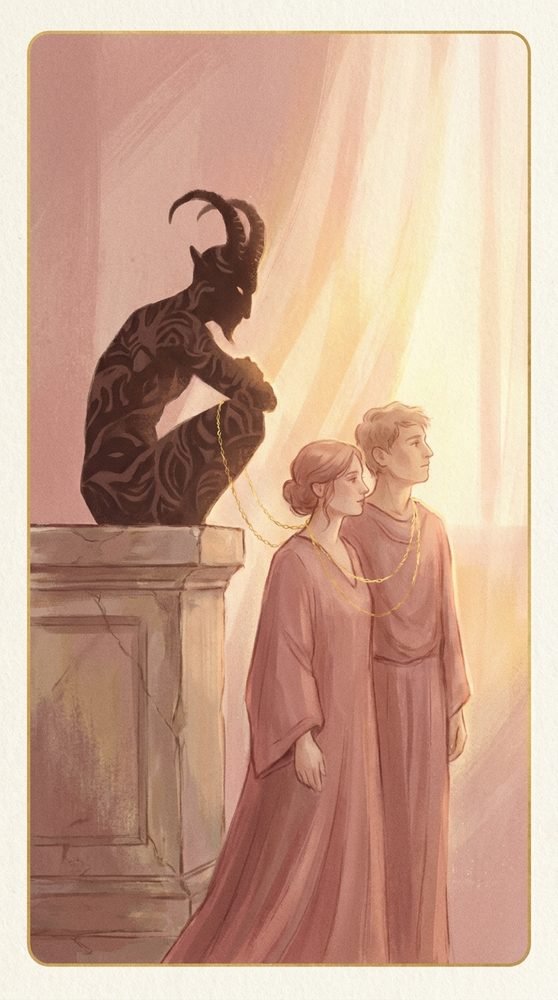
The Devil is about the things that hold you, and about how loose the hold actually is. In the picture two figures stand chained to a block, and the chains around their necks are wide enough to lift off. That detail is the whole card. Whatever you feel trapped by, some part of it is being maintained rather than imposed. This is not a card about evil, and it is not a warning that something terrible is coming. It is a very honest look at habits, attachments and arrangements that have quietly started running you, and at the choice you still have inside them.
The Devil upright meaning
Upright, The Devil names something you have probably already noticed and have not wanted to look at directly. A habit you defend, a relationship that keeps you small, a job you stay in for reasons you would struggle to say out loud, a way of numbing an evening that has become the whole evening. There is often shame around this card, and shame is exactly what keeps the pattern in place, so it is worth setting down. You are not weak. You are in an arrangement that gives you something real, and until you name what that something is, it will be very hard to change.
The Devil reversed meaning
Reversed, The Devil is usually a good sign. It tends to mark the moment the hold starts to loosen, when you can see the pattern clearly enough to describe it, which is most of the work. Sometimes it is the first refusal, the evening you did not, the message you did not send, the thing you finally said out loud to one person. It can also point to the uncomfortable middle where you have seen the truth and have not yet acted on it. That stage is not failure. It is the last quiet part before something actually changes.
The Devil in love
In love, The Devil deals with attachment that is stronger than the connection underneath it. Intensity that gets mistaken for depth, the relationship you keep returning to knowing how it goes, the situation where you are more addicted to the uncertainty than to the person. It also covers the ordinary version, two people stuck in a rut that neither of them chose. It is worth saying plainly that if a relationship involves control, fear or being made small, that is not a pattern to work through alone, and talking to someone you trust is a reasonable next step.
The Devil in work and money
In work and money, The Devil describes arrangements that hold you through comfort rather than through chains. The salary that makes leaving hard, the debt that quietly decides your options, the role you are good at and no longer want. It also covers overwork treated as a personality, where stopping feels more frightening than continuing. None of this predicts a financial outcome, and it is not saying you should walk out tomorrow. It is asking you to look honestly at what the arrangement costs you, in hours and in self-respect, and to know that number rather than avoid it.
The Devil as a yes or no card
As a yes or no, The Devil is a cautious maybe, and it comes with a question attached. Look closely at what saying yes would commit you to, especially anything that is easy to enter and hard to leave. Contracts, debts, intense connections, anything where the appeal is strong and the terms are vague. If the answer still looks good after you have read the fine print and named what you would be giving up, then proceed. If you find yourself not wanting to look at the fine print, that reluctance is the answer.
When it shows up as your card of the day
When The Devil is your card of the day, notice your automatic behavior rather than trying to fix it. The reach for the phone, the second drink, the shopping tab, the reply you always send to that one person. Just watch it and see when it happens and what came immediately before. It is often a day where an old temptation shows up in a convincing outfit. You do not have to be perfect about it. Seeing the mechanism clearly once is worth more than a week of white-knuckled resistance.
A small step to take with it
Write down one thing you say you cannot stop doing, and note the exact moment in the day it usually starts. Not why, not a plan to quit, just the time and what happens right before. Most patterns have a reliable trigger and almost nobody knows what theirs is, because we look at the behavior instead of the doorway into it. The Devil loosens when it becomes specific. Once you know the moment, you have somewhere to put a different choice, and that is a far more useful place to start than willpower.
Questions people ask about The Devil
Is The Devil a bad card?
It is an uncomfortable card rather than a bad one, and it is not a warning of harm. It describes patterns, habits and attachments that have more hold on you than you would like. People often find it clarifying, because it names something they had been circling for a long time.
Does The Devil mean addiction?
It can point to compulsive patterns of many kinds, from substances to work to a particular relationship. What it cannot do is diagnose anything, and it should never be used that way. If something in your life feels genuinely out of your control, a card is not the right tool, and talking to a professional is.
What does The Devil mean for an ex coming back?
It cannot tell you what they will do. What it does raise, gently, is whether the pull you feel is about the person or about the intensity and the unfinished feeling. That is worth being honest with yourself about, because the two can feel identical from the inside and lead to very different decisions.
The chains in the picture are loose. That is the part people miss.