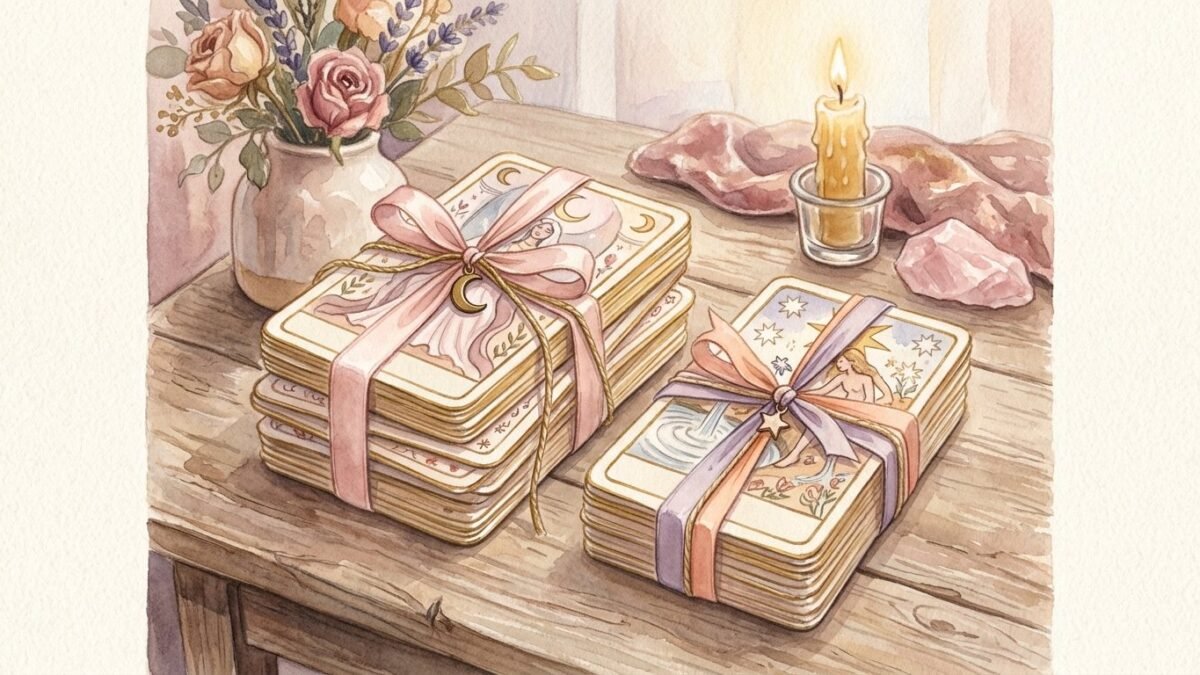
The major and minor arcana are the two halves of a tarot deck, and they are not equal halves. The major arcana are the twenty two named cards, from the Fool at zero to the World at twenty one, and they carry the big themes that turn up a handful of times in a life. The minor arcana are the other fifty six, in four suits that run from ace to ten with four court cards each, and they are about the week you are actually having.
The simplest way to hold the difference is that the majors name the chapter and the minors are what happens on the page. A reading full of major cards is describing something with weight in it, and a reading full of minors is about something practical and close to hand, which is most weeks.
The twenty two major arcana
Laid out in order, the majors tell the rough story of one person walking through the deck. The Fool sets off at zero with a small bag and no plan, meets the people who shape a life in the early cards, learns something hard around the middle in Death and the Tower, and comes out the far side in the Star, the Sun and the World. The numbers are an order of arrival rather than a ranking, and nobody moves through them once and in sequence.
A major card tends to point at something that is not entirely in your hands, a stretch you are in rather than a task you are doing. The Hermit is not asking you to send an email. It is describing a spell of pulling back, and the useful question is how to live inside it well rather than how to get it finished by Friday.
The fifty six minor arcana
The minors are where a reading becomes useful, because they are about things you can do something about before dinner. Each suit takes one part of life. Cups are feeling, love, and what moves between people, and the Ace of Cups is the first stirring of a feeling that does not have a name yet. Wands are drive, the work you want to do and the restlessness that gets it started. Swords are thought, words, decisions and the arguments you have in your head, which is why they are the suit people flinch at. Pentacles are money, the body, the house, the job as a job, and everything else you can put your hands on.
Within a suit the numbers run in a rough arc. An ace is the offer of a thing, the middle cards are the working out of it, with the fives usually being where it goes wrong, and the ten is the thing in full, which can mean a full house or a full load depending on the suit. The pages, knights, queens and kings sit at the top of each suit and are read as people or as roles you are playing, and the page on court cards takes them one rank at a time.
Major and minor arcana in one reading
Most readings mix the major and minor arcana, and the mix is the first thing worth noticing before you read a single card. Count the majors. If three cards come up and two of them are major, the situation is bigger than the question you asked about it, and the minor card is probably where your part lives. If all three are minor, the answer is close to hand and practical. If a court card is in there, somebody is behaving in a particular way, and it may well be you.
Are the majors more important?
The question people ask most about the major and minor arcana is whether one half matters more, and the answer is that the majors are bigger, not truer. The Three of Swords on a Tuesday can hurt more than the Tower does across a year, and a reading that treats every minor as filler misses most of what is going on. The majors get more attention because they have names and the minors have numbers, which is a fact about how memory works rather than about the cards.
Plenty of readers, especially early on, read with the majors only, and it is a fair way to learn the twenty two. It is also a diet of nothing but big news. Add the minors back in as soon as you can, because they are the ones that tell you what to do about it.
Where to begin
Before you read your next card, say out loud which half of the deck it comes from and, if it is a minor, which suit. It sounds too small to count as reading, and it is already half of one, because you have just said whether this is the chapter or the page, and what it is about.
Questions people ask
How many cards are in the major and minor arcana?
Seventy eight in all. The major arcana are twenty two cards, numbered from zero, the Fool, to twenty one, the World. The minor arcana are fifty six cards in four suits, cups, wands, swords and pentacles, and each suit has ten numbered cards from ace to ten and four court cards, the page, knight, queen and king. Every reading here draws from the full seventy eight.
Is it bad to draw a lot of major arcana cards?
No. A reading with several majors in it is describing something with weight, a stretch of life rather than a task, and that is information rather than a verdict. It usually means the question is bigger than the way you asked it. Look for the one minor card in the spread, because that is generally where the part you can act on this week is sitting.
Can I read tarot with only the major arcana?
You can, and some readers start that way to learn the twenty two properly. The trouble is that a majors only deck talks in big themes and never in errands, so every reading sounds like a turning point and none of them tells you what to do on Wednesday. Use it to learn, then put the minors back, because they are the half that hands you a step.