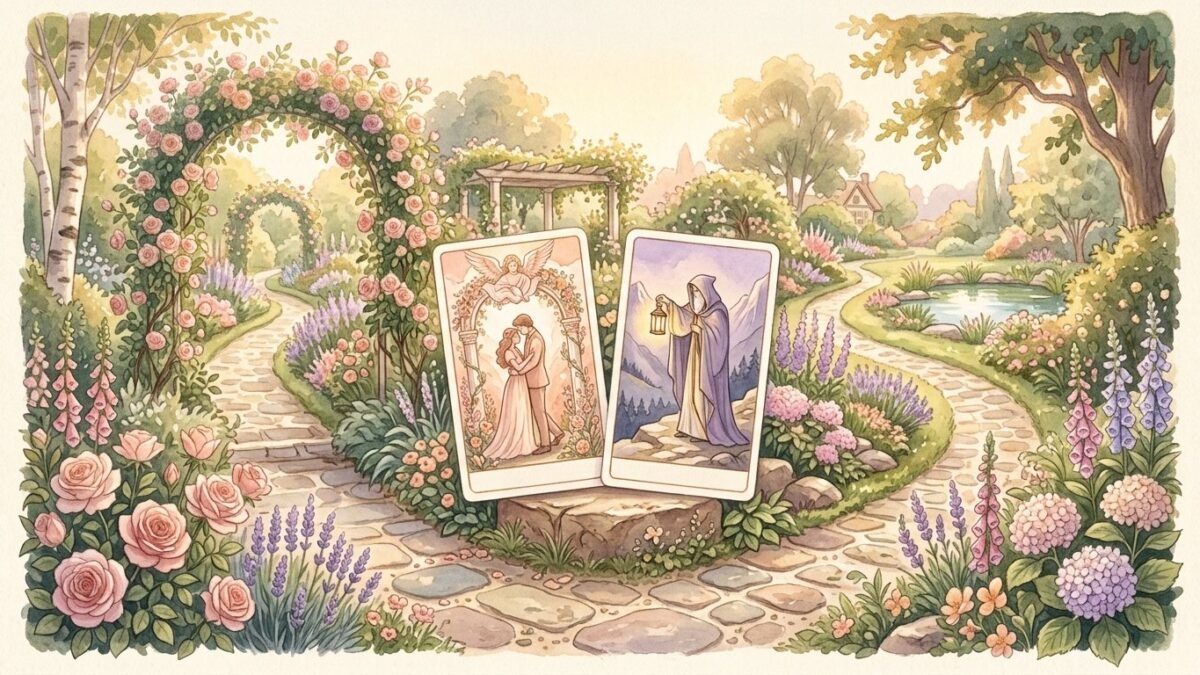
You already have the list. Two columns, roughly the same length, written on the back of something, and the fact that both sides came out even is how you know a list was never going to settle this. A tarot spread for decision making does not settle it either, and we will not pretend it does, but it changes the question from which option is better to what each option would ask of you, and that is a question a card can actually hold.
The layout below puts the two paths side by side and reads each of them for its demands and its price. Nowhere in it is a seat for which one wins, because no card can see the years after a choice, and a spread that claims to compare two futures is comparing two guesses with nicer pictures.
The five positions
The first card sits alone at the top and it is what you are actually deciding, which is not always the decision as you phrased it. A question about whether to take the job is often a question about whether you are allowed to want an easier year, and a question about moving is often a question about a person, and this seat is where that comes out.
Beneath it, two cards on the left for the first path: what it asks of you, and what you would be giving up. Two cards on the right for the second path, in the same two seats. Asks of you means the effort, the conversation, the version of yourself that would have to turn up on a Monday. Giving up means the real cost, which is usually not the one on the list.
Read the columns across rather than down: what the first path asks against what the second asks, and then the two prices against each other. Somewhere in that comparison is a small feeling of relief or a small feeling of dread, and either of those is the reading.
Why a tarot spread for decision making picks no winner
Because it cannot. A path is a hundred small choices that have not been made yet, most of them by people you have not met, and any card that appears to show you the end of it is showing you a picture you finished in your own head. The Two of Swords, a blindfolded woman holding two blades crossed over her chest, is the card that turns up here most often, and it is not about the options at all; it is about what it costs to keep sitting between them.
So the spread reads each path for what it would make of you rather than for what it would give you. That is less exciting than a verdict and a good deal more reliable, since the demands of a path are visible from here and its rewards are not.
How to ask so the cards can help
Write both options down in a sentence each before you deal, plainly and without the case for either one. If one of the options is really do nothing, write that down too and give it a column of its own, because staying put is a choice with demands and costs like any other and it hides very well behind the two you are arguing about.
Then set a date. A decision without a date is a worry, and the cards can do little for a worry except keep it company for ten minutes.
When a different spread fits better
If the decision is about work, the work spread has positions built for that pace, and should I quit my job takes the most common version on directly. If the decision is small enough to fit in a sentence with a yes at the end of it, the yes or no draw is quicker and gives you a lean instead of a layout. And if you are not choosing between two things so much as lost in general, the guidance spread is the one you want.
Start the decision spread
The app does not deal two paths side by side, so start a tarot spread for decision making at the three card spread, which reads its seats as past, present and future. Put both options into the question in one sentence, read the first card as what you are bringing to the choice, the second as where you actually stand between the two, and the third as where this leans if you keep not choosing, which is a real place and one worth seeing.
Either path will ask something of you. The reading is for finding out what, so that the choice gets made with your eyes open rather than by the calendar.
Questions people ask
Can tarot tell me which option to choose?
No, and a spread with a seat for the winner is comparing two guesses. A path is made of choices nobody has made yet, most of them by people you have not met. What the cards can show is what each option would ask of you and what it would cost, which is visible from where you stand, and the choosing stays yours.
What if both paths look equally hard in the cards?
Then the choice is not about difficulty, and that is worth knowing. Look at the two cost cards instead, because people can carry a great deal of effort for something they want and very little for something they do not, and the price you flinch at is usually the reading.
Should I do a separate reading for each option?
Keep them in one layout. Two separate readings tempt you to deal again until one path gets the nicer card, and by the third attempt you are not reading, you are shopping. Five cards on one table, read across, is enough for any decision with two real options in it.