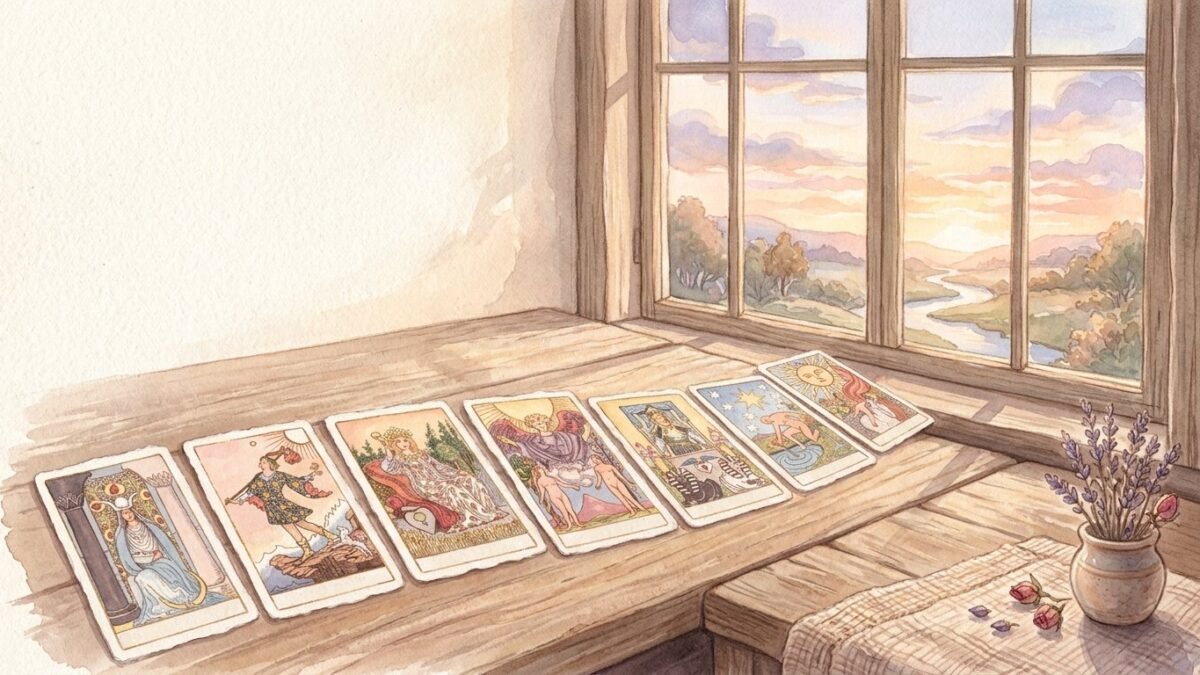
The question underneath a tarot spread for the future is usually smaller and more specific than the word future makes it sound: will the thing I am worried about happen, will the thing I am hoping for arrive, and when. We cannot answer any of those and neither can a card, and rather than hide that under a tenth paragraph we would put it here at the top, where you can decide whether to keep reading.
What a card can see is what already has some movement in it, from where you are standing now. So this spread does not deal a seat for the outcome. It deals a seat for where things lean if nothing changes, which sounds like a smaller promise and turns out to be a more useful one, because the lean is visible from here and the outcome is not.
The three positions
The first card is what is already in motion. Not what might happen but what is happening: the job that has been getting quieter, the friendship that has moved to voice notes, the plan you have half made and not said out loud. Most of the future that people worry about is already under way in a small form, and this seat finds it.
The second card is your hand on it. What you are doing, or not doing, that keeps the thing moving the way it is moving. This is the uncomfortable seat and the honest one, because it is the only part of the future anybody at the table has any say in, and it is the seat people would most like to skip.
The third card is where this leans if nothing changes. A shopping cart left on a slope in a parking lot will roll in a direction that anyone can see from where they stand, and nobody would call that a prophecy. That is the third card. It shows the direction, on the assumption that nobody, including you, does anything differently, and the reason for doing the reading at all is that something usually does.
Why a tarot spread for the future has no outcome seat
Because a card cannot see one, and because a reading that names an outcome takes over the whole evening. Once a page has told you that he comes back in the spring or that the offer arrives in March, everything else in the reading gets read in the light of that sentence, and the sentence was a guess with a card behind it. The tenth seat of the Celtic Cross has the same rule for the same reason: it is a lean, not an ending.
There is a second reason, gentler than the first. A future you have been told about becomes something to wait for, and waiting is expensive, while a lean is something you can put your hand on this week. If you want the longer argument, what tarot cannot do sets it out properly.
A five card version for your own deck
Add a seat before the first for what is behind, the thing that set all this moving, and a seat between the second and the third for what would change the lean. That fourth seat is the one that makes the layout worth doing, since it is dealt for the one thing you could do this week that would leave the cart somewhere else. Name it out loud before you deal, and read it small.
The questions this spread is for
A tarot spread for the future is for where this is going, in a relationship, a job or a plan, and for what happens if I keep doing what I am doing, and for whether the thing I have been half expecting is really on its way or whether I have built it out of two facts and a quiet weekend. It is not for the year as a whole, which the year ahead reading handles at the right scale, and it is not for questions about health, money or another person’s choices, which no seat can hold.
Start the future spread
Deal it at the three card spread, which names its seats past, present and future and reads the third exactly this way, as where things lean rather than as what will happen. Write the question as what is already moving here, and read the middle card for your own hand on it rather than for the situation in general.
The future is not written down anywhere, which is the most hopeful thing a deck can tell you, because it means the cart has not stopped rolling and you are still standing next to it.
Questions people ask
Can tarot predict the future?
No, and we would rather lose the click than say otherwise. A card can see what already has movement in it from where you stand, which is the lean, and it cannot see what people who have not decided yet will decide. Every honest reading of a future seat is a reading of the present with the direction drawn in.
What does the future card mean in a three card spread?
Where this leans if nothing changes. It is dealt on the assumption that nobody does anything differently, including you, and something usually does, which is the whole reason for doing the reading. Read it as a direction you can put your hand on rather than as an ending you have to wait for.
How far ahead does a future spread look?
As far as you can see from where you are standing, which for most situations is a few weeks. Past that the cards are not seeing, they are guessing, and the guess gets dressed up as a month or a year. If the question is about the year as a whole, the year ahead reading is built at that scale.