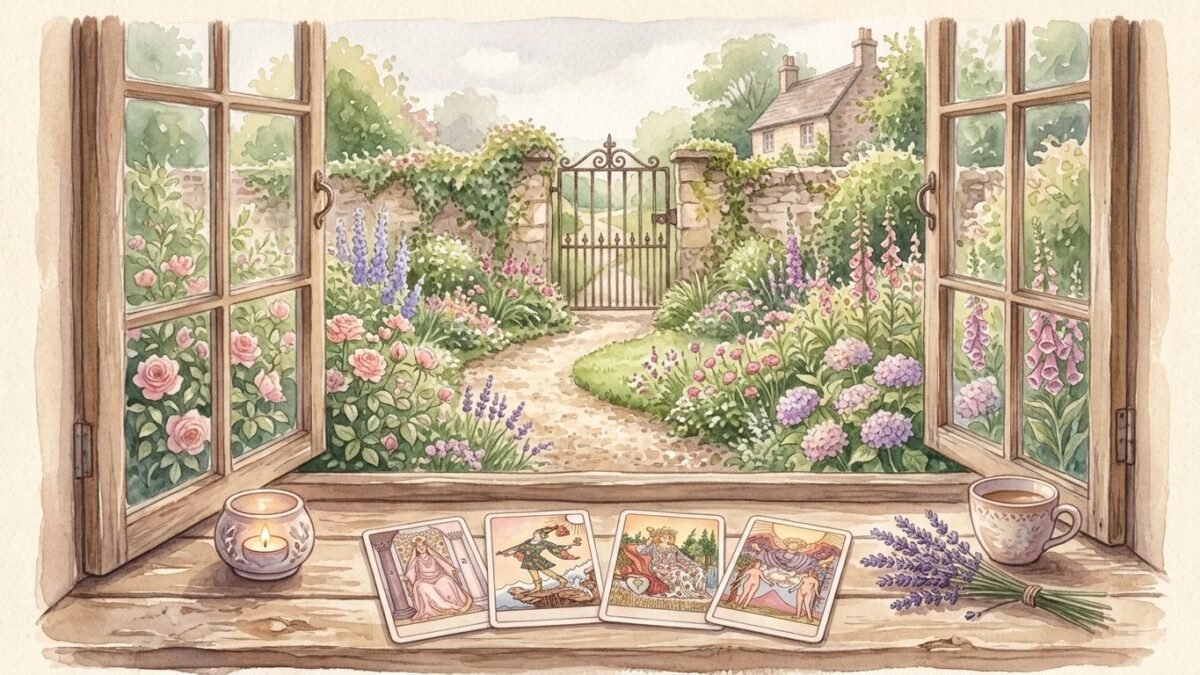
This is the most searched spread in tarot and the most misused, and the two facts are connected. A will he come back tarot spread, as it is usually laid out, has a seat for whether he misses you, a seat for whether he still loves you, a seat for whether he returns and a seat for when, and every one of those four seats promises something no card can see. We are going to lay it out anyway, because it is what you came for, and then read it in the only way it can be read without lying to you.
You could say the number of days without counting, and that is the part of this we want to take seriously before anything is turned over, because a question kept that carefully is not idle curiosity, it is a person who has not been able to put the question down.
The will he come back tarot spread as it is usually dealt
Four cards: does he miss me, does he still love me, will he come back, when. Deal a card into a box marked will he come back and it will be read as a yes or a no, because that is what the box asks for, and the Six of Cups becomes a yes and the Eight of Cups becomes a no and the Wheel of Fortune becomes soon. None of those cards can carry that. What has happened is that a picture landed in a box and the box did the talking.
The when seat is the worst of the four, because a date turns waiting into a schedule, and a schedule can be missed, and a missed date at three in the morning feels like proof of something. It is proof of nothing except that a card cannot see a calendar.
The honest version, four positions
The first card is what the waiting has become on your side. Not whether you should be waiting but what it has actually turned into: the drafts folder with four versions of the same message in it, none of them sent, the plans made loosely in case, the hour of the evening that still belongs to him. This is the seat that tells you most, and it is the one the usual layout leaves out entirely.
The second card is him, as far as anyone outside his life can honestly see. What he has done since, what he said when it ended, the pattern a friend would have described while it was still going on. Read only what is visible from where you stand. It is never read as what he feels or what he is going to do, in any phrasing and with any hedge, because no card reaches into another person’s week.
The third card is the space you both left, which is a real thing and a readable one: what the relationship was actually like in its last three months, as distinct from the version assembled out of the good weeks. The fourth card is what is yours to do at the hour he used to text. One thing, small, for this week. It is the only seat in the spread with a future in it, and the future belongs to you.
Why the honest version is the useful one
Because it is the only one you can act on. A yes leaves you exactly where you were, waiting, with a card for company; a no leaves you arguing with a card; and a date leaves you counting toward it. A will he come back tarot spread read this way hands you back the part that was always yours, which is the shape of your own days while you do not know.
The reading on the will he come back page is built on exactly this, and if what you are really in is the no contact stretch, will he come back after no contact is about the waiting itself, which is the part that is actually happening to you.
What to do with the fourth card
Read it as small as you can and then make it smaller. The card is not asking you to move on, delete him or start dating; it is asking for one hour this week spent somewhere other than the waiting posture, once, on purpose. Most people who deal this spread honestly find that the fourth card is the only one they remember a month later, and that the other three had told them what they already knew.
If you want the first thirty days of that laid out one at a time, no contact day by day does it without a promise at the end.
Start the spread
Deal the first three seats at the love spread, which names them you, them and the space between and holds the middle card to what is visible. Write the question as it is, will he come back, and let the reading say honestly what it cannot see before it turns to your side. The fourth card is the step the reading ends with, and it is the one to write down.
Whatever he does, and we cannot see it, you get to decide what the hour he used to text is for now.
Questions people ask
Why is there no yes or no position in this spread?
Because a card cannot see what another adult will choose, and a seat labeled will he come back guarantees a yes or a no from whatever lands in it. The four honest seats read your side of the waiting, which is the only side you can act on, and hand the rest back to him, where it was anyway.
Can I use this spread if I was the one who ended it?
Yes, and the first seat changes shape. The waiting becomes something closer to checking: whether he is all right, whether he has moved on, whether you were right. The other three seats work the same way, and the fourth is often easier to find, because you already know which hour you keep looking at your phone.
How often can I deal this spread?
Once, and then not for two weeks. Dealing it again the next night is waiting in another form, and by the third draw you are looking for the card that says yes rather than reading. If you need something in between, the daily card gives you one honest paragraph a morning without reopening the question.