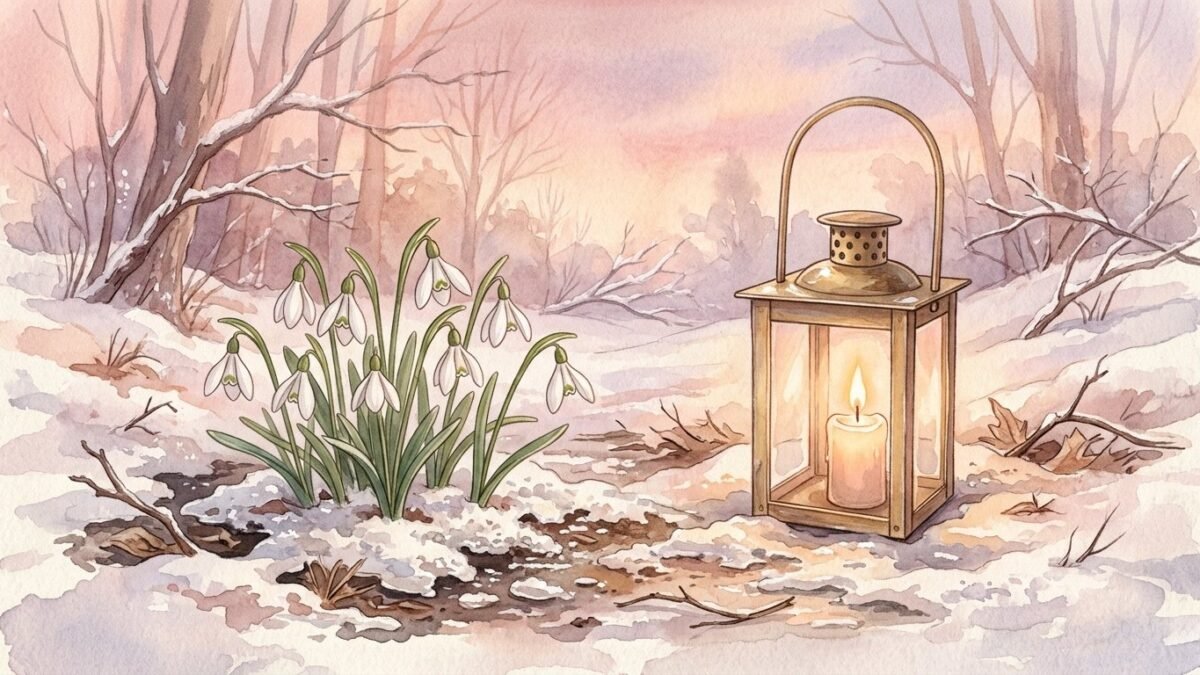
Halfway between the winter solstice and the spring equinox, there is a day that feels like a held breath. In the old Gaelic calendar it is Imbolc, kept on 1 or 2 February, and it marks the first small signs that the light is turning back: the evenings a little longer, a snowdrop at the edge of the garden, the first lambs in the fields. Nothing is in bloom yet, but something has clearly begun.
An Imbolc tarot spread fits that mood well. It is not a spread about the whole year, and it does not ask you to decide anything. It asks a quieter question: what is stirring in you under the cold ground, and what would help it grow? I like to do it with a single candle, a cup of tea and a pen, on the evening of 1 February 2027, which falls on a Monday.
What Imbolc is about
Imbolc is traditionally linked with the Irish figure of Brigid, with hearth fires, candles and the first milk of the year, and in many homes it still means lighting a candle and opening a window to let the winter air out. The common thread is gentleness. Spring is not here, but it has been noticed, and noticing is the whole festival.
That is a useful way to hold the cards too. You are not looking for answers about August. You are looking for what is waking up, so you can give it a little light.
The five cards
Shuffle slowly, thinking of one thing you hope to bring into spring. Lay out five cards in a gentle curve, like a path leading toward a window:
- What winter has been teaching me
- What is asleep in me that is ready to stir
- The candle: what deserves my attention right now
- What I can set down before spring
- The first small step toward the light
The third card is the heart of the spread. Give it the longest look, and read it aloud if you can.
How to read it
Read the first two cards together, as a quiet conversation between what the cold months gave you and what is now waking. If the second card is a gentle one, such as the Star, take it as permission to hope slowly. If it is a heavier card, treat it as something that needs patience and warmth rather than speed.
The fourth card is not a demand to give anything up. It is simply something that may be lighter to carry without. And the fifth card should be small enough to do within a week. If it feels too big, ask what the smallest honest version of it would be, and write that down instead.
A simple Imbolc evening
Tidy one corner of the room, light a candle, and draw your five cards. Write one sentence for each in a notebook, in plain words, and nothing more. Then blow out the candle, and notice how you feel. It does not need to be dramatic. A small, settled feeling is a good sign that the spread has done its work.
If you would like a longer practice around the same time of year, the winter solstice spread looks back at the dark, and the New Year spread looks ahead to the months to come. Imbolc sits quietly between them.
What the Imbolc spread will not do
It will not tell you what spring is going to bring. No spread can, and I would be wary of any that claims to. What it can do is help you notice what you already feel, name it kindly and take one small step. That is plenty for a February evening.
Questions people ask
When is Imbolc in 2027?
It is traditionally kept on 1 or 2 February, so the evening of 1 February is the most common choice. If that night is busy, any quiet evening in the first week of February works just as well.
Do I need a special deck for an Imbolc spread?
No. Any deck you like to look at will do. A candle and a notebook are nice to have, but they are optional.
Can I use the Imbolc spread if I do not follow any tradition?
Of course. You can treat it simply as a check-in at the point in winter when the light starts to return. You do not need to believe anything in particular to enjoy it.