Between Christmas and Epiphany lie twelve nights that have always felt a little outside ordinary time. In England they are the Twelve Days of Christmas; in the German speaking Alps they are the Rauhnächte, the rough nights, when the old year has stopped and the new one has not quite started. The folk belief that goes with them is a simple one: each of the twelve nights shows something of one month of the year ahead.
A Yule tarot spread follows that belief in the gentlest way. You draw one card on each of the twelve nights, and each card stands for one month of 2027. By Epiphany you have a small, handwritten map of the year, made slowly, a card at a time, in the quietest week of the calendar.
When the twelve nights fall
Traditions differ by a day here and there, but the most common count starts on Christmas Eve night and ends on the night before Epiphany. For 2027 it looks like this:
- The night of 24 to 25 December: January
- The night of 25 to 26 December: February
- The night of 26 to 27 December: March
- The night of 27 to 28 December: April
- The night of 28 to 29 December: May
- The night of 29 to 30 December: June
- The night of 30 to 31 December: July
- The night of 31 December to 1 January: August
- The night of 1 to 2 January: September
- The night of 2 to 3 January: October
- The night of 3 to 4 January: November
- The night of 4 to 5 January: December
Some people start on the winter solstice instead, on the twenty first, and run their twelve nights to the first of January. Either works. What matters is that you pick one count before you begin and keep to it, so the months line up.
How to do the twelve night spread
Keep your deck and a notebook somewhere you will see them each evening. Before bed, shuffle while you think about the coming month, not about anything in particular, just the name of it. Draw one card. Write down the date, the month it stands for, the card, and one line about how the day itself felt.
That last line matters more than it sounds. The old idea was that the mood of each night, the weather, the dreams, the visitors, also belonged to its month. You do not have to believe that to find it useful. A card on its own is a symbol; a card next to a real evening in your real life is a note you will actually understand when you read it again in May.
Resist interpreting too much on the night. The point of drawing one card twelve times is that the meaning comes from the whole row, not from any single draw.
Reading the twelve cards together
On the evening of Epiphany, the sixth of January, lay all twelve cards out in order, January to December, and look at them as one picture before you look at them as twelve.
- Count the suits. A year heavy with Cups is a year about people and feelings; Pentacles, money, work and the body; Swords, decisions and conversations; Wands, projects and energy.
- Notice the major arcana. Those months tend to be the ones you remember. Several in a row is a season of change; none at all is a year for steady, ordinary building, which is no bad thing.
- Look for repeats and echoes. The same number turning up in different suits, or a card that answers another six months later, is usually the thread of the year.
- Read reversed cards as slower, not worse. A reversed card in a month often means that month asks for patience or a second attempt.
Then put the list somewhere you will find it, the front of a diary or a note on your phone, and read the next month’s card at the start of each month. That is where this spread earns its place: twelve small check ins across the year, each one already waiting for you.
The thirteen wishes
A modern custom has grown up around the rough nights that pairs beautifully with the cards. Before the first night, write thirteen wishes for the year on thirteen small pieces of paper, fold them so you cannot see which is which, and put them in a bowl. On each of the twelve nights, take one out without reading it and burn it safely, letting it go to whatever you believe looks after such things.
After the twelfth night, one wish is left. That is the one you open, and it is the one you are responsible for yourself. I love this, because it is honest about what wishing can and cannot do. Most of what we hope for is out of our hands. One thing, each year, is ours to carry.
A one evening Yule spread
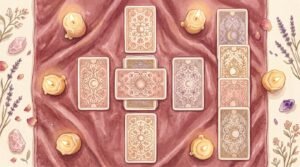
If twelve nights in a row is not realistic in your house, here is a five card spread for a single evening around Yule:
- What the dark half of the year taught me
- What I am carrying through the turning
- The light that is already coming back
- What I can leave on the fire
- The gift 2027 is holding out to me
Lay the first two to the left, the third in the middle, and the last two to the right, so the spread reads from the old year into the new one. The card in the middle is the heart of it.
What the Yule spread will not do
It will not tell you what is going to happen in August. No spread can, and the twelve night spread is at its best when you treat each card as a theme to notice rather than an event to wait for. It is a way of meeting the year a little prepared and a little curious, which is a good deal more useful than certainty would be.
If you would like the cards drawn for you
The reading below draws three cards for the year ahead in your own words: write your question first, something like what do I most need to know about 2027, and let it lay them out.
What would you like to look at
Pick the shape that fits the question. You can change your mind at any point before you draw.
Before we start
Twenty seconds, feet on the floor, hand somewhere warm. Breathe in while the circle grows and out while it settles. You can skip this whenever you like.
What is on your mind
In your own words, as much or as little as you like. You can leave it empty and simply draw.
Your cards
Laying them out now.
Clara
Same cards, one more look.
Did this land?
For self-reflection and entertainment. Not a substitute for medical, legal or financial advice. 18+.
Questions people ask
When do the twelve nights of Yule start?
The most common count runs from the night of 24 to 25 December to the night of 4 to 5 January, ending before Epiphany. Some traditions start on the winter solstice instead. Choose one count and keep to it.
What if I miss a night?
Draw the card the next morning for the night you missed, and note that you did. A missed night is not a bad omen; it is a busy week in December.
What if I draw the same card twice?
Keep it. A card that turns up twice in twelve draws is the clearest message in the whole spread, and the two months it falls in usually belong together somehow.