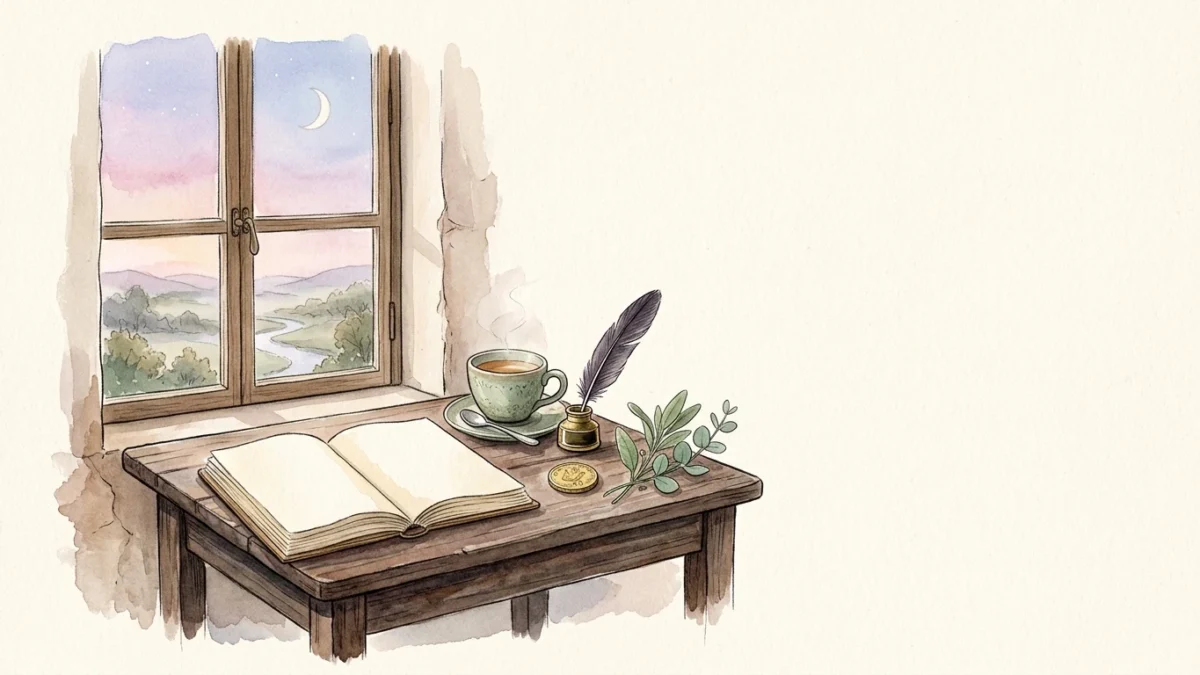
To interpret your own dreams, start with the feeling, not the symbols. How the dream felt, calm, frantic, sad or relieved, tells you more than any single image, because the feeling is the part that belongs to your waking life. The images are the mind’s way of dressing that feeling up.
You do not need special training or a dictionary to read a dream well. You need a few minutes, something to write on, and a willingness to be curious rather than alarmed. Below is what dreams are and are not, a simple five-step method, a worked example, an honest note on dream dictionaries, how a tarot card can work as a second lens, and one small step to start with.
What dreams are, and what they are not
A dream is your own mind, off duty, working on something that was already there. We dream most vividly during REM sleep, and dreams tend to pull together recent events, older memories and whatever feelings are running high. Stress shows up in dreams. So do worries you have been too busy to notice, and hopes you have not said out loud.
What dreams do not do is predict. They do not tell you that someone will die, get sick, cheat or come back, and they cannot tell you what another person feels or thinks. When a dream seems to be about someone else, it is usually about your relationship to them, or about a part of you they stand for.
So the useful question is rarely what a symbol means in general. It is closer to this: what was your mind working on, and why this week?
The five steps
This is the method behind every dream page on this site.
1. Start with the feeling
Before you think about what happened, name how it felt. One or two words is enough: panicked, tender, ashamed, free, lost. A snake that felt calm and a snake that felt terrifying make two different dreams, and the feeling tells you which one you had.
2. Find the main image
Most dreams have one image that stays with you after waking: the wave, the loose tooth, the house with an extra room. Pick that one and set the rest aside for now. Trying to decode every detail usually buries the one that matters.
3. Ask what changed in your life this week
Dreams tend to process the recent. Look back over the last few days for anything that stirred the same feeling you named in step one: a conversation, a piece of news, a decision, a memory that surfaced. The dream and the day will share a feeling even when they share nothing else.
4. Your associations before any dictionary
Ask what the main image means to you. Not to people in general, to you. What does water remind you of? Who in your life is like that animal? Write down the first three things that come to mind, even if they seem silly. Your own associations are nearly always more accurate than a list written by someone who has never met you.
5. Choose one small step
End with something you can do, not only something you know. A small, concrete action while you are awake: one true sentence, one conversation, one thing written down. This is what turns a dream from a puzzle into something useful, and it is often what lets a recurring dream finally quiet down.
A worked example
Say you dream your teeth are crumbling while you try to talk to a room full of people. Step one: the feeling was embarrassment, with a thread of panic. Step two: the main image is the teeth breaking as you speak. Step three: this week a presentation went badly. Step four: teeth, to you, are about your smile and whether people take you seriously. Step five: send the follow-up message you have been putting off.
Notice that the meaning came from the feeling and the week, not from a rule about teeth. The common reading of dreams about teeth falling out is a useful starting point, but your own week decides which part of it applies.
A note on dream dictionaries
Dream dictionaries can be a helpful place to start, but they are not a key. Most give one fixed meaning per symbol, as if everyone who dreams of a black cat or a wedding is dreaming the same dream. They are not. A dog means one thing to someone who grew up with a loving family dog and something else to someone who was bitten as a child.
Use the common readings the way you would use a friend’s guess: worth hearing, worth testing against your own life, and easy to set aside when it does not fit. The pages on this site, like what it means when you dream about snakes, try to give you the usual readings and then hand the question back to you. Be wary of any source that says a dream means something specific is about to happen. That is fortune telling, not interpretation.
Using a tarot card as a second lens
A tarot card will not tell you what a dream means, but it can give you a second angle when you feel stuck. After you have worked through the five steps, shuffle a deck, ask what this dream is working on, and draw one card. Then read the card’s picture the same way you read the dream: what is happening in it, what is the mood, what does it remind you of?
Sometimes the card simply echoes the dream. Sometimes it points at something you missed, a feeling you skipped over or a person you left out. Either way, it is a way of looking, not an answer. If you are new to the cards, how to read your own tarot cards covers the basics, and each dream page here suggests a card for that dream.
The card for this
The card for dream interpretation is The Magician. It shows a figure standing at a table, one hand raising a wand toward the sky, the other pointing down to the earth. On the table lie a cup, a sword, a coin and a wand, the four suits of the deck, and above the figure’s head floats the infinity sign.
It fits because the tools are already on your table. You have the feeling, the image, the week you just lived and your own associations. Nothing needs to come from outside. The gesture on the card, one hand up and one hand down, is also a good picture of dream work itself: taking something from the strange upper air of sleep and bringing it down into ordinary life, where you can use it.
What to do with this
Take the most recent dream you remember, even a fragment, and write two things: the feeling in one word, and one thing that happened this week that stirred the same feeling. This is the step because the feeling and the week are the heart of the method, and most people skip straight to the symbol. Doing just these two parts once shows you how much a dream can say when you start from the right end. If you want to make it a habit, keeping a dream journal makes every step easier.
A line to remember: a dream is not a riddle someone else wrote, it is a note you left yourself, and you already know the handwriting.
Questions people ask
What do dreams mean?
Most dreams reflect what your mind is already working on: recent events, worries, hopes and unfinished feelings. The feeling in a dream is usually the clearest clue. The images are the mind’s shorthand for that feeling, and they make more sense when you connect them to your own week.
Can dreams predict the future?
No. Dreams do not predict death, illness, pregnancy, cheating or what someone else will do. They can feel prophetic because they pick up on things you already sense but have not said. Reading them as a mirror is far more useful than reading them as a forecast.
Are dream dictionaries accurate?
They are a reasonable starting point but not a key. A fixed meaning per symbol ignores your own history with that image. Use one to generate ideas, then keep only what fits your life.
Can tarot help you interpret a dream?
A single card can work as a second lens once you have looked at the feeling, the main image and your week. It does not reveal a hidden meaning, but its picture can prompt you to notice something you skipped. Treat it as a conversation starter, not a verdict.
More in Dream meanings
 How to keep a dream journal (and actually keep it)
 Recurring dreams: why the same dream keeps coming back
 What does it mean when a snake bites you in a dream
 What does it mean when you dream about a queen
 What does it mean when you dream about a zombie apocalypse
 What does it mean when you dream about bears