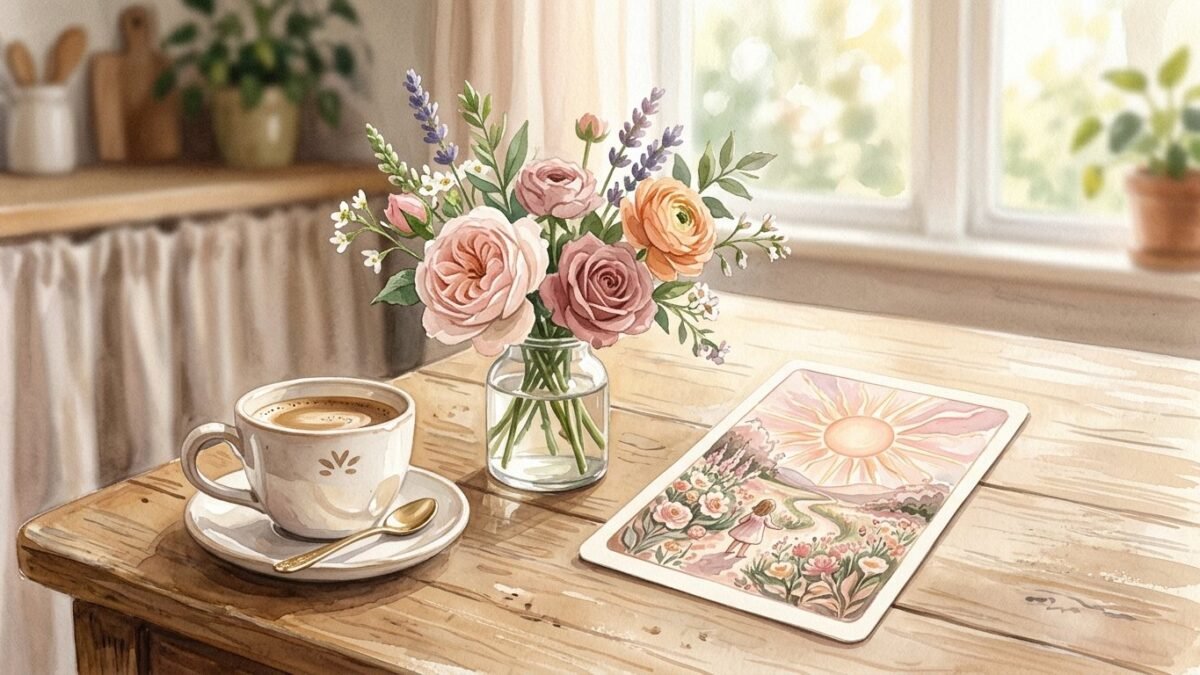
The daily tarot card habit is the smallest thing we do here and the one I would keep if I had to give up the rest of it.
Two minutes while the kettle goes. One card, one honest paragraph, one thing small enough to try before the day gets loud. It sounds like too little to be worth building anything on, and the smallness is precisely why it works.
Why one card and not ten
Because ten cards is a puzzle and one card is a question. Given ten, most people spend the whole time on the arrangement, hunting for the reading that fits together most satisfyingly, and come away with a story rather than a thought.
One card cannot be argued with in the same way. It sits there being a picture of a man walking away from eight cups, and the only thing to do with it is ask where that is in your week, which takes about forty seconds and is the entire exercise.
There is also the plain matter of repetition. A single card, every morning, gets you through the deck several times a year, each meeting attached to a real day. That is how the meanings actually go in, and no book has ever managed it.
What is actually happening
I would rather be honest about the mechanism than let it sound like something it is not. A card is a prompt. It is a picture with enough room in it that you can put your own week inside, and the useful part is the noticing you do while you look.
Which brings me to the thing skeptics say, and they are half right. Statements loose enough to fit anybody feel personal to nearly everybody, an effect studied since the nineteen forties, and a good deal of what passes for tarot online relies on it. That is a fair criticism of a bad reading.
What it misses is that a prompt does not have to be a prediction to be worth two minutes. A photograph of an empty chair is not making a claim about your life, and it will still put you in front of something you had been avoiding. The Eight of Cups did not know about your job. You did, and it took a picture of somebody walking away to get you to say so before nine in the morning.
The psychology of a very small step
The other half of the habit is the step, and it is deliberately tiny. Send the message before noon. Put your phone in the other room for one meal. Ask the one question you have been rehearsing.
People who study habits keep arriving at the same two findings, and they are not glamorous. A behavior small enough to do on a bad day survives bad days, and a behavior attached to something you already do reliably gets done. The kettle is already boiling. The card takes the ride.
A step that fits in fifteen minutes also has a quality bigger plans do not, which is that you can tell by bedtime whether it happened. Reflect on your patterns cannot be finished. Text one person and ask if they are free Thursday can, and the difference between them is most of why one works.
The evening half
The check-in matters more than people expect. One tap at night to say whether the step happened, and a line back that replies to what you did rather than to what you meant to do.
Not today is an honest answer and it gets an honest reply. Nothing is scored, nothing accumulates, and there is no streak to break, because a habit with a streak turns into an obligation and then into an app you delete in March.
The mornings you forget
You will forget. Most people miss a third of the days in the first month, and the ones who keep going are simply the ones who did not treat a missed Wednesday as evidence about themselves.
Pick it up on Thursday. The deck has not noticed. If you find you have missed two weeks, that is usually information about the two weeks rather than about your discipline, and it is worth asking what was happening in them.
What it is not
It is not a forecast for the day, and a card that turns up in the morning is not telling you what will happen by six. If a daily card ever starts to feel like a warning you have to defend yourself against, put the deck down for a week, because a habit that makes your mornings tense has stopped doing the job it was for.
It is also not a substitute for the things that actually keep people upright, which are sleep, other humans, and help when something is genuinely wrong.
What changes after a month
Three things, in the order people report them. You stop looking up meanings for about half the deck. You start noticing the pattern across weeks rather than the single card, which is where it gets interesting. And the step becomes the point, quietly, until the card is mostly a way of choosing which small thing to do today.
What would you like to look at
Pick the shape that fits the question. You can change your mind at any point before you draw.
Before we start
Twenty seconds, feet on the floor, hand somewhere warm. Breathe in while the circle grows and out while it settles. You can skip this whenever you like.
What is on your mind
In your own words, as much or as little as you like. You can leave it empty and simply draw.
Your cards
Laying them out now.
Clara
Same cards, one more look.
Did this land?
For self-reflection and entertainment. Not a substitute for medical, legal or financial advice. 18+.
The daily card page has the how of it, and how to read your own cards covers the part where you stop needing the book.
Start tomorrow rather than on the first of the month. The first of the month is four weeks of not starting.