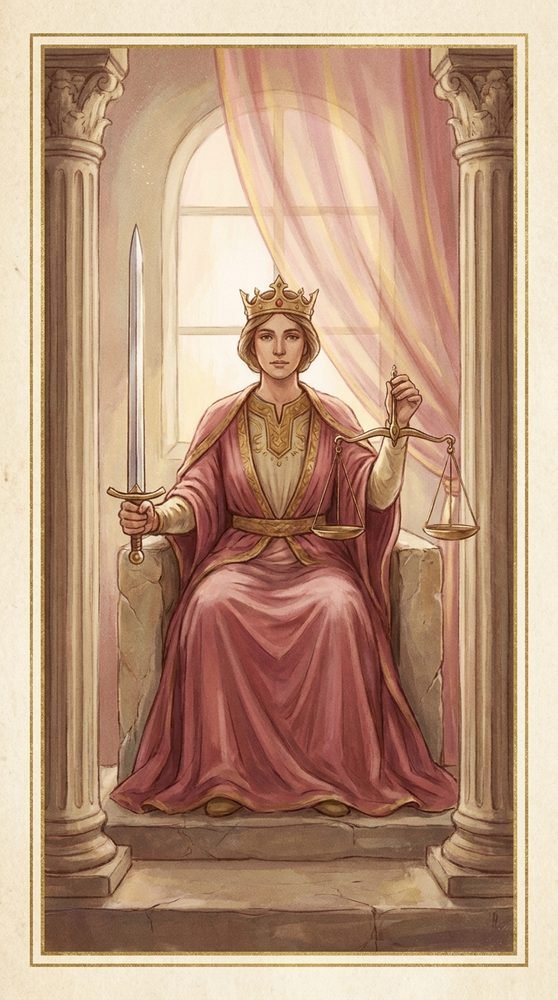
What Justice means
Justice is about looking clearly at cause and effect, including the parts you had a hand in. A figure sits with a sword upright in one hand and scales in the other, facing forward, not leaning either way. This card is unusually literal. It deals with fairness, honesty, contracts, consequences and the moment where a situation gets weighed on its actual merits rather than on how loudly anyone argued. It is not a punishing card. It simply declines to let you tell the flattering version. Whatever you are asking about, Justice suggests the outcome will follow the facts, and asks whether you have looked at them properly.
Justice upright meaning
Upright, Justice tends to arrive when something needs resolving properly. A legal matter, an agreement, a dispute, a decision that must be made on the evidence rather than on feeling. It favors honesty, clear thinking and taking responsibility for your share, which is often smaller than you fear and rarely zero. There is a certain relief in this card. Situations that have been fuzzy get defined, and things that have been dragging get settled. Upright, if you have acted reasonably, this card is on your side. It only becomes uncomfortable when the honest account is one you have been carefully avoiding.
Justice reversed meaning
Reversed, Justice points to imbalance that has not been addressed. Sometimes it is genuinely unfair treatment, a situation where the scales are weighted against you and pretending otherwise would be dishonest. Sometimes it is a matter you have been avoiding because dealing with it means admitting something. It can also describe judging a situation through one lens only, where the story you have settled on leaves out anything inconvenient. Reversed, the card is not accusing you. It is asking you to look at the whole picture, including your own part, before you decide who owes what to whom.
Justice in love
In love, Justice is about fairness in the day to day. Who carries more, who apologizes, who bends. It often shows up when a relationship has quietly become uneven and nobody has said so out loud. If you are single, it can point to being honest about your own patterns rather than treating every ending as something that happened to you. If you are together, it favors the direct conversation about what is not working, held without scorekeeping. It also covers the legal side of relationships, agreements, shared property, the practical parts people avoid discussing until they have to.
Justice in work and money
In work and money, Justice is a strong and practical card. It supports contracts, negotiations, formal complaints, tax matters and anything that requires the paperwork to be in order. If you have been treated unfairly, it favors addressing it through proper channels rather than letting it sit. If something has been sloppy on your side, it suggests putting it right before it becomes a problem. On money it asks for accuracy above all, knowing what you actually earn and owe. This card rewards people who read the whole agreement before signing it.
Justice as a yes or no card
As a yes or no, Justice answers according to the facts rather than according to what anyone wants. If your side of the situation is genuinely fair and you have done what you should, it is a yes. If there is a part of the story you have been leaving out, the answer follows that part rather than the edited version. It is one of the few cards in the deck that effectively hands the question back to you. Look at what actually happened, and you will usually know the answer before you finish reading.
When it shows up as your card of the day
When Justice is your card of the day, be precise. Check the details, read the terms, answer the email that requires an honest rather than a smooth reply. It is a good day for sorting out anything official and a poor day for shortcuts. If a disagreement comes up, listen for the part of the other person’s version that is true, because there usually is one. It is also a fair day to notice where you have been unfair to yourself, holding a standard you would never apply to anyone else.
A small step to take with it
Write out both sides of the situation as fairly as you can manage, including the part that does not flatter you. Two columns, plain sentences, no arguing. Then read it back as though it happened to someone you like but are not related to. Justice works through accuracy, and most stuck conflicts are held in place by a version of events that has been quietly edited over months. You do not have to share the page with anyone. Getting the honest account down is usually enough to show you what needs to happen next.
Questions people ask about Justice
Is Justice a good card?
It is a fair one, which is not always the same as a comfortable one. If you have acted reasonably, it is reassuring and tends to point toward matters being settled in a way you can live with. If there is something you have been avoiding, it is a nudge to deal with it now rather than later.
Does Justice mean a court case?
It can point to legal matters, contracts and formal processes, and it often shows up when one is in the picture. What it cannot do is predict an outcome, and no card should be used that way. For anything legal, the card is at most a prompt to get proper advice and keep your paperwork honest.
What does Justice mean for an ex coming back?
It says nothing about their decision. What it does ask is for an honest account of what happened, including your part, because that is what changes anything in a future version of the relationship. If you are hoping someone will finally admit they were wrong, that is a wish rather than a plan.
The fair version of the story usually includes something you would rather leave out.