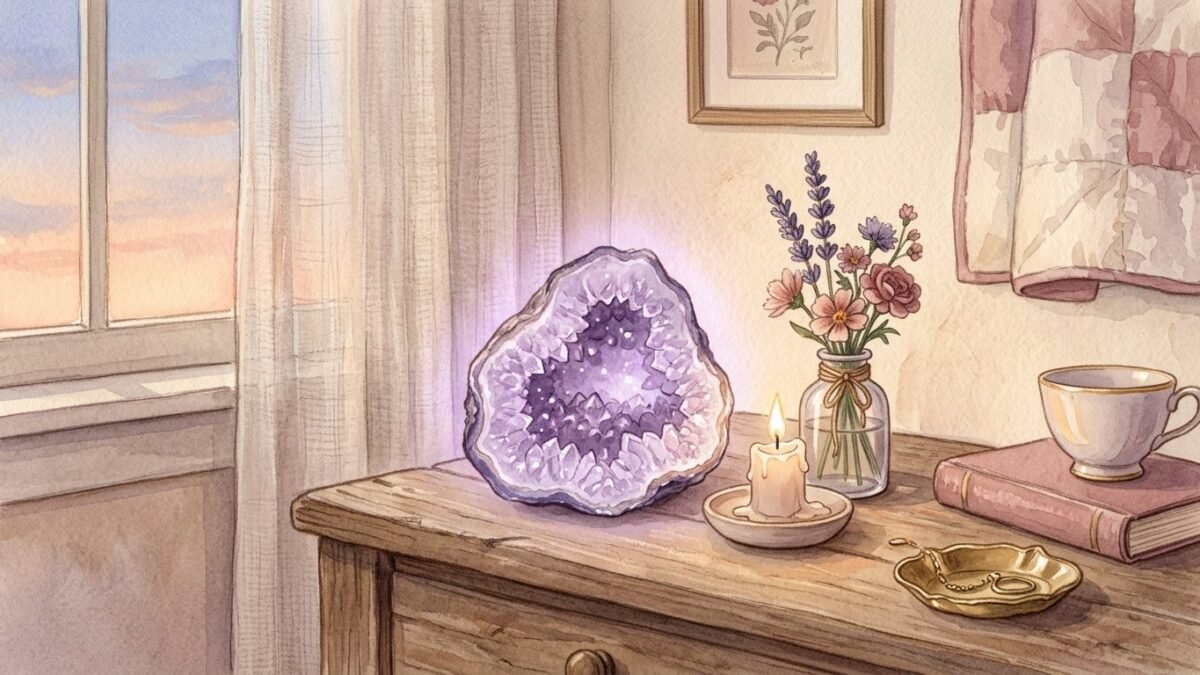
Amethyst is the stone people reach for at three in the morning, when the thinking has stopped being thinking and turned into the same eleven facts arriving in a slightly different order.
It sits on more bedside tables than any other stone, and the reason is not that purple quartz does something to your brain. It is that a mind going round needs somewhere outside itself to set things down, and a stone next to a notebook is a serviceable somewhere.
What amethyst means
The name is Greek and it means not drunk, which tells you what people originally wanted from it. Cups were carved from it and rings were worn in it on the understanding that the stone kept your head while everybody else lost theirs, and every meaning it has picked up since is a version of that same idea: sobriety, clear thinking, the quiet mind.
What it can do for you is mark an edge. Thinking and circling feel identical while you are doing them and only one of them ever finishes, so people use the stone as the place where one stops and the other is not allowed to start. This much tonight, and the rest waits for daylight. Naming that edge out loud, with an object to hang it on, works better than deciding it silently.
What it cannot do is stop your mind. It does not treat anxiety, it does not cure insomnia, and it will not take a genuine worry off your hands, because the worry is about a real thing and the stone knows nothing about it. If the nights have been like this for a month or more, the useful step is a doctor, and the stone can come to the appointment with you.
How people use it
By the bed is the usual place, generally with a pen and something to write on, because half of what keeps you awake is the fear of forgetting the thought you are having.
On the desk works for people whose circling happens in daylight, in which case it sits beside the screen and marks the difference between working on a problem and worrying at it, which is a distinction most of us cannot make unaided after four in the afternoon.
Worn on the hand you write with, it becomes a thing you catch sight of mid sentence, and a fair number of people report that the catching sight is the entire benefit. Nobody needs a whole ceremony. A stone that interrupts you once a day is doing its job.
The card it goes with
The Four of Swords, a figure lying still on a tomb with three swords on the wall above and one beneath, which is not a card about death and never has been. It is a card about a deliberate stop while the thing is still unresolved.
The intention for both: this much thinking, and then I put it down until morning. Say it when you set the stone on the table at night, and mean the second half of it, which is the half people quietly skip.
Three minutes before bed
Hold the stone and say, out loud if the house allows it, the one thing your mind is most likely to bring you at two in the morning. Then write it down in a single sentence, without the reasoning and without the plan.
Put the paper under the stone. That is the whole ritual, and its usefulness is that the thought now exists somewhere other than in your head, which is the condition your mind has been asking for since about nine o’clock.
Wear it
The amethyst ring is the piece most people take for this, since a ring is in your eyeline whenever your hands are, and the amethyst hand chain does the same across the back of the hand for anyone who finds a ring too easy to forget. Either one is a reminder rather than a treatment, worn to catch your attention at the hour when your attention is the thing running away with you.
If the nights are worse than this
Some nights are not a circling problem, they are grief, or fear about something real, or the sort of exhaustion that a bedside table cannot touch. When that is what is happening, put the stone down and tell one person tomorrow, in plain words, how you have been sleeping.
Questions people ask
Does amethyst help you sleep?
Not by itself, no. What helps is having a fixed place to put a thought at two in the morning, and a stone next to a notebook is a reasonable way to mark that place. If you have been sleeping badly for weeks rather than nights, that is worth a conversation with a doctor rather than a change of stone.
Why is amethyst the most common bedside stone?
Partly because it is beautiful and inexpensive, and partly because its old meaning fits the hour. The Greeks called it the not drunk stone and wore it to keep a clear head, and a clear head is exactly what people are after when they set one on the table at night.
Will it fade on the windowsill?
Yes, amethyst loses its color in direct sun over months, which is why the old pieces in museums look paler than the ones in the shop. Keep it somewhere shaded, or accept the fading as a record of where it has been sitting.