What the Three of Swords means
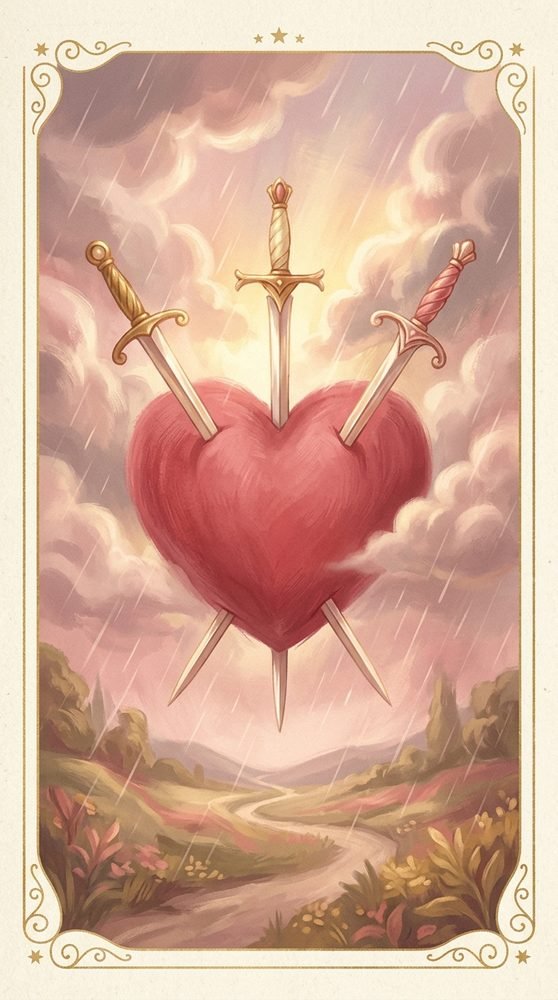
At its heart, the Three of Swords is about a hurt that arrived with the truth attached. Three blades cross a red heart under gray rain, and there is no story around it, no figures, no scene, just the fact of it. That plainness is why the card lands the way it does. It usually describes the moment something becomes undeniable, the sentence you cannot unhear, the message that explains a month of odd feelings. What hurts is rarely the words themselves. It is that a version of things you were living inside has ended, and there was no way to get to the truth without going through the loss of it.
Three of Swords upright meaning
Upright, this card is honest about pain and quite gentle about what follows. It marks grief in its ordinary forms, a breakup, a friendship that turned out to be less than you thought, a rejection, a piece of news you were not ready for. What the card also says, and this matters, is that the confusion is over. Something you had been half sensing is now out in the open, and while that is heavier for a while, it is a weight you can put down eventually rather than one you carry around guessing at. Upright, the Three of Swords is not a forecast of more pain. It is the naming of pain that already exists.
Three of Swords reversed meaning
Reversed, the Three of Swords usually points to the long middle part, after the worst of it and before it stops mattering. Sometimes it means healing that has quietly begun, where you notice you got through a whole afternoon without the thought arriving. Sometimes it means the opposite, a hurt you have kept polished and current by retelling it, either to yourself or to anyone who will listen. There is no shame in that. Rehearsing a wound is one of the ways people try to make sense of it. Reversed, the card simply asks whether going over it again is still teaching you anything, or whether you have learned what there was to learn.
Three of Swords in love
In love, the Three of Swords deals with heartache in the plainest sense, and it is worth saying that it does not predict one. Often it describes what has already happened, the ending you are in the middle of, or the honest conversation that finally cleared the air at some cost. Where a relationship continues, it can point to a hurt that was never properly acknowledged and is still shaping how you speak to each other. The useful move is not to prove who was wrong. It is to say what actually hurt, in one sentence, and let the other person hear it. This card cannot tell you whether someone will come back, and it does not try.
Three of Swords in work and money
In work and money, this card covers the disappointments that sting personally. The role that went to someone else, the feedback that was fair and still hard to read, a partnership that ended badly, a client who left without explaining. It can also mark a professional truth you had been avoiding, that the work no longer suits you, or that a situation you kept excusing is not going to improve. On money it tends to describe the sinking feeling of seeing the real figure rather than any prediction about loss. The practical response is the same either way. Get the facts in front of you, and let yourself be disappointed for a day before you plan.
Three of Swords as a yes or no card
As a yes or no, the Three of Swords leans no, and it leans that way kindly. It usually shows up when the honest answer involves something you did not want to hear, and it suggests that pushing on with the question as it stands will cost you more than it returns. That is not a verdict on your life or on the future. It is a note about this particular question, at this particular moment. Very often the useful thing is to ask a different question altogether, one about what you need now rather than one about whether the old thing can be saved.
When it shows up as your card of the day
When the Three of Swords is your card of the day, treat yourself as somebody who is recovering from something, even if you cannot immediately point to what. It is a day to keep the schedule light, to eat properly, and to be careful about scrolling through things that will make you feel worse. If a hard conversation is due, it can go ahead, but keep it short and kind and leave the score-settling out of it. Old grief sometimes surfaces on days like this for no obvious reason. Let it, and let it pass. Nothing about this card requires you to be productive.
A small step to take with it
Say the plain version of what happened to one person you trust, without softening it and without building a case out of it. Not the diplomatic summary, and not the version where you explain why you were reasonable. Just the sentence underneath, which is usually something like it hurt more than I let on, or I have been pretending that was fine. Pain kept private tends to get bigger and more detailed. Said out loud to one person, it becomes ordinary sized. If there is nobody you feel able to tell, or if the heaviness has been sitting on you for weeks, talking to a counselor or your doctor is a genuinely good use of an hour.
Questions people ask about Three of Swords
Is the Three of Swords always about heartbreak?
No, though it often is. It covers any hurt that came with a truth attached, which can be a friendship, a piece of feedback, a family matter or a disappointment at work. It also very often describes something that has already happened rather than something coming, and people are frequently relieved to have it named.
Does the Three of Swords mean my relationship will end?
It cannot tell you that, and no card should be read that way. What it points to is a hurt that is present and probably unspoken. Whether the relationship continues depends on two people and on what gets said, and this card is asking you about your half of that.
How long does the Three of Swords last?
Grief does not run on a schedule, and anyone giving you a number is inventing it. What the card does suggest is that the sharpest part is tied to the moment of finding out, and that it becomes duller and less constant with time. If it stays sharp for a long stretch, that is a reason to talk to someone rather than a sign anything is wrong with you.
The hurt is real, and it is not the whole of what happens next.