What the Four of Swords means
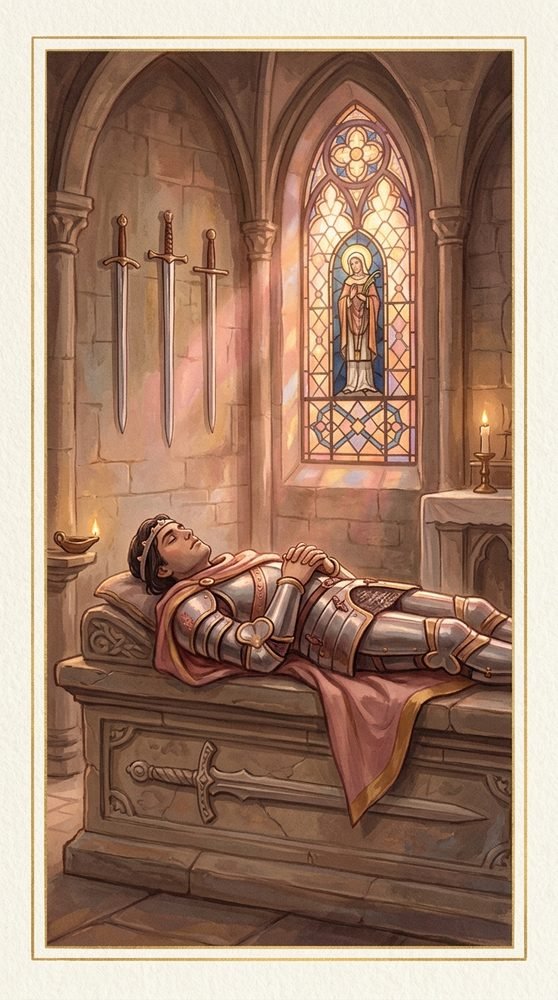
At its core, the Four of Swords is about rest you have earned and keep postponing. A stone figure lies on a tomb with three blades hung on the wall above and one resting beneath, hands folded, entirely still. The image looks solemn but the meaning is ordinary and practical. Something in you has been running for a long time, and the card is the pause that comes after the effort rather than instead of it. It shows up when a big push has just finished, or when you are ill, or simply when you have been holding a situation together for months and your body has started to make the argument for you.
Four of Swords upright meaning
Upright, this card gives you permission to stop, which is often the only thing standing between you and stopping. It favors sleep, quiet weekends, the appointment you keep rescheduling, the week where you deliberately do less. It also covers recovery of every kind, from an illness, from a difficult stretch at work, from a period of grief. Nothing in this card is passive. Rest here is a decision you make rather than a collapse that happens to you, and the difference matters, because chosen rest tends to restore you while forced rest usually arrives with something worse attached. Upright, the Four of Swords is on your side and asking very little of you.
Four of Swords reversed meaning
Reversed, the Four of Swords is usually the sound of someone refusing to stop. You know you are tired, you have known for a while, and you keep finding one more thing that has to be handled first. It shows up in restless nights, in the inability to switch off even when nothing is happening, in taking a vacation and spending it checking messages. Sometimes the reversal is kinder and means you are coming out of a quiet period and starting to move again. If the tiredness has been going on for months, or sleep has been bad for weeks rather than nights, treat that as worth a conversation with your doctor rather than something to push through.
Four of Swords in love
Space, rather than distance, is what this card asks for in love. If you are single, it often marks a season where dating is genuinely not what you need, and the card suggests that is fine rather than a gap to apologize for. Time spent recovering from the last thing usually changes who you choose next. If you are together, it can point to a relationship that needs quiet more than it needs another conversation, an evening where nothing is discussed and you are simply in the same room. It can also mean one of you is worn out and has not said so. If that is you, say it plainly, because unexplained withdrawal reads as rejection to most people.
Four of Swords in work and money
In work and money, the Four of Swords favors a pause over a push. It often turns up after an intense period, a launch, a deadline, a move, and it advises against immediately filling the space with the next thing. If you are making a decision about work while exhausted, the card suggests waiting, because tired people reliably choose the option that ends the discomfort fastest. On money it points to a quiet stretch rather than a bad one, a time to leave things where they are, avoid large commitments and let the account settle. It is a poor card for launching and an excellent one for stepping back to see what you have built.
Four of Swords as a yes or no card
As a yes or no, the Four of Swords is a maybe that is really asking about timing. It rarely objects to the thing itself. What it questions is whether you have the reserves to do it well right now, and whether the urgency you feel belongs to the situation or to your own tiredness. If you can put the decision down for a week and sleep properly first, do that, and you will probably find the answer has changed shape. If the deadline is genuinely fixed, choose the option that asks less of you.
When it shows up as your card of the day
When the Four of Swords is your card of the day, take it as a permission slip rather than an instruction. Cancel one optional thing, go to bed earlier than you meant to, leave the difficult message until tomorrow because it will still be there. It is a poor day for confrontation, big decisions and heavy socializing, and a good one for a walk, a long bath, a book, or lying on the sofa without calling it a waste of time. If you notice yourself filling every gap with something useful, that is the exact habit the card is pointing at.
A small step to take with it
Put one genuinely empty evening in your calendar this week and defend it like an appointment with someone else. Not an evening for admin, not an evening to finally sort out the cupboard, and not an evening that gets given away the moment somebody asks for it. Write it in, tell whoever needs telling that you are busy, and then do very little with it. Most people find the first hour uncomfortable and the second one quietly restorative. The Four of Swords works through actual stopping rather than through the idea of stopping, and an evening you have booked is much harder to talk yourself out of.
Questions people ask about Four of Swords
Is the Four of Swords a good card?
It is a kind one. Nobody finds it exciting, but it usually arrives at the moment somebody badly needs to hear that stopping is allowed. In readings about tiredness, recovery or a decision made while running on empty, it is one of the most helpful cards you can draw.
Does the Four of Swords mean I am ill?
No, and it should never be read as a health prediction. It does often turn up when someone is worn down, and it points toward rest and recovery in a general sense. For anything about your actual health, the card is at most a nudge to book the appointment you keep putting off.
What does the Four of Swords mean for a relationship on a break?
It supports the pause and says very little about the outcome, because that depends on two people rather than on a card. What it does suggest is that the space is more useful than more conversation right now, and that clarity tends to arrive once you are rested rather than while you are still raw.
Stopping is not the opposite of getting somewhere.