Spiders are makers, and that is the heart of their meaning: patience, quiet skill, and building something intricate out of material you produce yourself. As a sign, a spider is generally read as a message about what you are creating and whether you are giving it the slow attention it needs.
They also carry a second, older role as weavers of fate, which is why they turn up in so many myths. Below is what the sign means, what the web adds, why so many people feel uneasy about them, and one small step to take with it.
What it means
A spider builds a structure most engineers admire, using thread it makes inside its own body, then sits and waits. If it is destroyed, the spider builds it again. No fuss, no announcement, no evidence of discouragement.
That is the entire symbolic case, and it is a good one. Read as a sign, a spider asks about your own patient work: the thing you are making slowly, the life you are constructing out of your own resources, the plan that has been torn down once already.
The myths add the second layer. Spiders appear as creators and storytellers across many cultures, from Anansi in West African and Caribbean tradition to Grandmother Spider in several Native American traditions, and as spinners of fate in Greek myth. In almost none of these is the spider a villain. It is the clever one.
The spiritual meanings
You are building something and it needs patience
The most common reading. A spider appearing during a project, a recovery or a rebuild is taken as encouragement for the slow method rather than the fast one.
Rebuild it rather than mourn it
Webs get destroyed constantly, by rain, brooms and passing shoulders, and spiders simply start again. As a sign, this is read as a message about resilience without drama, which is a rarer quality than the loud kind.
You have the material already
Because the thread comes from inside the spider, this sign is often read as a reminder that you are not waiting on an external resource. What you need for the next stage is probably already in your hands, in the form of skills, contacts or things you have survived.
Notice what you are caught in
The less comfortable reading, and a fair one. A web catches things. Sometimes a spider appears when you are the one tangled in something: an obligation, a story, a relationship that has more threads in it than you can see from inside.
The practical side
If you are seeing spiders everywhere in late summer and autumn, there is a straightforward reason. That is when many species mature and the males wander in search of mates, which brings them across floors, up walls and into baths. It is a seasonal event, not a message aimed at you personally.
Fear of spiders is also extremely common, and it is not a spiritual failure. If it is strong enough to affect your sleep, your use of a room, or your day, it responds well to help. A few sessions of the right kind of therapy resolve most cases, and that is a far kinder solution than reading a frightening meaning into every encounter.
If you would rather not have one indoors, the glass-and-card method takes ten seconds and puts everyone in a better position than the alternative.
The web, the size, and where you found it
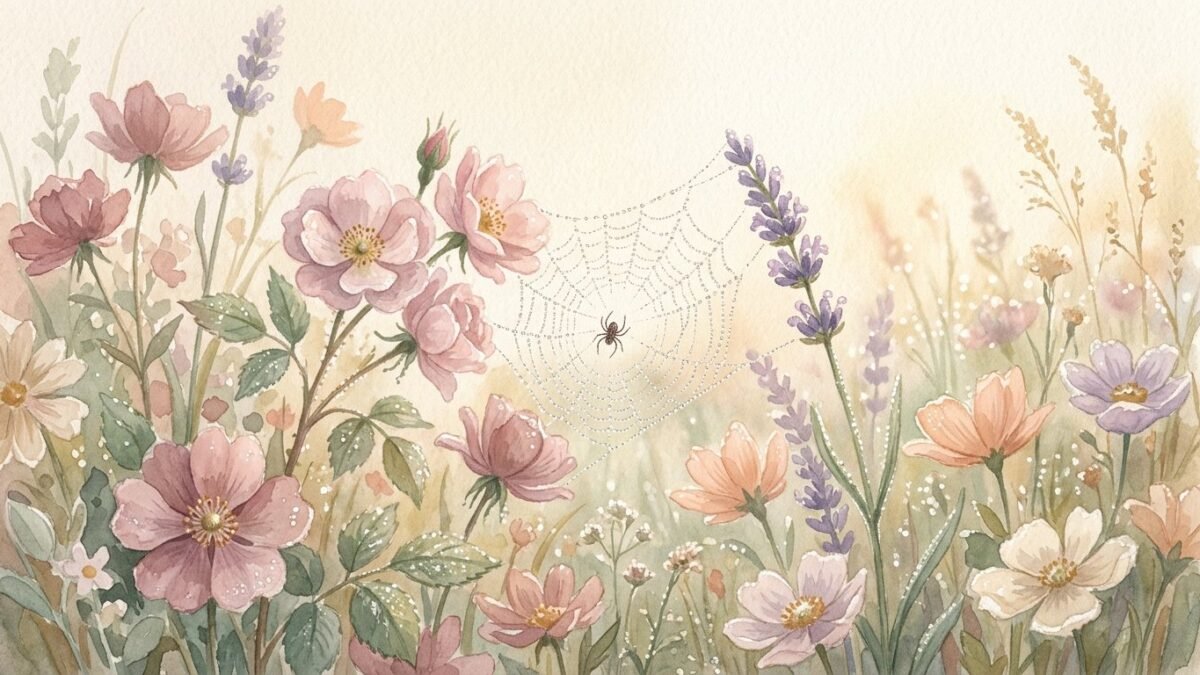
A web is usually read as structure: what you have built, what holds you, and occasionally what holds you back. A new web across a doorway in the morning is read as a fresh start, and the same web repaired after a storm is read as persistence.
A large spider is often read as a large piece of work, or a large fear, and the two are frequently the same thing. A tiny one is read as a small detail asking for attention, in the sense of a stitch in time. A spider descending on a thread in front of you is a classic sign of something coming down to your level to be dealt with, and in older folklore a money spider landing on you was considered fortunate, which is where the name comes from.
Where you found it matters too. In the bedroom, the reading leans toward rest and the private self. In the kitchen or the workroom, it leans toward what you are making. On you, it is the most personal version, and it usually means you brushed a plant on the way in.
What to do with this
Do fifteen minutes of the slow thing you keep postponing, and stop when the timer goes. The book, the accounts, the application, the practice, the difficult chapter. Not an hour, not a productive evening, and not a resolution to be more disciplined from now on. Fifteen minutes, once, today, and then put it down without guilt. Spiders do not build a web in a burst of motivation. They build it in one continuous unremarkable session, which is how almost everything of any size actually gets made.
A line to remember: what you build slowly is usually what stays up.
Questions people ask
What does a spider symbolize spiritually?
Spiders are usually read as symbols of creation, patience and self-reliance, because they build something intricate out of a material they produce themselves. In many traditions they are also weavers of fate and storytellers. The reading is almost always about making rather than about threat.
Is a spider in the house a good sign?
In most European folklore, yes. Spiders in the home have long been considered fortunate, and killing one was often thought to bring bad luck. Practically they are also useful housemates who eat the insects you like even less.
What does it mean if I keep seeing spiders?
Seasonally, it often means it is autumn and the males are wandering indoors looking for mates. Symbolically, repetition points at something you are building or should be building. If spiders frighten you, that fear is common and treatable, and it is worth taking seriously rather than pushing through.