What the Page of Swords means
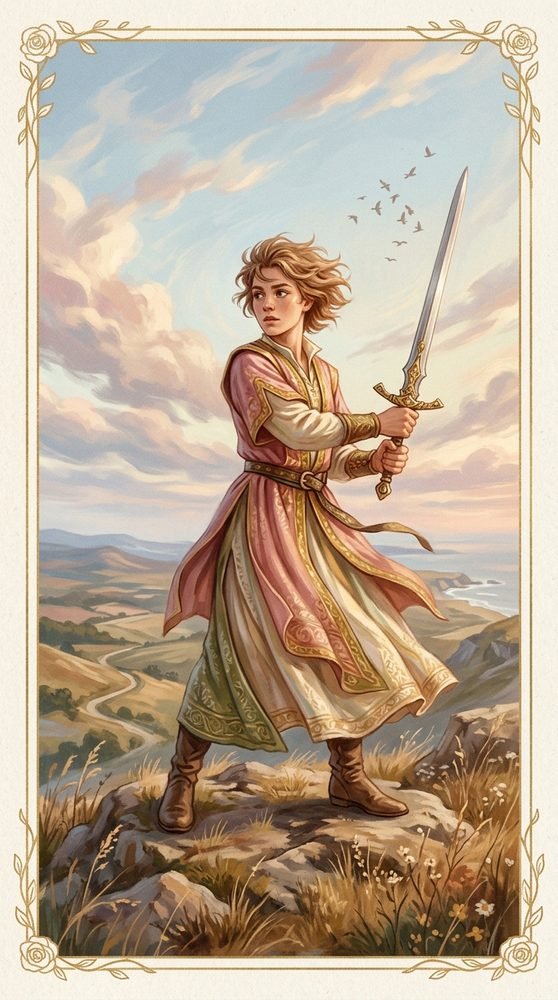
The Page of Swords is curiosity with a question already half formed and nearly out of your mouth. A young figure stands on a windy hilltop holding a blade upright in both hands, looking off to one side rather than straight ahead, clothes and clouds moving in the same restless direction. Pages are beginners, and this one begins with the mind. It marks the point where you become genuinely interested in something and start finding out about it properly rather than assuming. The card carries a slightly nervy energy, alert and watchful and not entirely settled, which is what being new at something feels like from the inside.
Page of Swords upright meaning
Upright, the Page of Swords is alert, interested and a little restless. It favors studying, researching, signing up for the course, reading the thing properly rather than skimming a summary of it. It also stands for news and messages, often small ones that turn out to matter, and for conversations that open something up. There is honesty in this Page that adults tend to have trained out of themselves. It asks the plain question in the room, the one everyone else has decided would be embarrassing to ask, and it is usually the question that unsticks the meeting. Upright, the card supports being a beginner in public, which costs a little pride and saves months.
Page of Swords reversed meaning
In reverse, the Page of Swords tends toward talk that outruns its foundation. That might be repeating something you heard without checking it, forming a firm opinion from a headline, or getting into a long online argument with somebody whose mind was never going to change. It can also mean scattered attention, five subjects half started and none of them finished, which is enjoyable and produces very little. In a heavier sense it can describe suspicion, watching someone for evidence rather than talking to them. Reversed, the card is mostly asking you to check your sources, finish one thing, and be careful about what you pass on.
Page of Swords in love
In love, this Page is early and curious rather than settled. If you are single, it can describe the interesting first conversations, the messaging stage, wanting to know how somebody thinks before you decide how you feel. That is a good instinct, and this card supports asking real questions instead of performing. If you are together, it points to genuine curiosity about a person you already know well, which is easy to lose and easy to recover. Ask something you have never asked them. Reversed it can warn against reading into small signals, checking things, and building a case out of fragments rather than saying what is on your mind.
Page of Swords in work and money
In work and money, the Page of Swords is a strong card for learning and a modest one for earning. It suits new roles, training, the first months in a field where you know you are behind, and any work that involves writing, research or asking good questions. Take notes, ask for feedback earlier than feels comfortable, and let people see that you are still learning, because it makes them more generous rather than less. On money it points toward getting informed, understanding how something works before you commit to it. This card would rather you spent an evening reading the terms than an afternoon regretting them.
Page of Swords as a yes or no card
As a yes or no, the Page of Swords leans yes, with the understanding that you are starting rather than arriving. It says the situation rewards curiosity and that you do not need to be qualified to begin. What it will not support is a yes that depends on you already being expert, or one where you have not asked the basic questions yet. If your question is whether to learn, apply, enquire or start finding out, the answer is a straightforward yes. If it is whether you are ready to be trusted with the whole thing, that comes later.
When it shows up as your card of the day
When the Page of Swords is your card of the day, be curious in an active way. Ask more than you tell, read something properly, look up the thing you have been meaning to understand for a year. Watch for messages and information arriving, because the day tends to carry more of them than usual and one is often more useful than it first appears. Keep some skepticism running too. It is a day where things get passed around quickly and not all of it is accurate. If you are tempted to weigh in on something you learned about ten minutes ago, wait.
A small step to take with it
Ask the question you have been assuming somebody else already answered, and ask it of a person rather than a search engine. Whether the deadline is real. What the actual budget is. Whether the arrangement you have been working around was ever intentional. Most systems, at work and at home, contain a rule that nobody can trace the origin of and everybody has quietly obeyed for years. The Page of Swords finds these by asking plainly and without accusation. The worst outcome is a short answer. The common outcome is that the answer is nobody knows, at which point the rule stops being a rule.
Questions people ask about Page of Swords
Does the Page of Swords mean a young person?
Sometimes, though it is more often a stage than a person. It can describe someone new to a situation at any age, including you, and it can describe a message or a burst of curiosity rather than anyone in particular. Read it as a person only when the rest of the reading supports it.
Does the Page of Swords mean news is coming?
It is one of the classic messenger cards, so it often coincides with information arriving, though it does not promise anything specific. What it says more reliably is that you are in a period of finding things out. Whether the news is welcome depends entirely on the situation rather than on the card.
What does the Page of Swords mean about someone I have just started seeing?
It describes the stage rather than the outcome, and it cannot tell you what they think or where it will go. What it asks of you is to stay genuinely curious about who they are instead of deciding early and collecting evidence. Ask better questions and let their answers actually change your mind.
Asking the obvious question is how most people find out the answer is not obvious at all.