What the Seven of Swords means
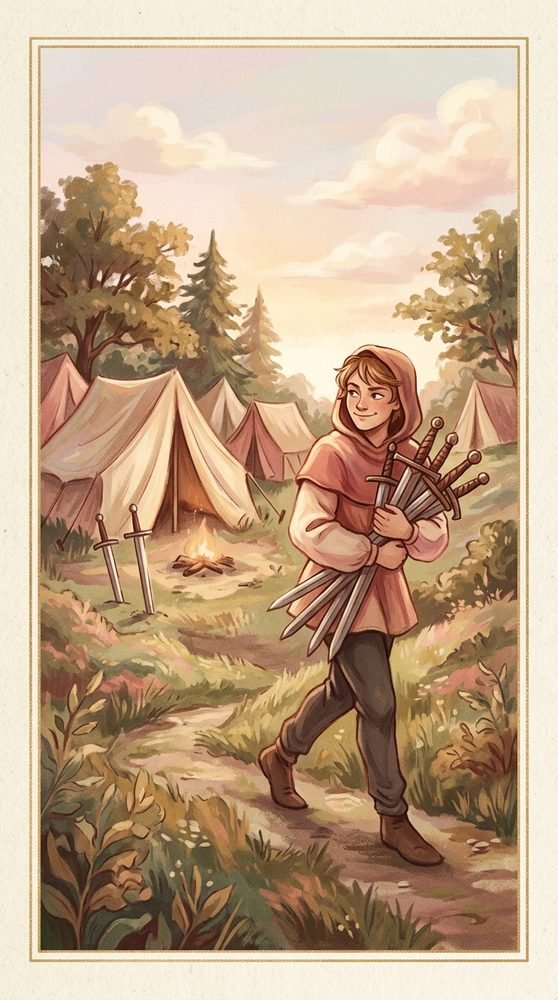
When the Seven of Swords turns up, it is describing a plan that goes around a problem rather than through it. A figure walks away from a camp carrying five blades, glancing back over one shoulder, with two more left standing in the ground behind. There is no obvious crime in the picture and no obvious victim, and the ambiguity is deliberate. This card covers everything from careful strategy to quiet omission, from handling something alone because involving people would slow it down, to taking the version of the truth that causes the least trouble. It asks a single question in all its forms, which is whether the shortcut is clever or whether it is just easier.
Seven of Swords upright meaning
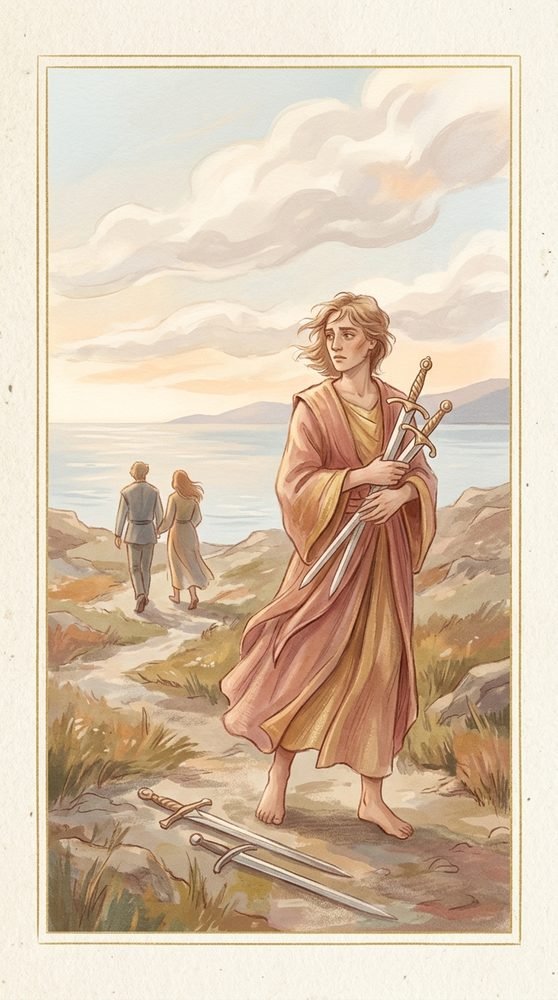
Upright, this card describes cleverness that may or may not be honest, and only you know which one you are holding. In its good sense it is strategy, discretion, keeping your plans to yourself until they are solid, choosing not to fight a battle you would lose and finding another route instead. In its harder sense it is the small deception, the expenses that were slightly rounded, the reason given that was not the real reason. Notice that the figure leaves two blades behind. Whatever this approach gets you, it tends not to get you all of it, and the part left standing is usually the part that mattered.
Seven of Swords reversed meaning
Reversed, the Seven of Swords tends to mean the truth surfacing. Sometimes that is someone else finding out, which sounds alarming and is usually far less dramatic than the anticipation of it. More often it is you deciding you would rather say the thing than keep managing it, returning what you borrowed, correcting the story, admitting you have been handling something alone that you cannot handle alone. Reversed, it can also point to self-deception, where the person being carefully managed is you. The relief in this card is real. Keeping a version of events consistent takes far more energy than most people notice until they put it down.
Seven of Swords in love
In love, the Seven of Swords deals with what goes unsaid rather than with betrayal, whatever its reputation. It can point to keeping part of your life private, to a feeling you have decided not to mention, or to being economical with the truth in order to avoid a conversation. It does not prove anybody is being unfaithful and it should never be read that way. What it does ask is whether the discretion in your relationship is protecting something or eroding it. If you are single, it sometimes describes presenting a slightly edited version of yourself early on, which is understandable and eventually exhausting.
Seven of Swords in work and money
At work and with money, this card sits with the workaround. The process you have quietly stopped following because it never made sense, the project you are keeping to yourself until it works, the negotiation where you are not showing your whole hand. Some of that is ordinary professional judgment. Some of it turns into a problem when somebody senior finds out from someone other than you. On money it advises against schemes that depend on nobody looking closely, and in favor of reading the small print in anything that seems unusually generous. Keep your own records honest. This card is much kinder to people who can show their working.
Seven of Swords as a yes or no card
As a yes or no, the Seven of Swords is a maybe with a condition attached. It says the plan could work, and it asks whether it would survive being described out loud to somebody whose opinion you respect. If you can explain the whole thing without editing, take that as a yes and go carefully. If you find yourself skipping a part, or planning how to frame it, the card is pointing directly at that gap. Answers built on something nobody can look at closely tend to hold for a while and then cost more than they saved.
When it shows up as your card of the day
If the Seven of Swords is your card of the day, be precise about what you say and how you say it. It is a good day for planning quietly and a poor one for cutting corners, since this is the sort of day where the corner you cut is the one somebody happens to check. Keep an eye on your belongings in busy places, in the practical sense the card has always carried. Mostly, notice where you are tempted to give a slightly easier answer than the true one. You do not have to overshare. You just want to be able to stand behind what you did say.
A small step to take with it
Say the plan out loud to one person whose opinion you respect, and pay attention to which parts you find yourself leaving out. Not to be talked out of it, and not for approval. The point is the editing, because what you skip when you explain something is almost always the part you already know is weak. If nothing gets left out, you are probably fine and can proceed with more confidence than you had. If something does, you now know exactly where to look, and you have found it before anybody else did, which is much the easier order for that to happen in.
Questions people ask about Seven of Swords
Does the Seven of Swords mean someone is lying to me?
Not reliably, and it is worth being careful here. The card points to something being withheld or handled indirectly, which can be as small as a person keeping their own counsel. It is never evidence about a specific individual, and using it that way tends to damage relationships that were fine.
Is the Seven of Swords always negative?
No. Read well, it is often about strategy, discretion and knowing when not to announce your plans. Plenty of sensible situations involve going around an obstacle instead of arguing with it. The card only turns uncomfortable when the shortcut starts requiring you to manage what people know.
What does the Seven of Swords say about my partner?
It cannot tell you what your partner is doing or thinking, and reading it as proof of anything would be unfair to both of you. What it can do is prompt an honest look at what is not being said between you, including on your side, and suggest that a direct question is better than a long stretch of quiet suspicion.
The part you would rather not explain is usually the part worth looking at.