What the Seven of Wands means
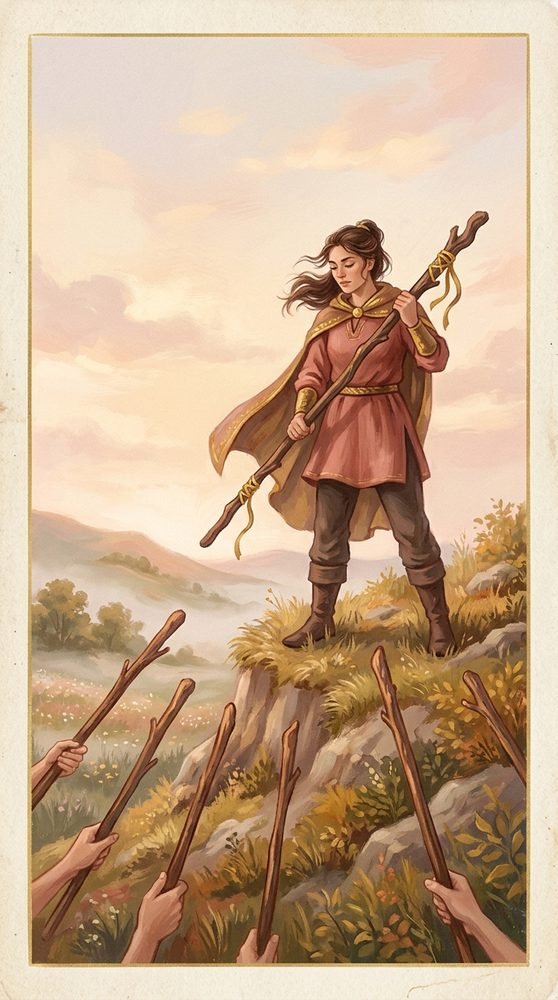
When the Seven of Wands turns up, it is describing what it costs to hold a position that is being questioned. A figure stands on higher ground with one staff braced in front of them while six more push up from below, and if you look at the feet you will notice two different shoes, as though they got up in a hurry and defended the hill anyway. That detail is the card. This is not a planned battle. It is the ordinary experience of having built something, said something or chosen something, and then having to keep explaining it to people who would prefer you had not. The higher ground is yours. The card asks whether you will keep standing on it.
Seven of Wands upright meaning
Upright, this card is about conviction under pressure. Something you care about is being challenged, perhaps openly and perhaps through a slow drip of raised eyebrows, and the useful move is to stay where you are. It often turns up when you have finally set a boundary and are now discovering that boundaries have to be maintained rather than announced. There is real strength in it, though from the inside it usually feels like being tired and slightly outnumbered. Upright, the Seven of Wands favors people who state their reason once, clearly, and then decline to relitigate it every time somebody brings it up again.
Seven of Wands reversed meaning
Reversed, the Seven of Wands is honest about the point where holding on stops being worth it. You may be exhausted from justifying yourself, or you may have started defending automatically, snapping at questions that were not attacks. Both are what happens to people who have been on the hill too long without relief. It can also mean ground quietly given up, an opinion softened until it no longer means anything, a boundary that has moved so many times nobody notices it. What reversed frees is the choice. Some hills are not yours, and letting one go is a decision rather than a defeat. Work out which of these you are actually holding.
Seven of Wands in love
In love, this card sits with the part of a relationship where you have to keep saying what you need. It might be a boundary with family, a difference in how you each want to live, a choice of partner that people around you have opinions about. If you are single, it can describe holding your standards while everyone tells you that you are being too particular. If you are together, it favors saying the difficult thing calmly rather than either conceding or escalating. What it will not do is tell you whether the other person will come around. It only asks that you stop arguing against yourself on their behalf.
Seven of Wands in work and money
At work, the Seven of Wands describes defending your work, your role or your rate. A project being second-guessed, a newer person moving into your territory, a decision you made that others keep reopening. It supports you, and it also asks you to pick your battles, because not every challenge deserves a full response. On money it is the card of holding your price. If you have been talked down before, this one favors naming the number and letting the silence sit. Keep your evidence in order, because in this card being right helps considerably more when you can show your working.
Seven of Wands as a yes or no card
As a yes or no, the Seven of Wands is a yes with effort attached. What you want is available and it will not be handed over quietly, so the answer really turns on whether you are prepared to keep asking after the first refusal. If you are, the card leans clearly in your favor. If you are hoping the situation will resolve without you having to be difficult about it, then it is closer to a no, not because you are wrong but because this particular card never delivers anything to people who are waiting politely.
When it shows up as your card of the day
With the Seven of Wands as your card of the day, expect at least one thing to be questioned, and decide in advance how much of your energy that is worth. It is a good day for holding a line, sending the firm reply, and repeating a boundary you have already set. It is a poor day for seeking consensus. Keep an eye on your tone, because tiredness turns conviction into snappishness faster than most people notice. If you find yourself defending something you no longer believe in, that is the useful discovery of the day rather than a failure.
A small step to take with it
Decide the one thing in this situation you are not willing to give up, and stop negotiating that particular point. Write it in a sentence. Everything else can stay flexible, and being flexible about the rest is what makes the single fixed point credible. Most people under pressure do the opposite, defending everything at equal volume until they are worn down on all of it. The Seven of Wands works through selective firmness. Knowing exactly where your line is makes conversations shorter, calmer and considerably less exhausting, and it tends to stop other people testing it quite so often.
Questions people ask about Seven of Wands
Is the Seven of Wands a warning?
Not really. It describes pressure that is already happening rather than trouble on its way, and it generally arrives to tell you that your position is defensible. Most people who draw it are already in the situation and are mainly wondering whether they are allowed to keep holding it.
What is the difference between the Five and the Seven of Wands?
Five is a scrum with no clear sides, everyone pushing at once and nothing much at stake yet. Seven is one person with something to lose, on ground they have already taken. Five is noisy. Seven is personal, and considerably more tiring.
What does the Seven of Wands mean if my family disapproves of my relationship?
It reflects the pressure and supports you holding your own choice, without promising that anyone will change their mind. That is genuinely outside your control. What is inside it is how often you agree to have the same conversation, and how much of your reasoning you owe people who have already decided.
You are allowed to hold a position you cannot make everyone agree with.