What the Ten of Swords means
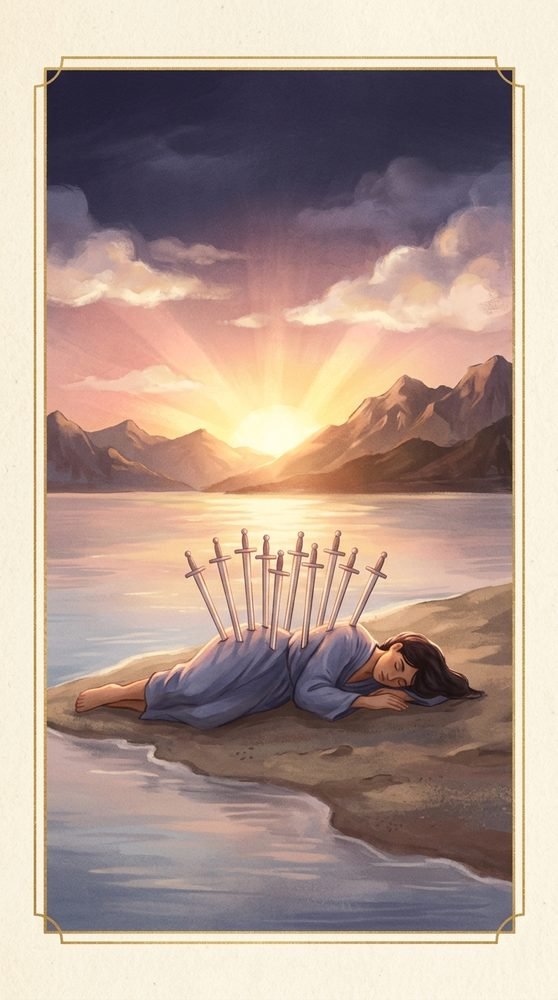
Most of the time, the Ten of Swords simply means that something is over. The picture is the most theatrical in the suit, a figure lying face down under a black sky with ten blades in a row along the back, and the far horizon already turning gold. The drama of it is misleading. In readings this card almost never describes catastrophe. It describes the end of something that had been dragging on well past its natural finish, a situation you had been propping up, a role you had outgrown, an argument that had become the whole relationship. The blades are all in. There is nothing left to defend, and that is where the relief begins.
Ten of Swords upright meaning
Upright, the Ten of Swords marks a finish that is not up for negotiation. Whatever it refers to has run out of road, and the strange gift in that is that you no longer have to try. There is a particular exhaustion in keeping something alive that has been ending for months, checking it each morning to see whether today is the day, adjusting yourself around it. This card puts that down. People often report feeling flat and then, a few days later, lighter than they have in a long time. The gold at the horizon is part of the card and not a consolation added afterward. Endings under this card are genuinely endings.
Ten of Swords reversed meaning
Reversed, the Ten of Swords usually means the worst is behind you and the getting up is underway. Not quickly and not gracefully, but underway. It describes the early part of recovery, where you are still tired and things have begun to function again. In its other sense it can describe an ending that is being dragged out, where the situation finished some time ago and nobody has said so, and everyone keeps returning to it out of habit. Reversed, the card is fairly direct about that. The thing is done. Continuing to attend to it is costing you the energy you will want for whatever is next.
Ten of Swords in love
In love, this card usually arrives after the fact rather than before it. It describes the relationship that ended properly, the last conversation, the point where hoping stopped being useful. That is painful and it is also final in a way that eventually helps, because the worst of a long ending is the not knowing. What the card cannot do is tell you what another person will decide, and it should never be read as a verdict on someone else’s heart. Where a relationship continues, it can mark the end of a pattern rather than the end of the couple, an old dynamic that finally collapsed under its own weight.
Ten of Swords in work and money
In work and money, the Ten of Swords covers the job that ended, the project that was canceled, the business idea that will not be continuing. It is usually less shocking than it sounds, because most people who draw it already knew. It can also describe the end of an era at work, a restructure, a manager leaving, a way of doing things that has stopped. On money it points to the low point in a stretch rather than to any prediction about your finances, and it is worth saying that no card can forecast money. Practically, the useful move is to stop pouring resources into the thing that has finished.
Ten of Swords as a yes or no card
As a yes or no, the Ten of Swords is a no, and it is a no about this particular version of the question. It says the thing you are asking about has run its course and that effort spent on reviving it will come back to you at a poor rate. That is not a statement about your future, only about this door. Most people who get this answer find that a better question is sitting just behind the one they asked, usually something about what they want next rather than whether the old thing can be saved.
When it shows up as your card of the day
If the Ten of Swords is your card of the day, treat it as a day for putting things down rather than a warning to brace. Something may formally end, or you may simply admit to yourself that it already has. Keep the day undemanding, tell one person how you are doing, and resist the urge to immediately fill the space with a new plan. It is a poor day for making big decisions and a good one for closing tabs, cancelling what you are not using, and letting yourself be tired. Tomorrow tends to be noticeably easier than today under this card.
A small step to take with it
Name one thing you have been holding up on your own, and decide today that you are setting it down. It might be a project nobody has asked about in months, a friendship you have been maintaining single-handedly, or the habit of checking whether a situation has changed when you already know it has not. Say it out loud, or write it in a sentence beginning with the words I am done with. The Ten of Swords works by ending things cleanly rather than by letting them fade, and the tiredness under this card usually belongs to the propping up rather than to the loss.
Questions people ask about Ten of Swords
Does the Ten of Swords mean something terrible will happen?
No. The image is dramatic and the meaning is far more ordinary, which is that something has finished. In practice it usually describes an ending that has already occurred or one you have seen coming for a long time. It is not a prediction of disaster, and no honest reading of it works that way.
Is the Ten of Swords the worst card in the deck?
It has that reputation and does not deserve it. It marks the bottom of a particular stretch, which is uncomfortable and also the point from which things stop getting worse. Many people find it oddly reassuring once they sit with it, because it puts an end to a period of waiting.
Does the Ten of Swords mean my relationship is definitely over?
It cannot decide that, and it says nothing about what another person will choose. What it does suggest is that something in the current arrangement has run out, whether that is a pattern, a stage, or the relationship itself. The honest step is to talk about it directly rather than to look for a verdict in a card.
It is over, and you can stop bracing for the part that already happened.