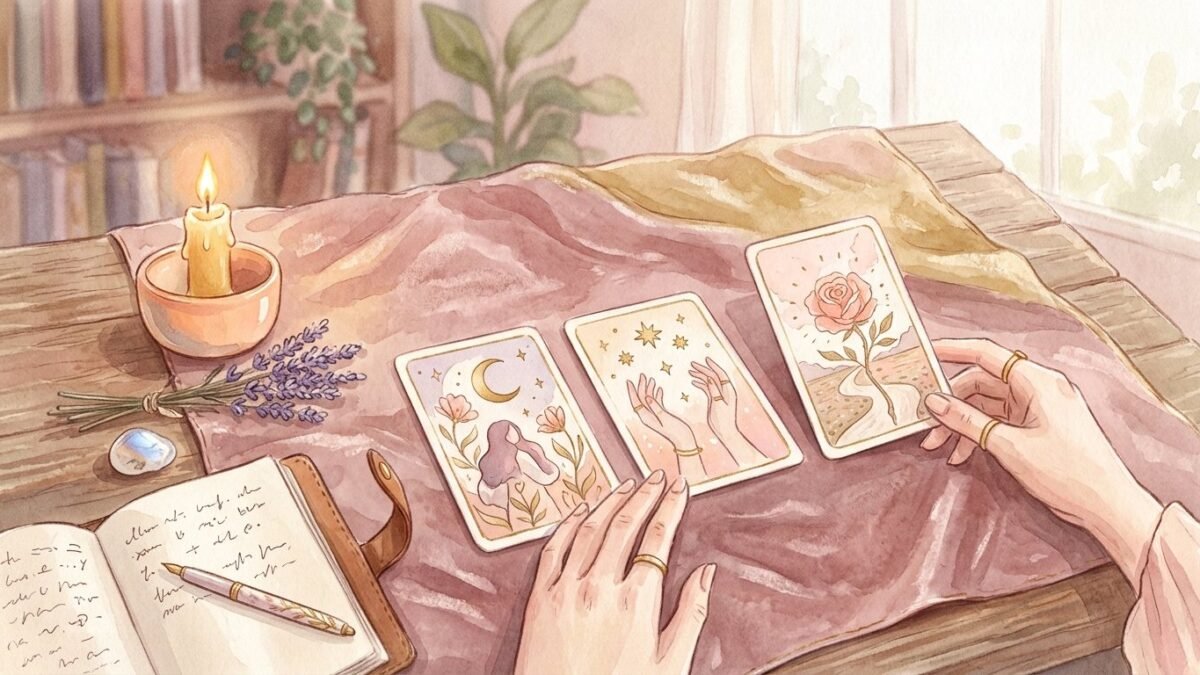
Nobody has to give you a deck. That is the first thing, because it stops a surprising number of people before they start, and the rule about a tarot deck having to be a gift appears to be about as old as the nineteen seventies and about as binding as any other thing someone said once in a shop.
Buy your own. Choose the pictures you like looking at, since you are going to be looking at them for a long time.
Which deck, honestly
If you want the practical answer, start with a Rider Waite Smith deck or one of the many decks drawn in its pattern. Not because it is more authentic, but because every book, every website and every explanation you will read for the next two years describes those pictures, and a deck with different imagery means translating everything while you are also learning.
The reason it works for beginners is that Pamela Colman Smith drew a scene on every card, including the numbered ones, which older decks did not. That means you can read a card by looking at it before you have memorized anything, and looking at it is the skill. Memorizing is the part that happens on its own later.
Start with one card a day
Not a spread, not a question, not the whole deck laid out on the floor. One card in the morning, and two lines about it at night.
Doing it this way teaches you the deck faster than any book, because you meet each card attached to an actual day rather than to a list of keywords. The Five of Pentacles stops being poverty and becomes the Tuesday you did not ask for help you needed. That is the association that stays, and it is yours.
The habit itself is small on purpose, and I have written about why the small size is the point over on why a daily card works. Two minutes at the kettle is a habit. Twenty minutes with candles is an event, and events do not happen on Wednesdays.
What would you like to look at
Pick the shape that fits the question. You can change your mind at any point before you draw.
Before we start
Twenty seconds, feet on the floor, hand somewhere warm. Breathe in while the circle grows and out while it settles. You can skip this whenever you like.
What is on your mind
In your own words, as much or as little as you like. You can leave it empty and simply draw.
Your cards
Laying them out now.
Clara
Same cards, one more look.
Did this land?
For self-reflection and entertainment. Not a substitute for medical, legal or financial advice. 18+.
How to actually read a card
Three questions, in this order, and you can use them from the first day.
What is happening in the picture. Say it out loud, plainly, like describing a photograph to somebody on the phone. A man walking away from eight cups at night. A woman on a throne holding a cup she is looking into. This step is not optional and it is the one people skip in a hurry to know what it means.
How does it feel to look at. Your first response is information, and it is worth catching before the book gets to you. Some cards are frightening in the picture and mild in the meaning, and some are the other way around.
Where is that in my week. This is where a reading either lands or does not. Not what the card means in general, but what in your last few days looks like the thing in the picture. When nothing comes, and some days nothing comes, write that down too and go and have breakfast.
When you want more than one card
Three cards is the natural next step and the positions matter more than the number. Decide what each position means before you turn anything over, and say it out loud, because deciding afterward is how a reading becomes whatever you needed it to be.
Past, present and future is the version everybody knows and it is the least useful for a real question. What is pulling me back, what is true now, and what would help is better. So is what I am doing, what I am avoiding, and what it would cost to stop. There is a longer explanation of the shapes on the three card spread page if you want somewhere to start.
Reading for yourself, honestly
The hard part of reading for yourself is not accuracy. It is that you have an interest in the outcome, and the deck cannot stop you shuffling until you get the answer you were after.
Two rules keep it clean. Write the question down before you draw, in one sentence, and leave it written so you cannot quietly change it into a different question halfway through. And do not redraw the same question. If the answer was unwelcome, the second reading is not more accurate, it is just the one you preferred.
The other honest note is about the questions themselves. Cards cannot tell you what someone else is thinking, whether the test will be clear, or what a court will decide, and a reading that claims to is doing you harm rather than a favor. I have written the whole of that out in what tarot cannot do.
The card you do not like
Everybody has one, and it is usually the Tower, or Death, or the Ten of Swords, and none of them mean what the pictures suggest at first glance. Death is the card of the ending you have already been having. The Tower falls on what was already leaning.
When a card frightens you, stay with the picture longer rather than reaching for the book. Ask what has already given way, or already ended, rather than what is about to. That question turns the frightening cards into the most useful ones in the deck.
How long until you are any good
A few months of daily cards will get you further than a year of reading about tarot, and you will know it has started to work when you look at a card and have a thought before you have a definition.
Keep the notebook, though. In a year the most interesting thing you own will be the record of which cards kept turning up in which months, and what was actually going on.
Come back and tell me what tonight’s card was, and what you saw in it before you looked anything up.