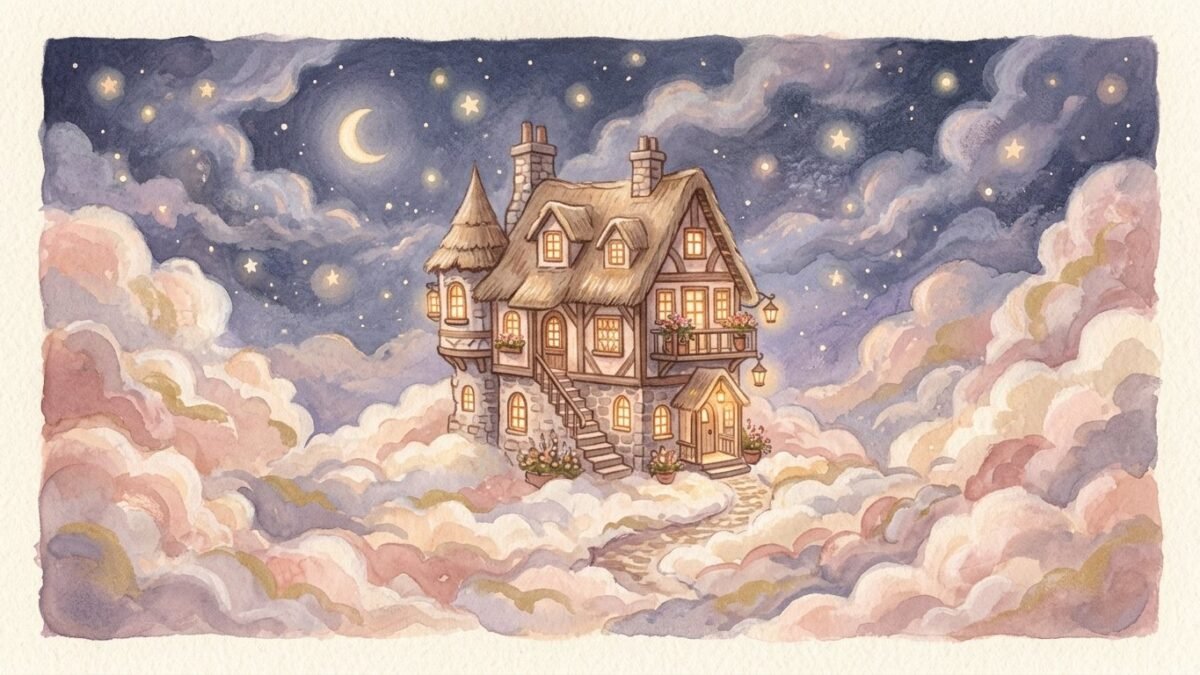
Dreaming about a house is usually a dream about yourself, and the state of the house is usually a fair picture of the state of you. This is one of the oldest ideas in dream interpretation and one of the few that holds up in ordinary experience: people dream of finding new rooms when their life has more room in it than they are using, of their childhood home when something in the present has reached back into that era, and of a house falling apart when they are stretched thinner than they have admitted. So the plain answer to what does it mean when you dream about a house is that you are walking around inside your own life, and the rooms are the parts of it.
Which room, and what condition it was in, carries most of the meaning. Below are the versions people search for most, what each tends to reflect in waking life, what dream research does and does not know about any of it, the two cards that sit with a house, and one small thing to do with the dream today.
Common versions of this dream
Finding rooms you did not know were there
This is the favorite, and people remember it for years: a door at the end of the hall, a staircase behind the wardrobe, a whole wing nobody mentioned. It tends to arrive when there is more to you than your current life is using, a talent parked since school, a kind of friendship you have not had in years, time that would be yours if you took it. The new rooms are rarely frightening, and the feeling is usually closer to recognition than to surprise.
Your childhood home
The childhood home is common at every age, and more common during transitions: a move, a new baby, a parent getting older, a job ending. The dream puts you back in the house where you first learned how families and safety worked, because something in the present has rhymed with that, and the useful question is what. What the house was like in the dream, and who was home, usually says which part of that era is being revisited.
A house falling apart
Cracks in the walls, a ceiling coming down, a floor giving way, rooms with the roof gone: this version tracks strain, and the strain is usually yours, a body that has been running on too little sleep, a relationship that is being held up by one person, a family arrangement that has stopped working and that nobody has said so about. It is not a prediction about your health or your home. It is a picture of what is carrying too much weight, and of where the weight sits.
An empty house, or someone else’s
An empty house tends to be a stretch of loneliness or a life with the people missing from it, and the dream is not unkind about it, only accurate. Being in a house that belongs to someone else, a friend, a stranger, a grand place you have never seen, usually points at a life or a self you are trying on, and how welcome you felt in it is the reading.
So what does it mean when you dream about a house
In waking life, house dreams follow the shape of your life closely enough to be used as a rough survey. The rooms tend to sort themselves: kitchens are the everyday and the family, bedrooms are the relationship and rest, bathrooms are privacy and what you would rather not be seen doing, basements are what was put away, and attics are what was kept but not looked at. None of this is a law, and your own house will have its own map, but it is a useful place to start when the dream has left you with a room and no idea why.
The condition of the house is the other half. A house you are repairing is different from one falling down around you, and a house you are clearing out is different again, and each of those is a fair description of what you have been doing with your own life this month. People who are grieving dream of packing houses, and people who are starting over dream of empty ones with good light. The dream is not subtle, which is a kindness, because you can act on it.
What dream science does and does not know
The house-as-self idea comes mostly from Jung, who described a dream of his own in which he went down through a house whose floors grew older the further he descended, until he reached a cellar with old bones in it, and who read it as a picture of the mind’s layers. It is a story rather than a finding, and it should be held as one. What research has shown is narrower and holds up better: dreams take their settings from places you have actually lived in and spent time in, the childhood home turning up more often than its share of your adult life would suggest, and the content of dreams tracks what you are concerned with while awake.
What has not been shown is that any room means the same thing to everyone, or that a house in a dream says anything about a real building, a move or a sale. If a house falling apart worries you for reasons that are not about the house, the dream cannot tell you if you are ill, and it cannot tell you if a relationship is ending, and it would be dishonest to say it could; those are questions for a doctor or for a conversation. What it can tell you is that you are tired somewhere, and where.
The tarot card that sits with this dream
The Ten of Pentacles is the card with a house in it: an old man in a patterned robe sitting under an archway with two dogs, a younger couple and a child passing through, ten coins laid over the whole scene like a family tree. It is the card of the home that stays standing and of what was put there before you arrived, and the Ten of Pentacles belongs to the childhood-home dream especially, because some of what holds you up now was built by people you will not get to thank, and some of it is worth inspecting before you build on it further.
The Hermit is the card for the new rooms: an old figure on a mountain holding a lantern with a star in it that lights only a few steps ahead, a staff in the other hand. He is the way you go through the unknown part of the house in the dream, one room at a time, and the Hermit suggests that the rooms you have not opened are not going anywhere and do not need the lights on all at once; three steps of lamp is what anyone gets, and it is enough to find the next door.
What to do with this today
Before the evening, draw the house. It does not need to be drawn well, only as a rough floor plan on the back of an envelope, with the rooms you remember from the dream and a word in each for what happened there or how it felt. Then write beside each room the part of your waking life it is most obviously about, the family, the job, the relationship, the thing you put away. Most people find one room they cannot label, and that room is the one the dream was actually about, so leave it blank and let the label arrive on the walk tomorrow.
If the dream was the new-rooms kind, add one more line: the thing you have not been using, and one small way to use it this week, a call, a booking, an hour with the door shut. The rooms do not need decorating. They need visiting.
A line to remember: a dream house is your life with the walls made visible, and every one of them can be moved.
Questions people ask
What does it mean to dream about finding new rooms in a house?
Usually that there is more to you than your current life is using: a talent parked since school, a kind of friendship you have not had in years, time that would be yours if you took it. The new rooms are rarely frightening, and the feeling is usually recognition. Write down what was in them, because the contents tend to be specific.
Why do I keep dreaming about my childhood home?
Because something in the present has reached back into that era. The childhood home turns up in dreams more often than its share of your adult life would suggest, and more during transitions: a move, a new baby, a parent getting older, a job ending. Ask what the house was like in the dream and who was home, because that says which part is being revisited.
What does it mean to dream about a house falling apart?
It tracks strain, and the strain is usually yours: too little sleep, a relationship being held up by one person, a family arrangement nobody has admitted has stopped working. It is not a prediction about your health or your home. Look at which part of the house gave way, because the room usually names the part of your life carrying too much weight.