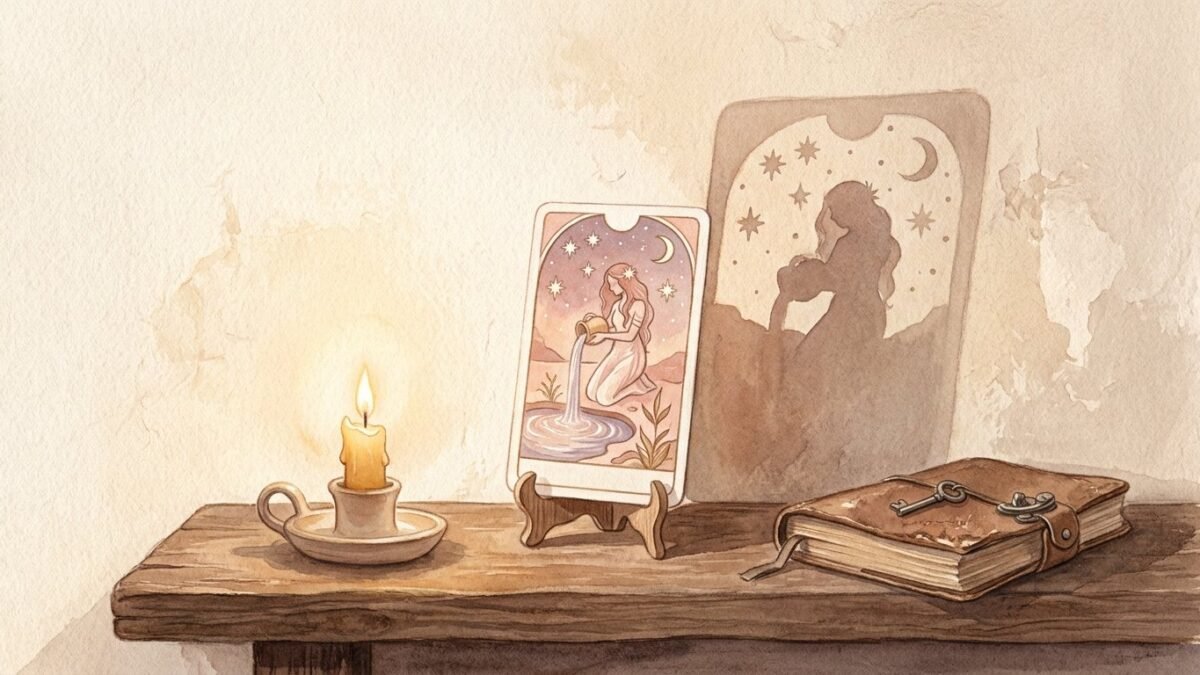
Shadow work has picked up a lot of mystique for something that is mostly a notebook, an hour, and a willingness to be unflattering about yourself for a little while.
The idea underneath it is old and fairly simple. The traits we cannot stand in ourselves do not go anywhere when we refuse to claim them, they just start driving from the back seat, and the clearest sign of one is a reaction that is much bigger than the thing that caused it.
What this reading is doing
Three cards: what you keep pushing out of the frame, what it costs you to keep it there, and what would help you look at it without flinching. There is nobody else in this spread, which is exactly why it tends to go somewhere.
Do it when you have a clear hour, not at midnight after a difficult phone call.
What would you like to look at
Pick the shape that fits the question. You can change your mind at any point before you draw.
Before we start
Twenty seconds, feet on the floor, hand somewhere warm. Breathe in while the circle grows and out while it settles. You can skip this whenever you like.
What is on your mind
In your own words, as much or as little as you like. You can leave it empty and simply draw.
Your cards
Laying them out now.
Clara
Same cards, one more look.
Did this land?
For self-reflection and entertainment. Not a substitute for medical, legal or financial advice. 18+.
Where the honesty sits
This is not therapy and we will not pretend it is. A deck cannot assess you, cannot hold you afterward, and cannot tell the difference between an old habit and something that needs a professional. If a reading opens something that stays open, that is a sign to talk to a person, and there is nothing weak about it.
What this can do is give you language. Most people find their difficult parts easier to handle once they have a plain name and a picture rather than a vague dread.
What people usually meet here
Envy, most often, because it is the one almost nobody will say out loud. Envy is useful information once it is admitted, since it points precisely at what you want and have not let yourself go after.
After that comes the need to be seen as good, which quietly runs a great many decisions, and the resentment that builds in people who never say no. The Devil page is worth reading alongside this, because the card is about the things we tell ourselves we cannot put down, and it is much less dramatic than its reputation.
The Moon is the other card that turns up constantly in this work, and it is about the difference between what is actually in the dark and what your imagination has put there.
How to actually run an hour of this
Choose one reaction from the past month that was bigger than the thing that caused it. Not a real injury, an overreaction: the colleague whose voice made your jaw tighten, the friend whose good news landed badly, the small favor you agreed to and then resented for two days.
Write what you would have said if there were no consequences. Not what you should have said, and not the fair version. The ugly one, in full, in your own handwriting, where nobody else will read it.
Then ask one question of it: what was being protected. Almost every unflattering reaction turns out to be guarding something, and the guard is usually a good deal older than the situation that set it off.
What to do afterward
Close the notebook and do something with your hands. Wash up, walk, put the laundry on. The insight settles better while you are doing something ordinary than while you are staring at it.
And be decent to yourself about whatever came up. The parts of you that you like least were, at some point, the parts doing the protecting.
Questions people ask
What is shadow work, in plain words?
It is looking at the parts of yourself you would rather not claim: the envy, the neediness, the temper, the pettiness. The idea is that those parts run the show more when they are unnamed, and less once you can say them out loud without collapsing.
Is shadow work dangerous?
For most people it is an uncomfortable hour with a notebook. If you are already having a very hard time, or if what surfaces is about something that was done to you, this is work to do with a person rather than a deck, and stopping is a perfectly good outcome.
How often should I do it?
Rarely and properly beats weekly and shallow. Once a month is plenty for most people, and the useful part is usually what you notice in the ten days afterward rather than during the session.