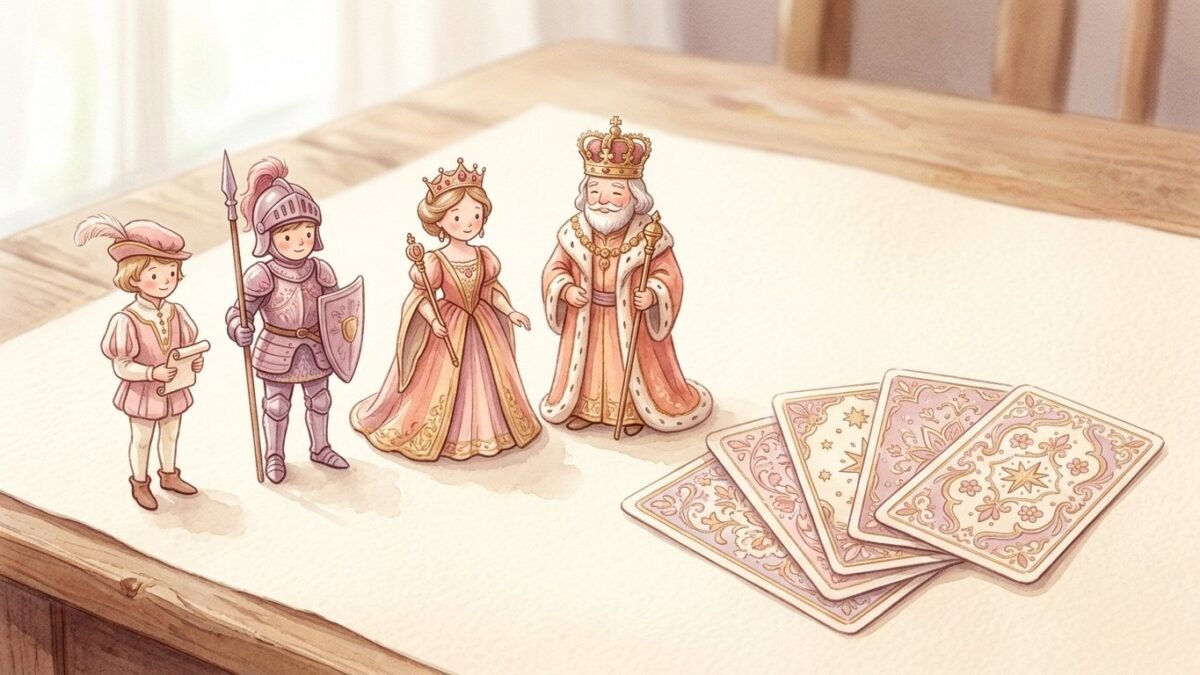
The sixteen tarot court cards are the pages, knights, queens and kings of the four suits, and they are the cards beginners most often skip, because the Page of Cups seems to be about a person and you cannot work out which one. The plain way through is that a court card is a way of behaving. The rank tells you how, the suit tells you about what, and whether the card is somebody in your life or a part of you is a question you can settle in about three seconds.
Nothing in the tarot court cards is a forecast of who is about to arrive. The old fortune telling matched the kings and queens to hair color and age, so that the Queen of Swords was a dark haired widow, and we leave all of that alone, because it gives you nothing to act on and a good deal to spend the week looking for.
Four ranks, four ways of doing a thing
Pages are at the start. They are learning, carrying a message, trying something for the first time, and a little clumsy about it, as anyone is at the start. Knights are in motion, in the middle of doing the thing, sometimes at a gallop and sometimes at a crawl, and pace is where they get into trouble. Queens hold. They have the suit’s quality settled in them and they turn it inward and toward the people nearby, tending rather than driving. Kings hold it too, and turn it outward, into decisions, responsibility, and being the one it lands on.
No rank outranks another in a reading; a page is an earlier card than a king rather than a lesser one, and there are weeks when being a beginner at something is precisely the point.
Four suits, four subjects
Cups are feeling, wands are drive, swords are thought and words, and pentacles are the practical side, the rent, the body, the house, the work itself.
Put a rank on a suit and you have a tarot court card, which is to say a person doing something. The Knight of Cups is feeling in motion, the message sent at midnight that would have been better sent at noon. The Queen of Swords is thought held steady, the friend who tells you the true thing in one sentence and does not enjoy it. Once you can build them this way you do not have to memorize the sixteen, because you can work any of them out at the kitchen table.
Reading tarot court cards as people, or as parts of you
Here is the three second test. When a court card turns over, if a real person comes to mind before you have finished looking at it, the card is probably about them. If you hesitate, it is probably you, in that role, this week.
Most of the time, in a reading for yourself, it is you. The King of Pentacles in a reading about your family is not a wealthy man about to appear; it is the version of you that pays the bill and does not mention it. The Page of Wands in a reading about your work is the part of you that wants to start something and has been told to wait.
When a court card does stand for somebody else, it is worth being plain about its limits. It can describe how they are behaving from where you stand, which is something you can see. It cannot tell you what they feel, and a reading that turns the Knight of Wands into proof that he is about to call has stopped reading and started guessing. In a layout with a seat for them, like the love spread, that seat is read as what is visible, and a court card there is a way of naming it.
Reversed court cards
Reversed tarot court cards are the same people having a hard week. The Queen of Cups reversed is still the one who feels everything for everyone, with the tap left running and nobody topping her up. The King of Swords reversed is still the clear thinker, using the clarity as a weapon or turning it on himself. The page on reversed tarot cards has how we read a turned card, and none of it involves an omen.
The court card you keep drawing
If the same court card turns up for a month, it is usually a role you are living in or a role you are avoiding, and it is worth asking which. The Knight of Pentacles four times in three weeks is not a slow man on his way to you. It is a fair description of the pace you have been keeping, and whether that is patience or stalling is something only you can tell, and the deck is only asking. Answer it tonight, in one line, by writing down what that card did today and whether the line reads like you.
Questions people ask
Do tarot court cards always represent a person?
No, and in a reading for yourself they are more often a part of you than anyone else. A court card is a way of behaving, built from a rank and a suit, and the test is whether a real person comes to mind before you have finished looking at it. If one does, it is probably them. If you hesitate, it is probably you, in that role, this week.
Does a queen card have to mean a woman?
No. The queens and kings are ways of holding a suit’s quality, turned inward or outward, and either can describe anyone. A man who quietly looks after everybody is the Queen of Pentacles as surely as a woman is, and a woman who makes the hard call and lives with it is the King of Swords. Read the behavior, and leave the gender to the picture.
What does it mean when I keep drawing the same court card?
Usually that you are living in that role or avoiding it, and the deck is asking which. The Knight of Pentacles three times in a month is a fair description of the pace you have been keeping rather than news of somebody slow arriving. Write down what the card did each time it turned up, and by the fourth time the pattern is generally plain.