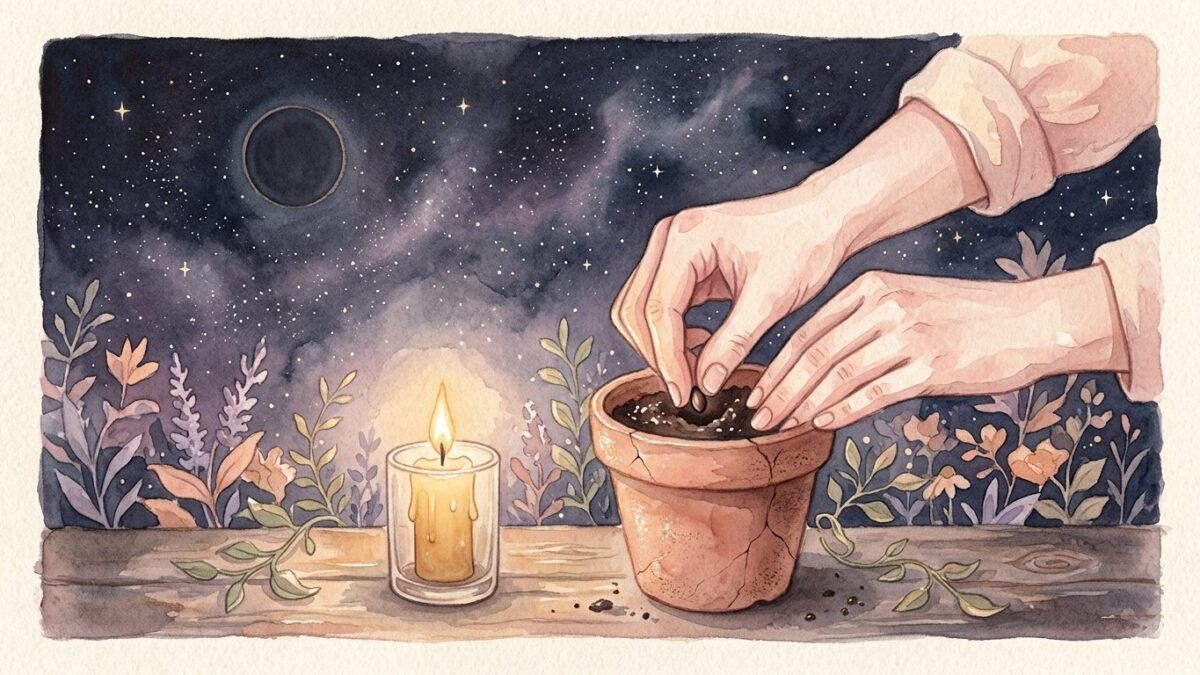
People tend to ask about this slightly apologetically, as though wanting a small ceremony at the start of something were a bit much. It is not, and the reason these evenings work has very little to do with the moon.
What the date gives you is an occasion, and an occasion is the only reliable way most of us ever sit down and decide something on purpose.
Waxing gibbous
94 percent lit tonight
Almost full, almost ready, and the honest work now is finishing rather than adding.
A reading for tonight's moon One card, read in tonight's light. Free.
What a new moon ritual is actually doing
I want to be straight about the mechanism, because I think the honest version is more useful and rather more encouraging than the mysterious one.
Writing something down makes it specific. Specific things get done and vague ones stay on a list for years, and that is more or less the whole finding. Add a day of the week and the odds go up again. Add a first action that takes two minutes and you have done most of what any goal setting method has ever reliably achieved.
The moon does not grant anything. What it does is give you a date that comes round every twenty nine and a half days, which is often enough to keep a habit and rare enough that it still feels like an occasion.
What this takes
A pen, one sheet of paper, twenty minutes, and somewhere to put the paper afterward where you will actually see it. A candle if you want the room to feel different, which is a perfectly good reason to light one.
The twenty minutes themselves
Begin with the honest bit, which is not the wish. Write down what has been standing still. Two or three lines about the thing you keep meaning to start and have not, without excuses and without the paragraph explaining why this year has been difficult.
Then ask what you are nearly ready for. Nearly is the important word. New moon plans fail when they are three sizes too big, and the thing you are nearly ready for is almost always the one that survives to the full moon.
Then write one sentence. It has a verb in it and a day in it and no conditions. Not I would like to get back into drawing, which will read exactly the same next year, but I draw for twenty minutes on Sunday morning before anybody is up.
Then write the first two minutes of it underneath. Not the plan, the very first physical action: open the document, find the pencils, look up the phone number, put the trainers by the door tonight.
Where the paper goes
Somewhere you will see it without going looking. The inside of a kitchen cupboard, the back of your phone case, taped to the side of the kettle. A note that has to be found is a note that is already gone.
And put a reminder in your phone for the full moon in two weeks, with the sentence in it. That is the whole accountability structure and it works better than a group chat.
The permission part
A surprising amount of what happens in these twenty minutes is not planning at all. It is somebody deciding they are allowed.
If you get to the sentence and find yourself arguing about whether it is worth doing, whether it is a bit late, whether you would be any good, then that is the actual content of tonight and it is worth writing down instead. That argument has been running longer than any of the plans, and it will still be running in April unless it gets looked at.
Beginning again, rather than beginning
Most new moon plans are not new. They are the third or the fourth attempt at something, and that history is usually why it is hard to write the sentence with a straight face.
Starting again is not worse than starting. It is the ordinary way almost everything gets done, and the people who look as though they began once and kept going have simply not told you about the two years in the middle. If it helps, put the number in the sentence: this is the fourth time I have tried this, and I am trying it on Tuesdays.
The part of you that expects to fail
Do not argue with it and do not try to talk it round, because it has evidence and you will lose.
The useful move is to make the plan small enough that the doubt has nothing to say about it. Twenty minutes on a Sunday is not a claim about your character, and it is very difficult to be cynical about.
If you miss the exact night
Do it the next evening. The moon is dark for a couple of days and the calendar is not a test. Nothing about a beginning depends on getting the timing right to the hour, and treating it as though it does is a very good way of not starting.
One more thing about the paper: write it out with a pen if you can. There is nothing mysterious about that, it is simply slower, and slower is what stops you writing the impressive version instead of the true one.
One card to take into it
A single card, read against your sentence, is the right size for a beginning. Anything bigger will have you managing something that does not exist yet.
What would you like to look at
Pick the shape that fits the question. You can change your mind at any point before you draw.
Before we start
Twenty seconds, feet on the floor, hand somewhere warm. Breathe in while the circle grows and out while it settles. You can skip this whenever you like.
What is on your mind
In your own words, as much or as little as you like. You can leave it empty and simply draw.
Your cards
Laying them out now.
Clara
Same cards, one more look.
Did this land?
For self-reflection and entertainment. Not a substitute for medical, legal or financial advice. 18+.
If you want the fuller version with the reading built in, the new moon reading page is set up for it, and the full moon page will be waiting two weeks from now to see how much of your sentence you meant.
Start small enough to be slightly embarrassed by it. Those are the ones that last.