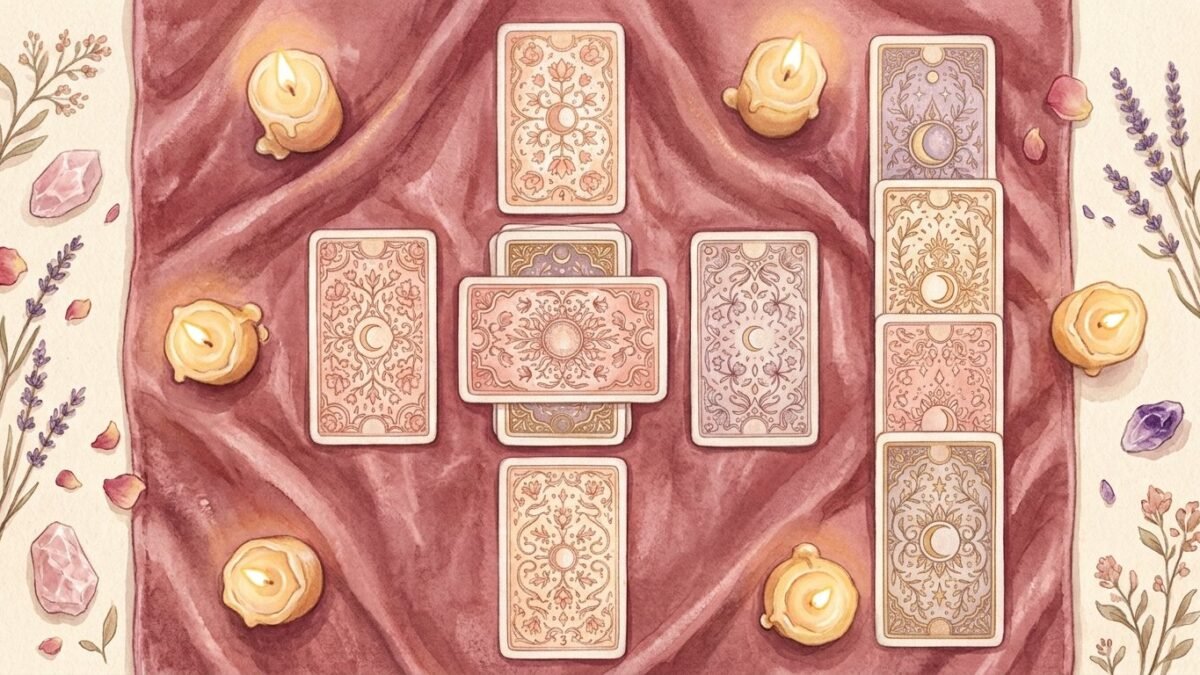
The Celtic Cross tarot spread is the ten card layout everybody has seen and rather fewer people can actually explain. It is worth the half hour when a situation has been going round in circles for months, and it is completely wrong for whether to answer a message.
The ten positions, in plain words
One: the heart of it
The situation itself, as it stands. Not what you fear about it and not what you want from it, just the thing you would describe to a friend in one sentence.
Two: what crosses it
The card laid sideways over the first. What complicates the situation, which is often not an obstacle in the dramatic sense but a second true thing pulling the other way.
Three: what is beneath
The root. What was already there before this started, sometimes years before, and what the situation is built on without anybody choosing it.
Four: what is behind
What is on its way out, whether or not you have finished with it. This position tends to be gentle and it is often the one that makes people put the pen down.
Five: what is above
What you are aiming at, or telling yourself you are aiming at. Read it against position three and the two of them usually say something you already suspected.
Six: what is ahead
The near future in the modest sense: what is already in motion and will arrive whether or not you do anything. Not a prophecy, more like weather that has been visible on the horizon for a while.
Seven: you in this
How you are actually standing in this situation. Braced, hopeful, exhausted, performing. This card is often uncomfortable and it is the one worth writing down.
Eight: the people around it
The environment: the family, the office, the friends who have opinions. Read carefully, this position is about the pressure you can feel rather than about what anybody is thinking, and we do not read it as a report on other people’s feelings.
Nine: hopes and fears
One card for both, which sounds like a compromise and is actually accurate, since for most situations they are two versions of the same thing.
Ten: where this leans
Not an outcome. A direction, based on everything above it, on the assumption that nobody does anything differently. Something usually does change, which is the entire reason for doing the reading.
When it is worth the half hour
Use it for the big, tangled, long running ones: a relationship you have been in and out of for two years, a career question with a family in it, a family situation with a decade of history. The ten positions give a complicated thing room to be complicated.
Do not use it for a quick question. A Celtic Cross asked about whether to text somebody will produce ten cards of significance about a two minute decision, and that is how people end up more confused than when they started. One card is right for that, and three for most of the rest.
Start a Celtic Cross
Deal it at the Celtic Cross when you have a clear half hour, and read the synthesis at the end rather than only the ten paragraphs.
Ten cards is a lot of information. One thing you decide to do with it is the point.
Questions people ask
Is the Celtic Cross too hard for a beginner?
It is not hard so much as long. Ten cards means ten things to hold at once, and most beginners do better with three for a few months, then come to this one with something real to bring to it.
Do I have to use all ten positions?
You can read a shortened version and plenty of readers do. If you are going to drop positions, drop the ones you cannot explain in a sentence rather than the uncomfortable ones.
What does the tenth card actually mean?
Where this leans if nothing changes. It is not an outcome and it is not a prediction, and reading it as one is the single most common way this spread gets misused.