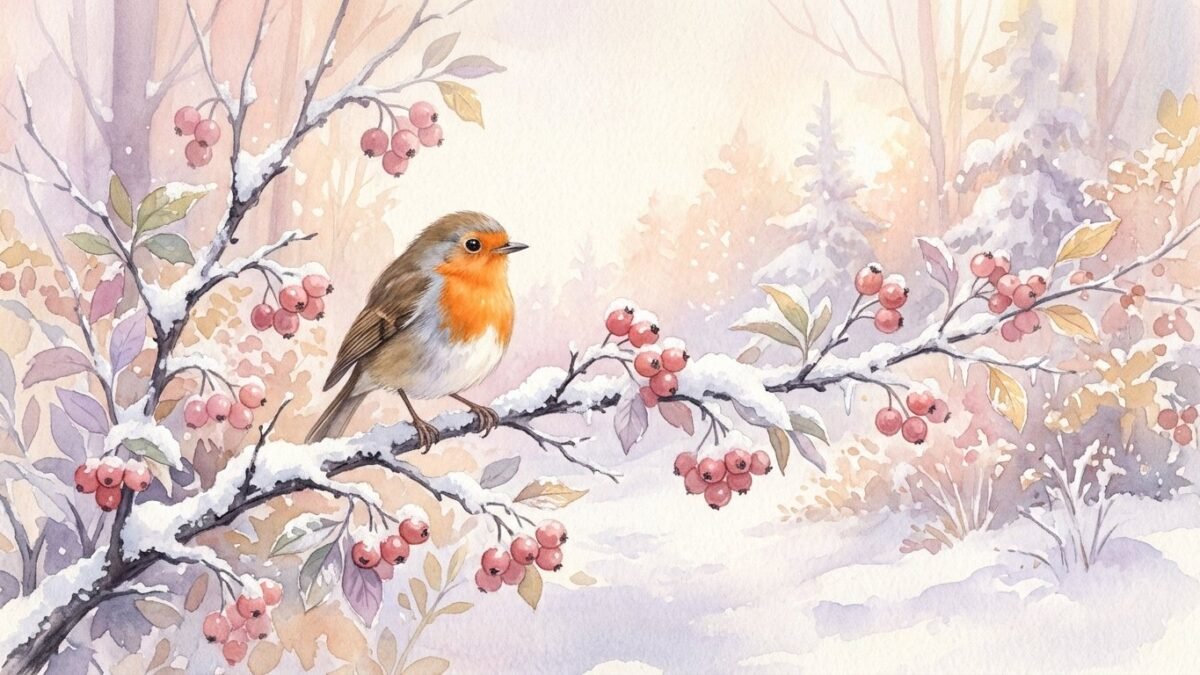
A robin is read, in Britain and Ireland especially, as a visit from someone who has died, and the saying that carries the idea, when robins appear, loved ones are near, is printed on more memorial cards than almost any other line. Older readings make the robin a sign of a new beginning and of company through the cold months, since it is one of the few birds that sings all winter, and the robin spiritual meaning most people are looking for sits between those two: someone is with you, and the season is not as empty as it looks.
Robins are also among the most common garden birds on either side of the Atlantic, and they come close to people for a reason that has nothing to do with the dead, and this page keeps the saying and the reason in the same room. Below is what the sign has come to mean, the saying held gently, the versions people ask about, the honest part about worms, the tarot card that sits with it, and one small thing to do today.
What a robin has come to mean
The robin’s reputation comes from two habits. It sings in winter, when almost everything else has gone quiet, because both males and females hold territories through the cold and defend them in song, so a robin on a bare branch in January is the sound of something refusing to give up. And it follows people, standing a yard from the spade while you dig, because for thousands of years it followed wild boar turning over the forest floor and learned that disturbed earth means food, which makes it the tamest wild bird most of us will ever meet.
Put those together and you get the older meanings: constancy, cheer in a hard season, the friend who turns up while you are working. The Victorians put the robin on Christmas cards partly because postmen wore red and were nicknamed robins, and the bird has stood for messages ever since. The reading that it carries messages from the dead is much younger, largely from the last few decades, and it spread because it does something kind for people at the worst moments of their lives.
In North America the robin is a different bird entirely, a large thrush with a brick red chest, and the robin spiritual meaning there is spring: the first robin on the lawn is the sign that winter is over, while the cardinal takes the role of the bird that stands for someone lost.
Robin spiritual meaning and the saying about loved ones
When robins appear, loved ones are near. It is worth saying plainly what the sentence can and cannot do. Nobody can show that the dead send birds, and this page is not going to claim it, because a claim like that leans on grief at exactly the moment grief cannot check it. What the saying gets right is smaller and truer: a robin, close and unafraid and looking straight at you, makes you think of someone, and the thinking is the visit. People who read it that way lose nothing, and they do not have to defend it to anyone.
So if a robin came to the fence the morning after the funeral, or sat on the headstone, or landed on the handle of the fork your father used, keep it. You are not being foolish. You are doing what people have done with birds for as long as there have been people and birds, which is to let something small and living stand in for someone who is not here.
The versions people ask about
A robin at the window, tapping or fluttering at the glass, is read as a message wanting in. It is also, in spring, a male attacking his own reflection, which can go on for days, and something on the outside of the glass to break up the reflection spares him a lot of effort. A robin that visits every day is read as a companion; practically, it holds a territory that includes your garden and it has learned when you put food out. A robin landing on you is the version people remember for the rest of their lives, and it is read as being chosen; it also happens because robins are bold and you were still.
A robin in the house is read, in older British folklore, as a bad omen, and that reading is left here for completeness and not endorsed, because a bird that flew in through an open door knows nothing about your family or your year. A robin singing at night under a streetlight is a robin confused by the streetlight, and also a small, stubborn sound in the dark that people have taken comfort from for centuries.
The honest part about coincidence and attention
The robin is among the most common birds in Britain and Ireland, present in nearly every garden, and the American robin is one of the most numerous birds on its continent. They come close because we dig, and cemeteries, with their short grass and freshly turned soil, are among the best places a robin could hope to feed, so a robin at a graveside is doing exactly what a robin does, and it would do it whether or not anyone was grieving there.
That is worth knowing, and it takes nothing away. The bird has been in the garden all year; the morning you stopped for it is the morning something in you was open. A sign is a meeting between what is outside and what you are carrying, and the robin’s half of that meeting is worms, while your half is the person you have been missing, and your half is the readable part.
The card that sits with it
In tarot the robin belongs to the Six of Cups, two children in an old garden, one handing the other a cup with a white flower in it, with a house and a guard’s back in the distance. It is the card of memory and of kindness from an earlier time: the people who were good to you, the place you grew up, the version of tenderness that did not need explaining.
Read for this sign, the Six of Cups suggests that whoever the robin brought to mind is not finished being useful to you. Not as a presence you have to believe in, but as a way of being that you can borrow: the way she answered the door, the way he talked to the dog, the patience with a seedling. The card’s advice is to let the memory be practical rather than sad, to take one thing from that person and do it today, in your own garden, in your own voice.
What to do with a robin today
Today, spend ten minutes outside doing one small ordinary job, sweeping the step or pulling a weed, and let whoever came to mind keep you company while you do it. You do not have to speak to them, though people do, and you do not have to decide what you believe about birds. The robin’s whole habit is to arrive when someone is working quietly in the open, so the step is simply to be that person for a few minutes and to notice who you were thinking of by the end. If nobody came to mind, notice that instead, and notice the bird, which is company of its own kind.
A line to remember: the thinking of them is the visit, and it is yours to have whenever you like.
Questions people ask
What does it mean when a robin visits you?
The best known reading, especially in Britain, is that a robin is a visit from someone who has died, summed up in the saying that when robins appear, loved ones are near. Older readings make it a sign of a new beginning and of company through winter. Robins also come close because digging turns up worms, and both things can be true at once.
Is it true that when robins appear loved ones are near?
It is a modern saying rather than an old belief, and it is on memorial cards because it comforts people, which it does. Nobody can show that the dead send birds, and this page will not claim it. What the saying gets right is that the robin makes you think of someone, and thinking of them, out loud or quietly, is the part that is real and yours.
What does a robin tapping at the window mean?
Folklore reads it as a message pressing for attention, or as someone who has died trying to reach you. Practically, robins are fiercely territorial and a male attacks his own reflection in glass for days in spring. Breaking up the reflection from outside spares the bird, and the moment you stopped to watch can still mean what it meant to you.