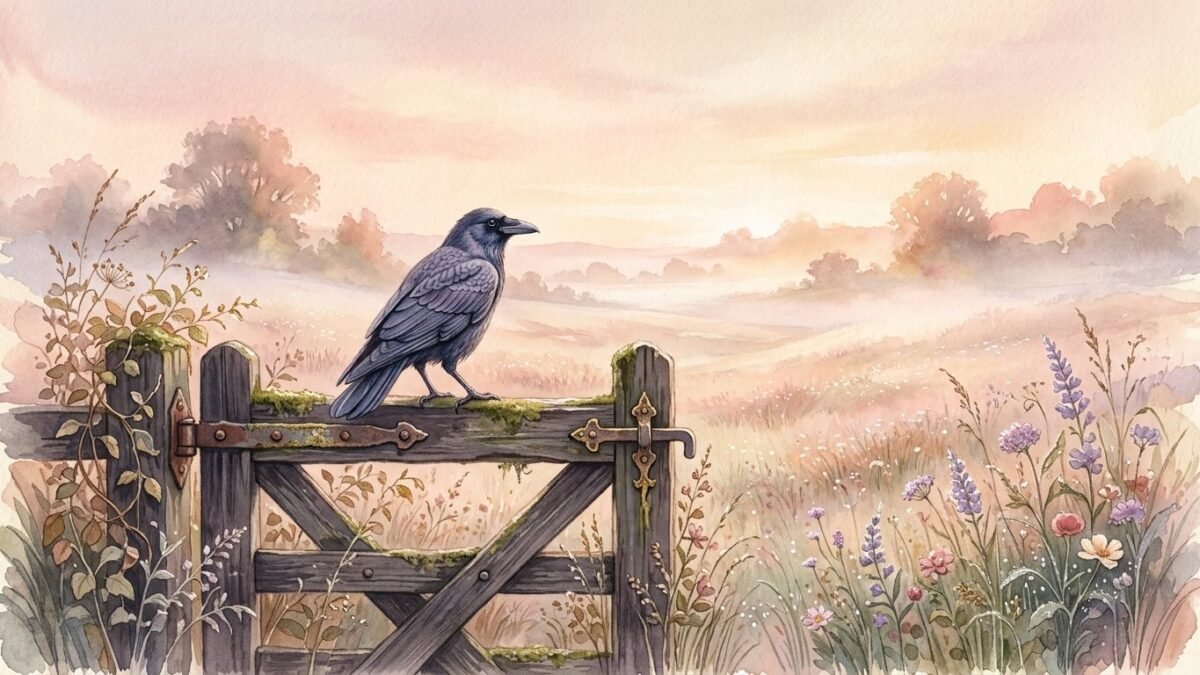
A crow is read as a messenger, a clever one, and as the sign of something ending so that something else can begin. The crow spiritual meaning most people are looking for is gentler than the old stories suggest: one crow is a message or a stretch of your own company, a group is community and a great many voices at once, and a crow that follows you is, more often than not, a bird that knows your face and has decided you are worth keeping an eye on.
Crows have carried a death omen in European folklore for centuries, and that is addressed plainly below rather than skipped. First, what the crow has come to mean, the versions people ask about, the honest part about how clever and social these birds are, the tarot card that sits with them, and one small thing to do with the sighting today.
What a crow has come to mean
Almost every culture that lived alongside crows made them messengers. Odin kept two ravens, named for thought and memory and close cousins of the crow, and sent them out each morning to bring back what the world was saying. In Japan a three-legged crow guided the first emperor to his kingdom. In parts of India crows are fed during the days set aside for the ancestors, because the crow is believed to carry what is offered across to them, and in the storytelling of several Pacific Northwest nations it is Raven who steals the light and gives it to people.
The thread through all of it is intelligence and traffic between worlds: the crow goes where you cannot and comes back with something. Read as a sign, it says a message is close, that it will not arrive dressed up, and that you are expected to be clever enough to catch it.
The heavier reading needs saying too. Crows eat carrion, and for a long time in Europe they were seen at battlefields and gallows before anyone else arrived, so they became attached to death in the way a hearse is. The meaning that survived is an ending, a chapter closing, and nothing about a crow predicts a death in your family or anyone else’s. We would rather say that plainly than leave it hanging over the page.
Crow spiritual meaning, from one crow to the whole roost
One crow, alone on a wire or a fence post, is read as a message meant for you in particular, or as a stretch of your own company that you are being asked to make use of. The counting rhyme that begins one for sorrow was written for magpies and gets applied to crows anyway, and it is a children’s rhyme rather than a forecast.
Two crows are read as partnership, and there is a plain reason: crows pair for years, and two crows in your garden are almost always a couple working the same patch. Three or more, or a whole loud roost at dusk, is read as community, family and a great many opinions at once, and the collective noun everyone quotes, a murder of crows, comes from a fifteenth-century list of fanciful terms rather than from anything the birds do.
A crow cawing at you is read as something being said to you plainly and repeatedly, which is worth taking at face value, because crows do scold what they recognize. A crow on the roof or at the window is the version the old omen attaches to, and in practice it is a warm chimney, a good lookout post, or a bird in spring fighting its own reflection in the glass. A crow feather on the path has its own page under black feather meaning.
When a crow follows you
This is the version people find unsettling, and it is the one with the best explanation. Crows recognize individual human faces and remember them for years, which researchers established by wearing masks while catching and releasing crows on a university campus and then being scolded by those crows, and by their offspring, long afterward. Crows also remember who feeds them, and there are well-documented cases of crows leaving small objects, buttons and beads and bits of glass, for people who put out food regularly.
So a crow that follows you down the street has probably met you before. You fed it once, or someone who looks like you did, or you startled it in March, or you walk the same route at the same time each morning and it has simply learned your schedule. The reading that comes out of that is a good one: you are known and noticed more than you think, in your neighborhood and in your life, and what you do is being watched by more eyes than you count.
The honest part
Crows are everywhere people are, because they live on what we leave behind, and in winter they gather in roosts of hundreds or thousands, so a sky full of crows in November is a sky full of crows and not a message about you. They are also among the cleverest animals on the planet, tool users and problem solvers with tight family groups that stay together for years, and they mob hawks and owls as a group because a family that shouts together survives.
What is not ordinary is that on this day, out of all the crows you have walked past, this one made you stop. A sign works through attention, and attention goes where something in you is unresolved, so the question worth sitting with is not why the crow was on the wall but what you were thinking about when you looked up and found it looking back.
The card that sits with a crow
In tarot the crow belongs with the Page of Swords: a young figure on a windy hill holding a sword upright with both hands and looking over one shoulder, with a flock of birds crossing the sky behind. It is the card of watchfulness and quick wits, of news you have not opened yet, and of saying a thing plainly before you have finished being polite about it.
What the Page shares with the crow is that neither of them lowers its voice. If you have drawn this card lately, or you keep meeting crows, the message is about the honest sentence you keep wrapping in softer ones, and about how much effort the wrapping costs you.
What to do with a crow today
A crow does not say a thing once and it does not say it gently, and that is the useful part of the sign. Before the day is out, say the plain version of the thing you have been softening: to the person it concerns, in one sentence, without the three cushioning sentences you usually put around it. If they are not around, write the one sentence in your notes so it exists somewhere outside your head. Most people find that the plain version is shorter and kinder than the version they were protecting everyone from.
A line to remember: the message is usually plainer than the messenger.
Questions people ask
What does it mean when you see a crow?
A crow is read as a messenger and as the sign of something coming to an end so that something else can start. It is also one of the cleverest birds on the street, so the modern reading leans toward watchfulness, plain speech and adapting to what is in front of you. Seeing one is common; noticing one is the part worth reading.
Is a crow a bad omen or a sign of death?
No. The death association comes from crows being carrion birds that gathered at battlefields and gallows, so European folklore attached them to endings. Nothing about a crow predicts a death, and we would rather say that plainly than leave it hanging. Read it as a chapter closing, which is a different thing and usually a smaller one.
What does it mean when a crow follows you?
Crows recognize human faces and remember them for years, so a crow that follows you probably knows you: you have fed it, or once startled it, or you walk the same route at the same time each day. The reading is that you are known and noticed more than you think. It is a good moment to say something plainly.