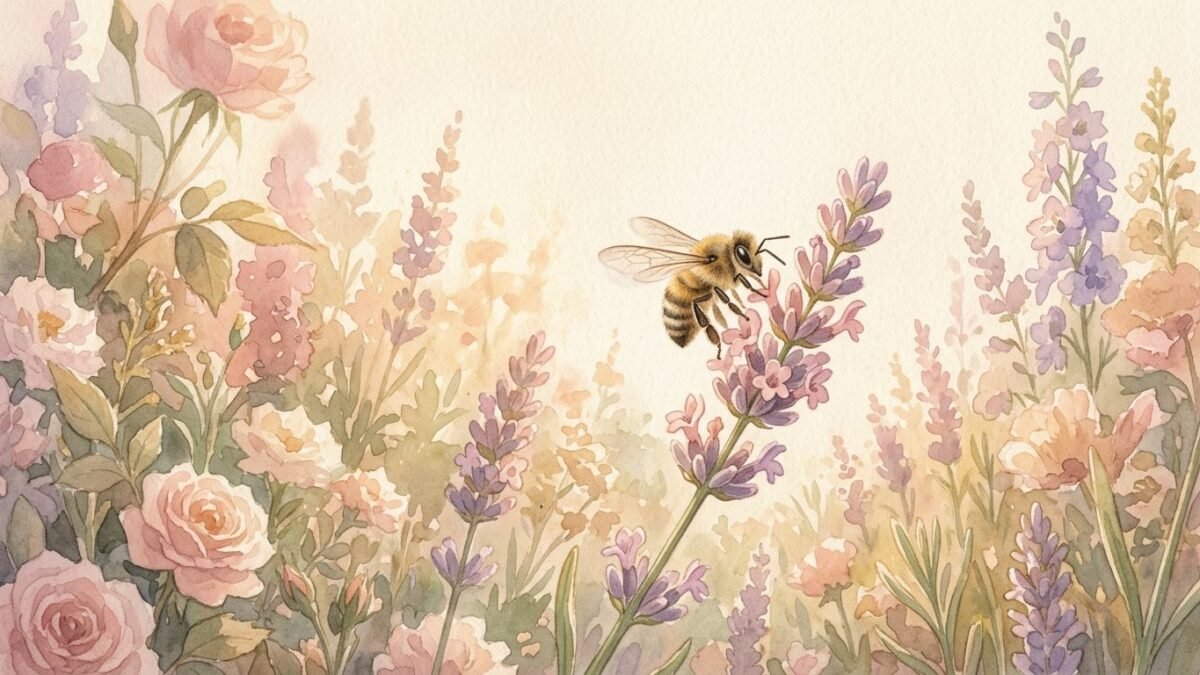
A bee is read as work that is shared and sweetness that follows it: the sign of a community you belong to whether or not you feel it, of effort that adds up in small trips, and of news that has to be told to the people who share your life. The bee spiritual meaning has almost nothing frightening in it, which surprises people who were stung as children, and the versions people ask about most, a bee landing on you and bees in the house, are both read as a visit rather than a threat.
Below is what the bee has come to mean, what it means when one lands on you or comes indoors, the old custom of telling the bees, the honest part about why bees do what they do, the tarot card that sits with them, and one small thing to do with the sighting today.
What a bee has come to mean
People have gathered honey for at least eight thousand years, and every culture that did read something into the bees. The Egyptians said bees were born from the tears of the sun god as they fell on the ground. The priestess at Delphi was called the Delphic bee, and honey was the food of the gods across the Mediterranean. Medieval writers held up the hive as the model of a community in which everyone has a task and nobody hoards, and Napoleon put golden bees on his coronation robes because a king from the fifth century had been buried with three hundred of them.
The thread through all of it is that a bee is never working for itself. A single jar of honey is tens of thousands of trips by bees that will not be alive to see it eaten, and that fact has done most of the work of the symbol: the reading is that what you are building is bigger than you and will outlast your part in it, and that the sweetness is real but it comes late and it comes to the group. The ladybug is read the same way, as help that arrives small, and has its own page under ladybug spiritual meaning.
Bee spiritual meaning when a bee lands on you
A bee landing on you is read as being chosen for a moment, and in most traditions as luck, a message, or confirmation that you are on the right road with the work you are doing. Because the bee is the busiest thing in the garden, a bee that stops on your arm is read as the busiest part of your own life pausing to look at you, and people often report it in the middle of a stretch when they have been working without lifting their head.
A bee that lands and stays is read as an invitation to stay with something yourself, and a bee that lands and goes as a reminder that the work is there to be left as well as done. If you were thinking about a person when it landed, the folk reading is that the person is thinking of you, and we would rather say plainly that no bee can report on what another person is thinking, and that the thought you had is the part worth keeping.
Bees in the house, a bee that follows you, and a sting
In old English and Irish folklore a bee flying into the house meant a visitor was coming, and killing it brought bad luck on the household, so the custom was to open the window and wait. In practice a single bee indoors has followed the light or a bowl of fruit through an open window, and a glass and a postcard will see it out; a steady stream of bees at the same spot in May or June usually means a colony has moved into a wall, a chimney or a roof space, which a local beekeeper will often come and collect for very little. Read the first as a greeting and the second as a phone call.
A bee that follows you on a walk is usually after your shampoo, your perfume, the sugar on your fingers or the blue of your shirt, and the reading is that you are carrying something sweet without knowing it. A bumblebee in early spring, big and slow and flying low along a wall, is a queen looking for a nest site and is read as a beginning being founded quietly. A sting has been read as luck and as a sharp lesson, and if you are allergic the only reading that matters is a medical one and it belongs to your doctor rather than to a page like this.
Telling the bees
The custom people ask about most is the oldest and the best. In England, Wales and Ireland, and in the parts of Europe and New England the custom traveled to, a family told the hives whenever something happened in the household: a death first of all, but also a marriage, a birth, a departure. Someone went out to the hives, knocked gently, and said the news out loud, and for a death the hives were draped in black cloth and sometimes given a piece of the funeral cake, and for a wedding a slice of the wedding cake, because the belief was that bees who were not told would leave the hive or stop making honey.
When Queen Elizabeth II died in 2022, the royal beekeeper went to the hives at Buckingham Palace and told them, and it was reported around the world, partly because it was charming and partly because so many people recognized what it was for. Telling the bees was never really about the bees. It was a way of making a family say its news aloud, to something that would listen without comment, before it had to say it to anyone else.
The honest part
Bees are everywhere in the warm months and they are drawn to sugar, scent, bright color and still, warm surfaces, which is why so many of these encounters happen to somebody sitting in the garden with a drink. They are not interested in you, and a swarm hanging from a branch is usually the most placid thing in the neighborhood, because the bees are full of honey and have no home to defend.
None of that explains the timing, and the timing is what people are asking about. You have walked past bees all summer. This one landed on the day you were tired of working alone, or the week you had news you had not told anyone, and the sign was never the bee; it was the fact that you stopped and looked at it and thought of what you thought of.
The card that sits with a bee
In tarot the bee belongs with the Three of Pentacles: a young stonemason standing on a bench inside a church, working on an arch, while a monk and an architect hold up the plans and talk it through with him. It is the card of work that only exists because several people are doing their part of it, and of skill being noticed by the people who can see it.
What the card shares with the bee is that nobody in the picture is finishing anything alone. If you keep meeting bees, or the Three of Pentacles has been turning up, the message is about the part of your work you have been treating as a solo job when it was always a hive.
What to do with a bee today
Take the custom literally. Tonight, tell one person one piece of your news that you have been carrying by yourself: the appointment, the offer, the thing that ended, the thing you have been quietly building. Say it in plain words, in a single message or across the table, without the introduction you have been rehearsing, the way the old beekeepers knocked on the hive and said it. The news does not get smaller for being said; it gets shared, which is a different weight entirely.
A line to remember: sweetness is made in small trips, and none of them are made alone.
Questions people ask
What does it mean when a bee lands on you?
It is read as being chosen for a moment: a small, busy visitor deciding you are worth a look, and in most traditions a sign of luck or of a message meant for you. Practically, bees land on people who are still, who smell of something sweet, or who are wearing bright colors, and they leave when they find no flower. Stay still and the bee and the reading both pass gently.
What does a bee in the house mean?
In old English and European folklore a bee coming into the house meant a visitor was coming, and killing it brought bad luck. In practice a single bee has come through an open window, and a steady stream of them in early summer may mean a nest in a wall or chimney, which a local beekeeper will usually collect. Read the first as a small greeting and the second as a phone call.
What is telling the bees?
It is an old custom from England, Ireland and parts of Europe and New England in which a family told the hives about a death, a marriage or a birth in the household, sometimes draping the hives in black or offering them a slice of the wedding cake, so the bees would not leave. When Queen Elizabeth II died in 2022 the royal beekeeper told the palace hives, and it was reported around the world.