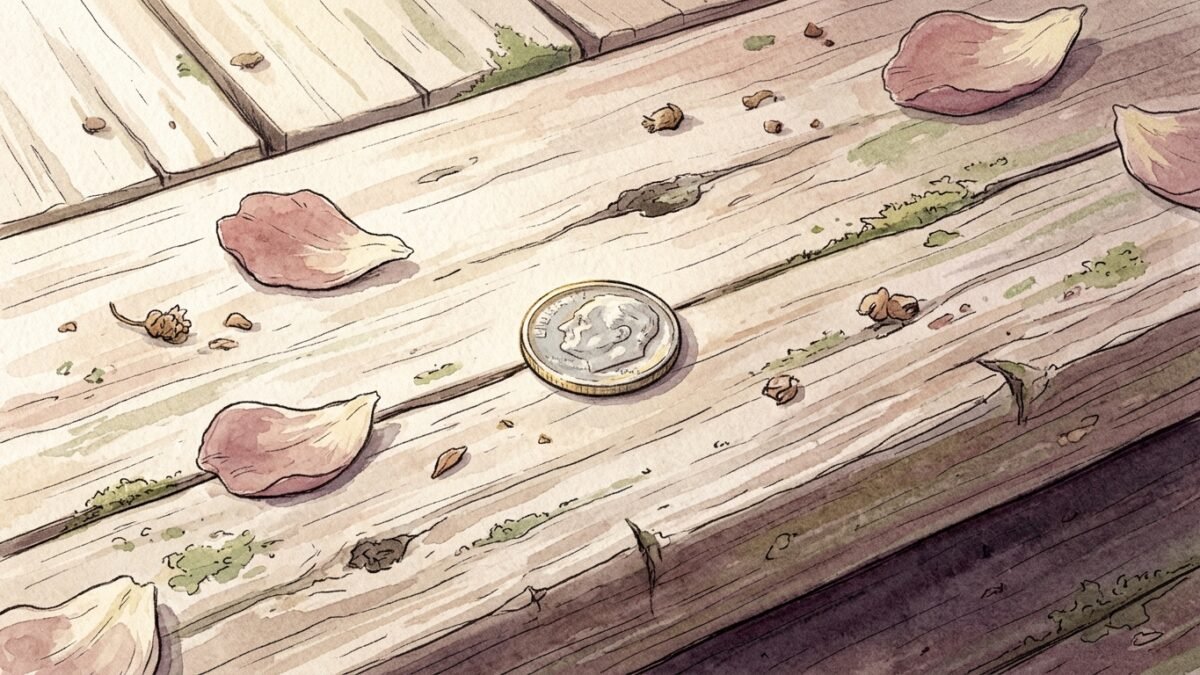
Finding a dime is usually read as a quiet sign of reassurance: you are on a decent path, someone or something is rooting for you, and a small thing is worth noticing right now. Dimes carry a special place in the folk language of signs, especially for people who are grieving, and the same coin that is small and silver in your palm can feel very large when it turns up at the right moment. This page covers where the belief comes from, what a dime can say about love, work and loss, and the plain fact that coins fall out of pockets every day.
Why the dime has its own meaning
Pennies get most of the folklore, so it is fair to ask why the dime stands apart. Part of the answer is simple: it is rarer to find one. It is the smallest coin by size in the American set, light and silver, and it tends to catch the light. Something that flashes at the edge of your vision on a porch step or a kitchen floor is easy to feel was meant for you.
The other part is cultural. Over the last couple of decades, the idea of a dime as a small “hello” from someone who has died has spread through books, memorial pages and ordinary family conversation. People tell each other: “when a dime turns up, they are close.” It is a modern tradition, only a few generations deep, and it is loved because it is gentle and easy to keep.
What a dime means in the spiritual traditions
In popular spirituality, silver is the color of the moon, of reflection and of quiet intuition. A dime is therefore often read as a nudge toward listening: to your own steady voice, to the people around you, to the small hunch you keep brushing aside. Where a penny says “begin,” a dime tends to say “you are doing fine, keep going.”
That reading suits the way most people actually find them, in the middle of an ordinary stretch, rather than at a dramatic turning point. If you want the bigger picture of how we make meaning from ordinary coincidences, the page on synchronicity is a good companion.
A dime and grief
This is where the dime matters most to many people. If someone you love has died and you keep finding dimes, you may feel they are letting you know they are near. If that is what it is for you, let it be what it is. You do not owe anyone a proof, and you do not need to decide what is true. A dime can be the small thing that brings a face to mind, makes you say their name aloud, or lets you sit for a minute with how much you loved them.
Some families keep the dimes in a small dish or a pocket of a coat. Others give one to a child, or tuck one into a card. If you would like more company, the pages on signs from loved ones who have passed and the white feather speak about the same tender territory.
A dime and love
If you find a dime while thinking about a relationship, read it as a message to you. It can be a quiet encouragement to trust your own steady sense of what you want, to speak plainly, or to be patient with yourself in a season of waiting. It does not tell you what another person feels or what they will do. It can only meet you where you are and ask what the next small kind thing might be.
A dime and work
At work, a dime often shows up when you are in the long middle of something: a project that is not finished, a skill you are still building, a decision you have turned over many times. Read gently, it says that steady effort counts, and that small, repeated steps add up more than one bold leap. You are allowed to keep going at the pace you can.
When it is simply a dime
Dimes are small enough to slip through a hole in a pocket, roll under a car seat or bounce off a counter. They end up in parking lots, gutters, laundry rooms and between sofa cushions, and we find them when we are looking down or when the light happens to hit them. That is the whole of it for many dimes, and there is nothing lesser about that. Noticing a small coin is already a small act of attention, and attention is worth practising.
If you find several in a short space of time, it often just means you have been walking where coins fall, or that you have started to look. If it begins to feel like a message, ask what you were thinking in the moment before you saw it. That answer is usually the real one.
How to hold the sign
Pick it up, if you want to, and hold it for a breath. Notice what you feel: warmth, relief, a catch in the throat. Then put it somewhere you will see it. You can keep it, give it away, or leave it for someone else. The meaning lives in what you do with the moment, not in the coin.
The card that sits with it
In tarot, the dime belongs to the Eight of Pentacles: a craftsperson at a bench, working quietly on one coin after another, with more coins waiting on the wall. It is the card of patient practice and of faith in small, repeated effort. Read for this sign, it says that your steady work counts, even when it feels slow, and that you are already part-way along. If you enjoy reading pairs of cards, the guide on reading two tarot cards together shows a worked example.
Questions people ask
What does it mean spiritually when you find a dime?
Most readings take it as a gentle reassurance that you are on a decent path and that something kind is close. For many people it is also a symbol of a loved one who has died, which is a personal meaning you are free to keep.
Is a dime a sign from someone who has died?
Many grieving people feel so, and the belief is warmly shared in families. Hold it as your own meaning rather than a fact to prove. A dime can open a good memory, and that is worth having whatever you believe about its source.
What is the difference between finding a penny and a dime?
Folk tradition tends to read a penny as a small beginning and a dime as steady reassurance, a sign that you are doing fine. These are loose customs rather than rules, so use the reading that helps you.
Why do I keep finding dimes?
Often it is because you are looking down, walking where coins fall or feeling open to signs, which makes you notice more. If it feels like a message, ask what you were thinking at the time.
What should I do with a dime I find?
Keep it, carry it or pass it on. Many people keep a small dish of found coins. There is no wrong choice, and the moment of noticing is the part that matters.
Does the date or year on the dime matter?
In folk tradition some people look for a meaningful year, but there is no fixed rule. If a date reminds you of someone or something, that personal link is the meaning that counts.