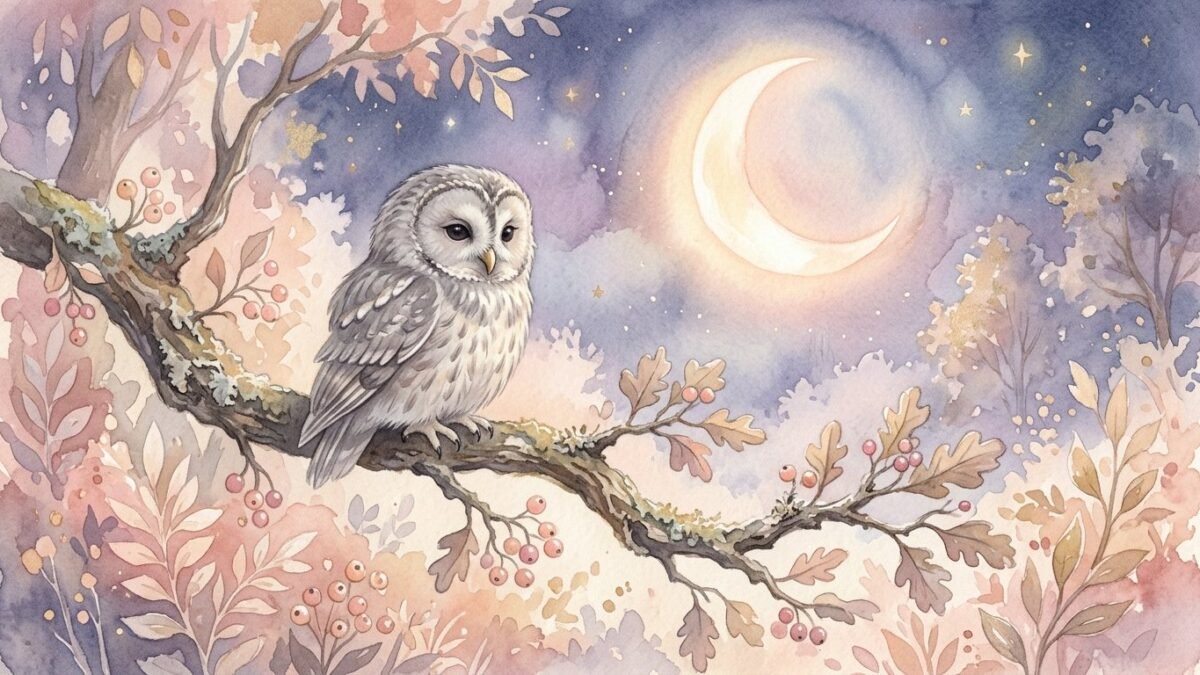
An owl is read, in most traditions, as wisdom and as the ability to see in the dark, with an older layer underneath about change and the border between one state and the next. Seeing one, or more often hearing one, is taken as a nudge to look at something you have been avoiding, as company through a stretch where you cannot see far ahead, and in several cultures as an omen, which is the part of the owl spiritual meaning that people search for at night with the window still open.
This page reads the omens honestly instead of repeating them, because no bird knows anything about your future, and it also explains why you are hearing owls this month in particular. Below is what the owl has come to mean, seeing one against hearing one, the old readings, the honest part about fall and territories, the tarot card that sits with it, and one small thing to do tonight.
What an owl has come to mean
The owl’s reputation for wisdom is Greek. It was the companion of Athena, goddess of wisdom and of the city, and the little owl was stamped on Athenian coins so widely that the coins themselves were called owls, and from there the bird passed into every Western picture of the wise. The reputation for ill luck is Roman: writers of the time describe owls calling before the deaths of emperors, and a hooting owl on the roof was something to be dealt with rather than enjoyed.
Both readings come from the same fact, which is that an owl sees where we cannot. It hunts in the dark by hearing and by eyes that gather nearly every scrap of light, it flies without a sound, and it turns its head far enough that it seems to look at you from behind, so to a person in a lit house a creature that comfortable in the dark looks either wise or uncanny, depending on the century. Elsewhere the owl is simply lucky: in Japan the word for owl can be read as no hardship and owl charms are sold for luck, in India the owl carries Lakshmi, the goddess of wealth, and a number of Native American nations treat it as a guardian of the night, while others hold it as a messenger from the dead and do not speak of it lightly.
Owl spiritual meaning: seeing one, hearing one
Hearing an owl at night
By far the most common version, since owls are heard a hundred times for every time they are seen. Read as a call to pay attention, to something being said underneath what is being said, or as a reminder that you are not the only one awake. If it has been outside your window three nights running, the section on fall below is the one to read.
Seeing an owl in daylight
Read as the most significant form of the sign, something from the night crossing into the day. Practically, short-eared owls and snowy owls hunt in daylight, barn owls hunt at dusk and in hungry weather by day, and a roosting owl flushed by crows will fly in full sun. Meaningful and explainable, as most of these are.
An owl crossing your path, or at the window
Crossing your path is read as a change on its way, a marker that you are moving from one stage into another; barn owls hunt the grass along road verges at night, low and slow, which is why so many people meet one in the headlights. An owl at the window or on the roof is the old omen reading at full strength, and an owl on the house is an owl using the house as a perch to hunt from, with no interest in who lives underneath, while what the moment means to you is a separate and legitimate question.
The old omens, read honestly
Here is the difficult part, said plainly. In Roman belief, in a Mexican proverb about the owl singing, in some Native American traditions and in a good deal of European folklore, an owl calling near a house was read as a sign of a death to come, and people still carry that fear to pages like this one at two in the morning. So: an owl has no way of knowing who is going to die, and it has never once made it happen. The reading exists because people who were already frightened for someone lay awake, and the awake are the ones who hear owls.
What the omen is really recording is a night when somebody could not sleep, and that is worth taking seriously on its own terms. If you are lying awake worried about a person, the owl did not bring the worry, and there is a plain thing to do with it in the morning that has nothing to do with birds, which is to call them. If the worry is about your own health or someone else’s, a doctor knows more than any owl, and that is the only sentence about doctors this page needs.
The honest part about fall and territories
If you have started hearing an owl this month, it is very likely the calendar. Tawny owls in Britain and Europe are at their loudest from September through the winter, because the year’s young are being pushed out to find territories of their own and the adults are announcing that this one is taken, so the hooting and the sharp answering call go on for hours. In North America the great horned owl begins courting in late fall and hoots through the coldest nights, and the barred owl asks its who cooks for you question loudest in late winter. None of this is about you, and all of it is why the owl chose this week.
The noticing is a different matter. An owl has been in that tree, or one like it, for years, and the night you heard it is the night you were awake and listening, which usually means something in your life has gone quiet enough to hear. That is the honest owl spiritual meaning, and the honest reading of nearly every sign on this site: the animal is doing what it does, and you are the one whose attention has changed, so the question is not what the owl wants but what you are listening for at that hour.
The card that sits with it
In tarot the owl belongs with the Hermit, an old figure in a gray cloak on a mountaintop, holding a lantern out in front of him that lights only the next few steps. The Hermit is not the card of being alone for its own sake. It is the card of seeing by a small light because the big one has gone, and of being willing to look at the next step without demanding the whole path.
Read for this sign, the Hermit says the owl’s kind of seeing is available to you, and that it takes patience rather than brightness: your eyes adjust to the dark if you stop switching lights on. Whatever you have been refusing to look at directly, a bill, a letter you have not opened, a relationship that has gone quiet, is more visible than you think once you stand still in front of it. The Hermit does not hurry, and neither does the owl.
What to do with an owl tonight
Tonight, sit at a window for ten minutes with the light off and no phone, and notice what you can see once your eyes have adjusted. It takes longer than people expect, three or four minutes before the garden comes back in gray, and then more than you thought is there. If something comes to mind while you are sitting there, and it usually does, write it down in one line before bed so that it is waiting for you in daylight, and if you are awake at three anyway, the page on waking at 3am keeps you company. The owl’s whole lesson is that the dark is not empty, it is only dark, and that most of what we call not knowing is really not having waited long enough to see.
A line to remember: your eyes adjust if you stop turning the light on.
Questions people ask
What does it mean when you see an owl?
An owl is most often read as wisdom and as the ability to see what others miss, with an older layer about change and the border between day and night. Seeing one is taken as a nudge to look at something you have been avoiding, or as company through a dark stretch. In several traditions it is an omen, which this page reads honestly rather than repeating.
Is hearing an owl at night a bad sign?
In Roman belief, in a Mexican proverb and in some Native American traditions, an owl calling near the house was read as a bad sign, sometimes of a death. No bird has ever known who was going to die, and the plainer explanation is that owls are loudest in fall and winter, when the young are finding territories. What you felt when you heard it is the readable part.
What does an owl symbolize spiritually?
Wisdom, since the owl was the companion of Athena and sat on the Athenian coin; sight in the dark, since it hunts by hearing and by eyes that use almost no light; and transition, since it lives at the edge of the day. In Japan it is a luck charm and in India it carries the goddess of wealth, so the meaning is far kinder than its reputation.