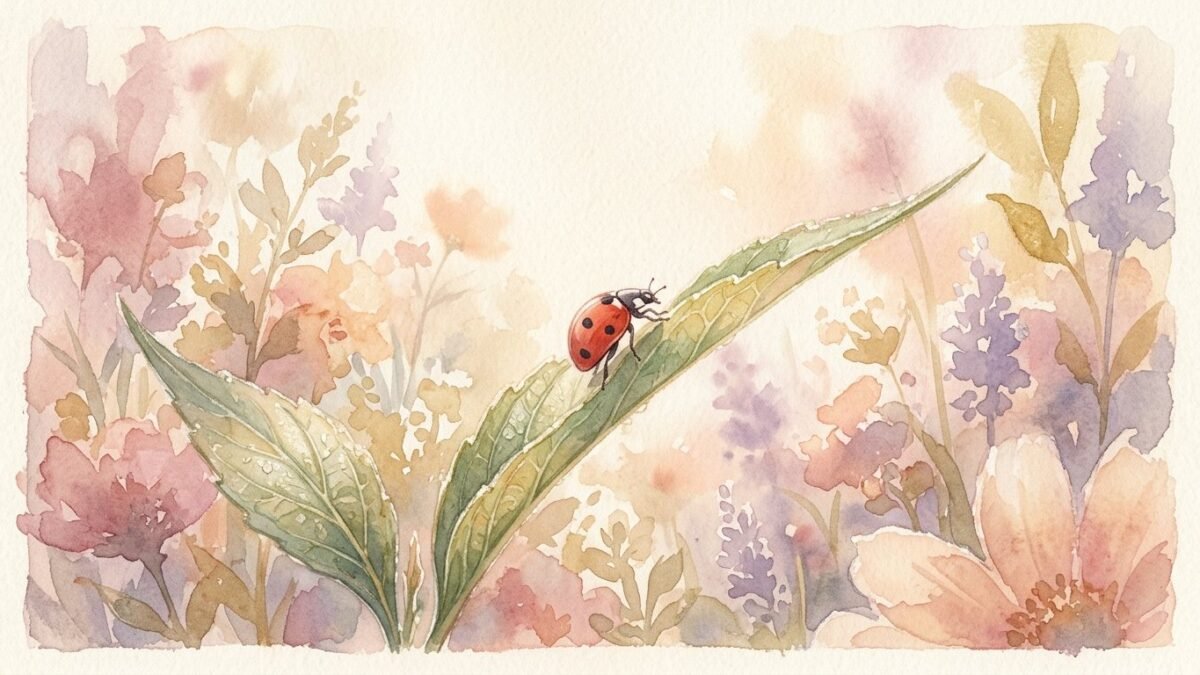
A ladybug is read as luck that arrives small: a wish taken seriously, a piece of good fortune you did not have to earn, and a sign that the worst of something has passed. The ladybug spiritual meaning is one of the few in the whole set of signs with no dark version at all, which is why people who would never call themselves superstitious still hold their breath when one lands on their sleeve.
It is also a beetle that eats aphids, sleeps through the winter in your window frames, and is drawn to warm, pale, still things, which is a fair description of a person sitting quietly in the sun. Below is what the sign has come to mean, the versions people ask about, the honest side of it, the tarot card that keeps it company, and one small thing to do with it today.
What a ladybug has come to mean
The name is the oldest clue. In medieval Europe the beetle was called Our Lady’s bird, after Mary, because farmers whose crops were being eaten by aphids prayed for help and the little red beetles arrived and ate the aphids, dozens a day each, and the red of the wings was read as her cloak and the seven spots of the commonest kind as her seven sorrows and seven joys. The British still call it the ladybird, the Germans call it Mary’s beetle, and the French call it the good God’s creature, and every one of those names is a thank you.
So the meaning was gratitude before it was luck. A ladybug was the help that came without being paid for, and the readings that grew up around it all keep that shape: a wish granted, a good harvest, a hard year ending, and a small kindness from somewhere you cannot see. The rhyme that tells it to fly away home was a charm to send it back to the fields, where it was needed. The bee carries the same idea of help that arrives small and has its own page under bee spiritual meaning.
Ladybug spiritual meaning when one lands on you
This is the version people remember for years and the one most searches are about. A ladybug landing on you is read as luck choosing you personally, and the old folk instructions are precise: do not brush it off, let it walk, and count the spots, because each one is a month of good luck, or in older versions a year, or the number of children you will have, which is a folk count and not a forecast of anything. When it flies off on its own it is said to carry your wish with it.
A ladybug on your hand is read as something good arriving through what you do, on your shoulder as a small weight lifting, and in your hair as a piece of luck you did not see coming. A ladybug landing on you while you were thinking about a decision is read as a gentle yes, and the honest version of that is a yes with a beetle’s worth of authority, so use it as permission to stop agonizing rather than as an instruction.
In the house, in winter, and the ones that are not red
A ladybug in the house is read as good fortune for the household and as protection for whoever lives there, and in older European folklore a ladybug indoors in the cold months meant the family would come through the winter. That reading has an explanation, and it is a kind one: ladybugs cannot survive a frost in the open, so in October they crawl into window frames, curtain folds and the gaps around doors to sleep, and on the first afternoon the heating runs warm enough one of them stirs and walks across your ceiling in January.
The ones that are not the classic red with seven spots deserve a word. Orange ladybugs with many spots, and the ones that gather in dozens on a sunlit wall in fall, are usually the harlequin, a cousin that arrived from Asia and does the same aphid work; black ladybugs with red spots are their own kind and are read as the same luck with a little more depth. A yellow one is read as a fresh start, and a ladybug with no spots at all is read as luck that has not decided its shape yet. A dead ladybug on a windowsill is a small sorrow and not an omen, and a room full of them in fall is a south-facing wall and a warm week.
The honest part
Ladybugs land on people because people are warm, still and often wearing something pale, and a red beetle is easy to see against a white shirt, which is half of why the encounter feels so deliberate. There are thousands of species and they are common wherever there are aphids, which is wherever there are gardens, so the beetle itself is not rare.
What is rare is the pause. Out of every small red thing that has ever crossed your path, you stopped for this one, and that is the part that carries the meaning, because attention is not accidental and it gathers around whatever you have been hoping for without saying so. A sign like this one does not tell you what will happen; it shows you what you were wishing for the moment before it landed, and that is more useful.
The card that sits with a ladybug
In tarot the ladybug belongs with the Ace of Pentacles: a hand reaching out of a cloud holding a single gold coin above a garden with a hedge and an archway, and beyond the archway, mountains. It is the card of a real, small, good thing being offered, and of the ordinary garden it is offered in, and the question it asks is whether you will take what is held out or explain why you should not.
The ladybug asks the same. It is a small, unearned, specific bit of luck, and a lot of people are far better at giving those than at receiving them. If you keep meeting ladybugs, or the Ace keeps turning up in your draws, the message is about your hands being open as much as it is about the coin.
What to do with a ladybug today
Today, the next time something small goes your way, accept it. The compliment, the seat someone offers, the colleague who covers ten minutes for you, the change in the weather. Say thank you and stop there, without paying it back on the spot and without explaining why you did not really deserve it. This is harder than it sounds for most people, and it is the whole of the ladybug’s instruction: do not brush the luck off. Let it walk to the end of your finger and leave when it is ready.
A line to remember: luck that lands on you is still yours, even if you did not earn it.
Questions people ask
What does it mean when a ladybug lands on you?
It is the most personal version of the sign and is read as luck choosing you: a wish taken seriously, a small piece of good fortune, and in the old folk count one month of luck for every spot. Practically, ladybugs land on warm, still, light-colored surfaces, and a person sitting quietly in a pale shirt is exactly that. Both things are true at once.
What does a ladybug in the house in winter mean?
Traditionally a ladybug indoors is read as good luck for the household and as a sign that a hard stretch is easing. In winter the explanation is that it came in during the fall to sleep in a window frame and stirred on the first warm heating day. The kindest thing is to let it be, or move it somewhere cool and dry, and it will leave in spring.
Is a dead ladybug a bad sign?
No. Ladybugs live about a year, sometimes longer, and many of the ones found on windowsills in late winter simply did not make it through the cold, which is ordinary rather than ominous. No ladybug, alive or dead, predicts anything. If finding one made you think of something you have been putting off, that thought is the readable part, not the beetle.