A deer is usually read as a sign of gentleness and quiet strength: an invitation to move softly, trust your instincts and stay open, even when life asks a lot of you. Many people also take a deer that stops and looks at them as a moment of being seen, a small pause in an ordinary day. Below is what the deer has meant across traditions, what it can say about love, work and grief, how to tell when it is simply a deer at dusk, and the tarot card that belongs with it.
Why the deer reads as gentleness
Most animals we call signs are read for their strength or their cleverness. The deer is read for something rarer: the way it stays alert without becoming hard. It hears everything, it moves the moment it needs to, and yet nothing about it is aggressive. That combination is why so many people feel something when they meet one. A deer seems to say that being sensitive is not the same as being weak, and that you can notice everything around you and still keep a soft heart.
There is also the stillness. A deer that has seen you will often freeze, ears forward, and simply look. For a few seconds the world goes very quiet. People remember those seconds for years, and I suspect that is a large part of the meaning: the deer gives you a pause you did not plan.
The deer in different traditions
In Celtic and old British stories a white hart, a pure white stag, appears at the edge of the forest and leads a hunter or a knight into a new part of his life. Nobody ever catches it. The point of the white hart is that following it changes you, and in the Arthurian tales its appearance often marks the start of a quest.
In Buddhism the deer stands for peace and for listening. The Buddha is said to have given his first teaching in a deer park near Sarnath, and two deer facing a wheel still sit above the doors of many temples. In Japan the deer of Nara have been treated for centuries as messengers of the gods of the Kasuga shrine, and they still walk freely through the town, bowing to visitors for crackers.
In the Hebrew psalms a deer longing for streams of water is the image of a soul longing for what it loves. Across Native American nations the deer appears in many different stories, so I will not fold them into one meaning, though gentleness, provision and care for the young come up again and again. What links all of these is a creature that is revered and approachable at the same time, never a threat, always slightly out of reach.
When a deer stops and looks at you
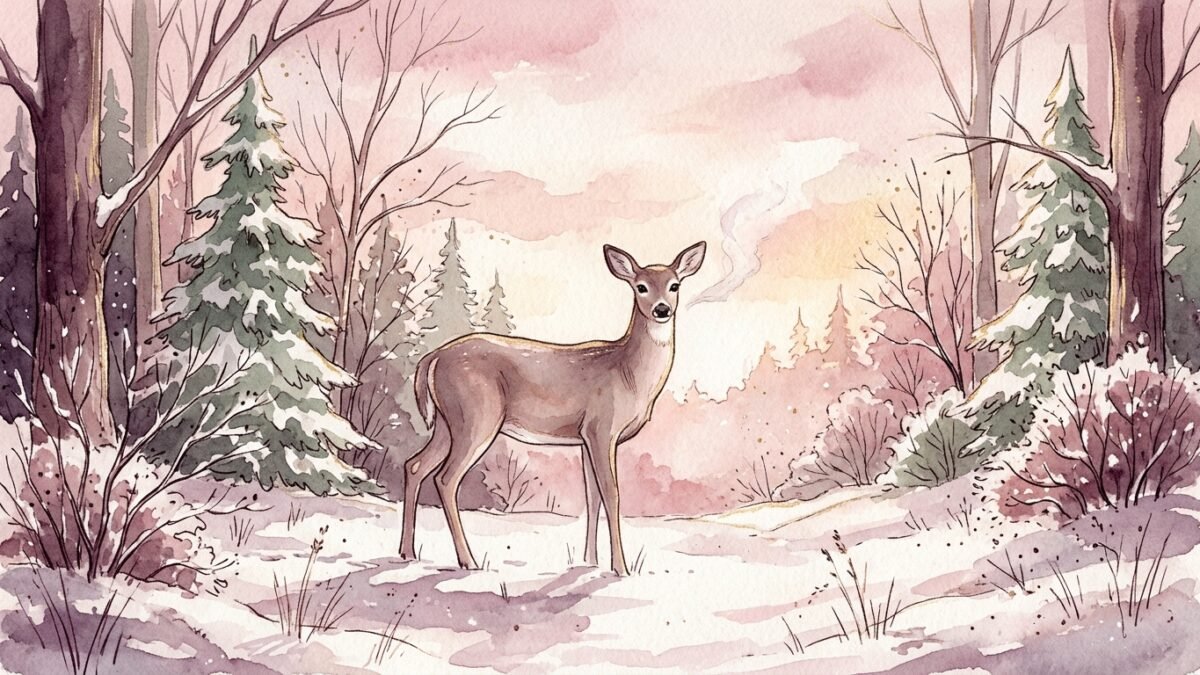
This is the moment people write to me about most. You come around a corner, or look out of the kitchen window at dawn, and a deer is standing there, perfectly still, looking straight at you. Here is the gentlest way I know to read it: it is an invitation to stop as well. Notice where you were rushing to and what you were telling yourself just then. Ask whether you have been moving through your days with the softness the deer has, or with your shoulders up around your ears.
A doe with a fawn is often read as a sign about care: caring for someone small or new in your life, or caring for a younger part of yourself. A stag with antlers is read as quiet authority, the kind that never needs to raise its voice. A deer that bounds away before you can look properly is not a bad sign. It is simply a deer being a deer, and the glimpse still counts.
A deer in winter
Deer are easier to see in late autumn and winter. The leaves are down, they move more in daylight to feed, and snow makes their tracks and outlines stand out. A deer at the edge of a snowy field is one of the loveliest sights of the cold months, and in winter its meaning leans toward endurance. Deer do not hurry through the cold. They slow down, keep to paths they know, and wait for spring without fuss. If you are in a quiet, stripped back stretch of your own life, that is a kind example to borrow.
What a deer can mean for love
In love the deer speaks about tenderness and pace. It can be a reminder to let something new grow slowly, without forcing answers, and to stay soft rather than guarded. If you have been hurt, it can be read as encouragement that your sensitivity is worth protecting, not something to grow out of. It says nothing about what another person feels or will do. It is about how you want to arrive in love yourself: open, gentle, and still very aware of what is good for you.
What a deer can mean for work and change
At work the deer is a sign for steady, perceptive people. You may not be the loudest voice in the room, and you do not need to be. Your gift is noticing what others miss. If you are at a crossroads, the deer suggests moving forward carefully and on your own timing, trusting the instinct that tells you when a path is safe. Like the white hart, it can also mark the start of something new that you will only understand once you are partway along it.
A deer when you are grieving
Many people see a deer soon after losing someone and feel it as a visit, or at least as a kindness. If that brought you comfort, you are allowed to keep it. Nobody can prove what a deer means, and nobody needs to. What I can say is that the deer is an old and gentle symbol of the soul and of peace, and that meeting one in a raw week can be a moment to breathe, to think of the person with love, and to let yourself be quiet for a minute.
When it is just a deer
An honest word, because it makes the meaningful moments easier to trust. Deer are most active at dawn and dusk, and in many places they have become common in gardens, parks and the edges of towns. Autumn is their mating season, so in October and November they travel more and cross roads more often. Seeing deer near your home every week usually means you live near good deer country, not that each sighting is a message. And please drive slowly on country roads at dusk this time of year.
The meaning lives in the moment, not in the animal alone. If a deer appeared just as you were thinking about someone, asking yourself a question or feeling lost, that timing is the part worth holding on to.
The card that sits with it
In tarot the deer belongs with Strength. On the card a woman calmly closes the mouth of a lion with her bare hands, and there is no fight in it at all. Strength is the card of soft power: patience, kindness and a steadiness that wins without force, which is exactly what the deer seems to carry. If your deer came with tenderness or love on your mind, its second card is the Page of Cups, a young dreamer looking at a fish peeking out of a cup, open to feeling and to small surprises. You can draw your own card for the day with pick a card and see what it adds.
Questions people ask
What does it mean when a deer crosses your path?
It is most often read as a nudge to slow down and move through what is in front of you with gentleness and care. Many people also read it as the start of a new chapter. In practical terms it is a reminder that more deer may follow, especially on a road at dusk.
What does it mean when a deer stares at you?
It is read as a moment of being seen and an invitation to pause. The deer is checking whether you are safe. You can take it as a chance to check in with yourself too: what were you thinking about just before you saw it.
Is seeing a deer good luck?
In most traditions, yes. The deer is linked with peace, gentleness, plenty and kindness, and nothing about it is read as a bad omen.
What does a white deer mean?
In Celtic and Arthurian stories the white hart marks a quest or a turning point, a call toward something new. Real white deer are very rare and usually have a pale coat from a genetic trait called leucism, which is part of why a sighting feels so special.
Can a deer be a sign from a loved one who passed?
Many people feel that it can, and if a deer brought someone to mind, that comfort is yours to keep. Nobody can know for certain. What matters is that the moment let you feel close to them for a while.
If the deer spoke to you, these signs are close cousins: the fox, the white dove, the owl, the hawk and snow. You may also like signs from loved ones who passed. Every sign we have written about is on the signs page.