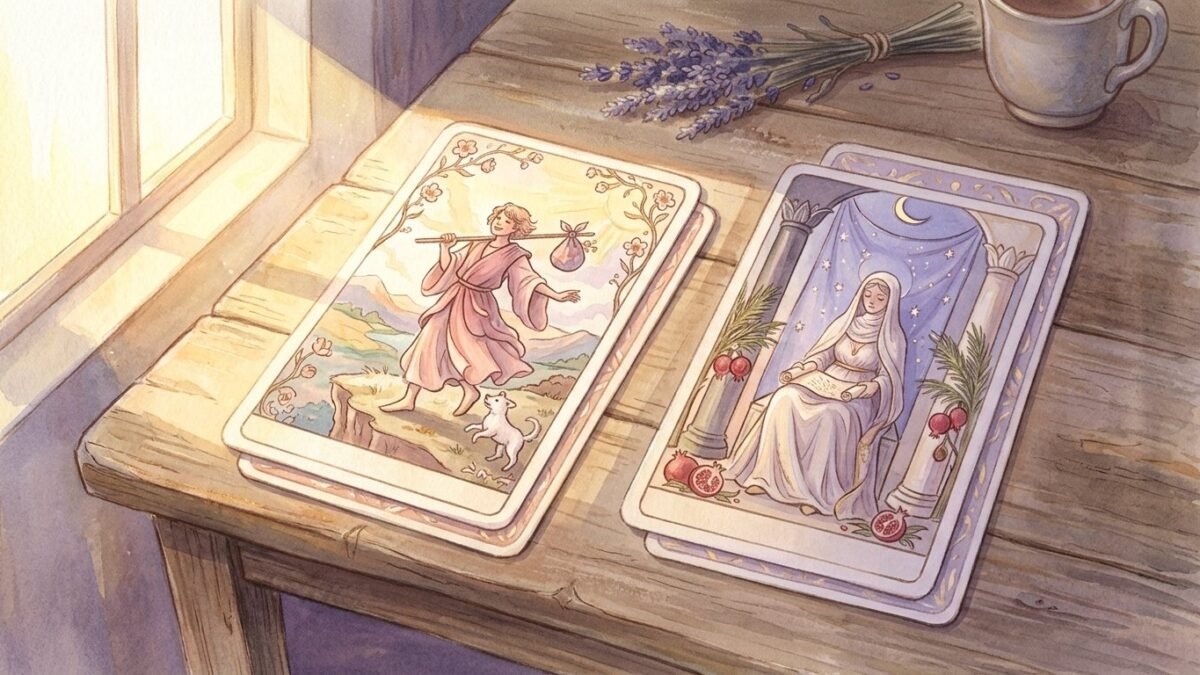
Most yes or no tarot cards lean yes, a smaller group lean no, and a good handful sit at maybe, and the list below is the one the readings on this site actually use. Before the list, one rule: a lean is about your side of a question, whether to send it, go, apply, or say yes to Saturday, and it is never about what another person will do.
So the Sun does not mean he will text. It means that if the question is whether you should, the card is with you. Keep that in your pocket while you read, because a list of yes or no tarot cards is useful with it and fairly harmful without it.
The yes or no tarot cards that lean yes
Roughly half the deck, which is worth knowing before you get excited. The clearest yes is the Sun, and close behind it come the Star, the World, the Fool, the Magician, the Empress, Strength and the Wheel of Fortune. All four aces lean yes, because they are beginnings, and the Ace of Cups in particular favors the feeling you have not said out loud yet.
In the small cards, the Two, Three, Nine and Ten of Cups say yes, and so do the Nine and Ten of Pentacles, the Three and Eight of Pentacles, the Four, Six and Eight of Wands, and the Six of Swords, which is a quiet yes that improves once you have moved. Most court cards lean yes as well, especially the Pentacles and Wands courts, who tend to back the person who takes the thing in hand.
The cards that lean no
Fewer than people fear. Only six cards read as a plain no here: the Tower, the Ten of Swords, the Three of Swords, the Five of Swords, the Five of Pentacles and the Ten of Wands.
Notice that each of them says no to the shape of the question rather than to the whole subject. The Tower is no, not in the form you are picturing. The Ten of Wands is no, not the way you are carrying it. The Five of Swords is the interesting one, because it says you could probably win this and the winning is where the trouble starts, which is a no you will be grateful for later.
The maybes, which are the honest middle
Eighteen cards sit at maybe, and a maybe almost always means not yet, or not until you have looked. The High Priestess, the Hermit, the Hanged Man and the Moon are waiting cards, and the Devil is a maybe that asks you to check what you would be agreeing to.
In the suits, the Two, Four, Seven, Eight and Nine of Swords are maybes about the state you are in rather than about the question, and the Nine in particular says ask again after you have slept. The Four, Five and Seven of Cups, the Two, Four and Seven of Pentacles, and the Two and Five of Wands round out the group, and every one of them is a reason to ask a smaller question rather than to give up on the big one.
Yes, if: the cards with a condition attached
About a third of the yeses come with an if, and the if is the reading. The Lovers is yes if the choice matches what you actually value rather than what looks right. Justice is yes if your side of it is fair. Death is yes to the ending, which is not the same as yes to the thing you asked about. The Eight of Cups is yes if the question is whether to leave.
The Cups and Swords courts mostly answer this way too. The Queen of Swords is yes if it stands up to a clear look, the Queen of Cups is yes if it still sits well after a night’s sleep, and between them they describe the two checks worth running on any answer you get.
The rule that keeps this honest
A lean belongs to the person asking. If the question has somebody else’s decision inside it, will he come back, will they offer me the job, does she still think about me, then no card leans on it, and the honest first sentence is that the card cannot see that. Rewrite the question with yourself as the subject, should I reach out, should I apply, should I stop waiting, and the same card suddenly has something to say.
The same goes, quietly, for anything about health, pregnancy, a court case or money coming in, which are not places for a lean. The yes or no draw explains how the readings here handle those questions, and any list of yes or no tarot cards is only as honest as the question it is applied to.
Draw once, then do something with it
Take your question, check that you are the subject of the sentence, and draw once at the yes or no oracle. Read the reason underneath the word before you read the word, because the reason is the part that survives contact with an actual week.
Then do one thing with it before you draw again. A yes you never act on and a no you never accept are the same card, and it is the one still sitting on the table at midnight.
Questions people ask
Which tarot cards mean yes?
The Sun, the Star, the World, the four aces, the Two, Three, Nine and Ten of Cups, the Nine and Ten of Pentacles, the Four, Six and Eight of Wands, and most of the court cards. Roughly half the deck leans yes, which is worth knowing before you draw, because a yes is the least remarkable thing a deck can say.
Which tarot cards mean no?
Fewer than people expect. The Tower, the Three, Five and Ten of Swords, the Five of Pentacles and the Ten of Wands lean no here, and each of them says no to the shape of the question rather than to the whole subject. A no from any of these is usually an invitation to ask a smaller question.
Can yes or no tarot tell me if he will come back?
No, and any list that says the Sun means he will is guessing. A lean is about what you should do, and whether another person returns is not yours to decide, so no card can lean on it. Ask instead whether to reach out, or whether to stop waiting, and the deck has something honest to say.