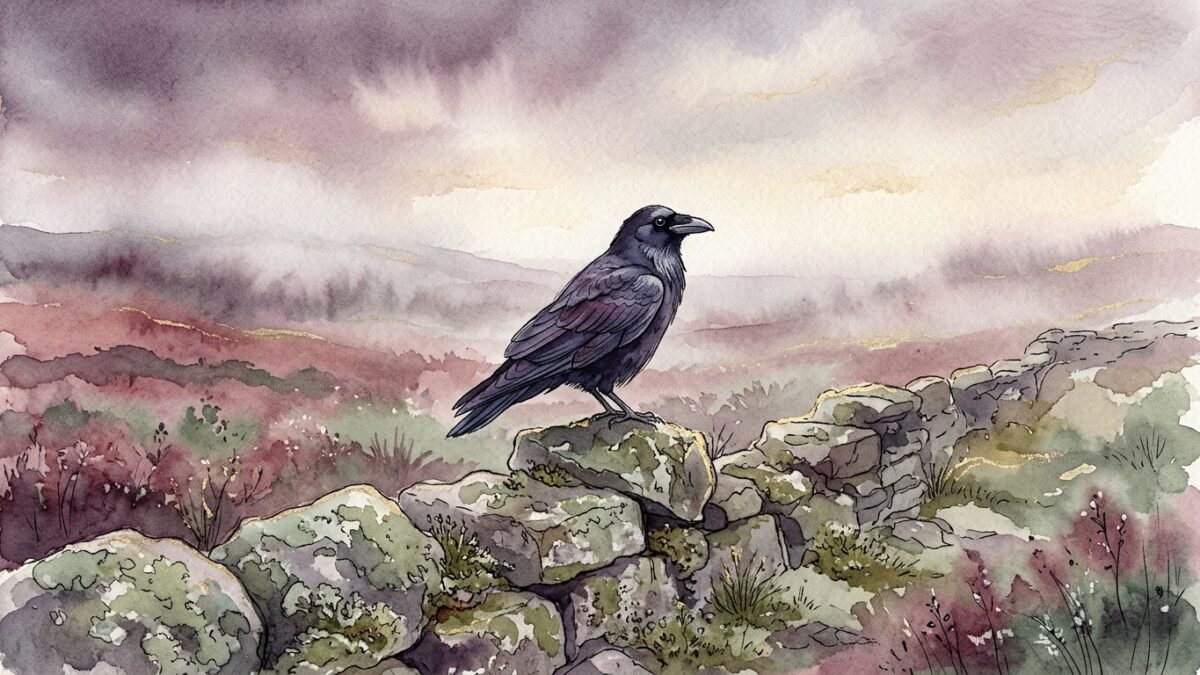
A raven is most often read as a messenger of insight: a sign that you are being asked to look more closely, to trust what you already sense, and to expect a change that is more thoughtful than frightening. The raven has a darker reputation in stories than it has earned in the traditions that actually honored it. This page sets out where the meaning comes from, what it can say about love, work and loss, and the practical truth that a big black bird on a wall is also just a bird going about its day.
Where the raven’s meaning comes from
Ravens are some of the most intelligent birds there are, and people have always noticed. In Norse myth, Odin kept two ravens, Huginn and Muninn, who flew out each morning and came back to tell him what they had seen. That made the raven a bird of thought and memory. Among many Indigenous peoples of the Pacific Northwest, Raven is a clever trickster and a creator who brings light into the world. In Celtic stories ravens are tied to the Morrigan and to sovereignty and fate. In the Hebrew Bible a raven is the first bird sent out from the ark.
The fear that clings to ravens in modern tales, the sense of doom, comes mostly from poetry and gothic fiction. The older traditions are closer to respect: the raven sees widely, remembers well, and moves between worlds.
What a raven can mean for you
When a raven catches your attention, the usual reading is about perception. It can be an invitation to notice what you have been half-aware of and not yet named, a feeling about a situation that you have talked yourself out of. The raven asks you to trust your own observation again.
It is also a bird of transition. Many people see one when a chapter is closing, and the meaning there is not loss for its own sake but clarity: you can see more, from a little higher up. If you want a way to hold that, ask yourself what you now understand that you did not understand last month.
A raven and love
In love, a raven is read as a call to honesty. It might point to a conversation that is overdue, or to a pattern you have been seeing clearly and avoiding. It does not say what anyone else feels, and it does not predict an ending or a beginning. What it offers is a prompt to look at your own relationship with a clear eye and to say what is true for you.
If you are single, the raven can be a gentle reminder that depth matters more than speed. It favors the slow, well-observed connection over the quick spark.
A raven and work
At work the raven stands for intelligence and strategy. It is a good sign to meet when you are weighing a decision and need to think before you move. Many people read it as encouragement to gather information, notice who really holds influence, and wait until you can see the whole picture. It is also the bird of the problem solver, so it often appears in stories as the one who finds the clever way through.
A raven and grief
Ravens are sometimes seen as companions of the dead because they gather near places of loss in old stories. In practice, people who meet a raven after a bereavement often describe being struck by its steadiness. If one arrived while you were missing someone, you can take it as company in a hard hour, a presence that did not look away. There is no need to decide what it means beyond that. The page on signs from loved ones who have passed offers a gentle way to sit with such moments.
Raven or crow: telling them apart
Ravens are larger than crows, with a heavier beak, a wedge-shaped tail in flight, and a deeper, rougher call. Crows are smaller and more social. Many people who think they saw a raven saw a crow, and the two carry related but not identical meanings. If you want the other side of the family, the page on the crow covers it in the same spirit.
When it is just a bird
Ravens and crows are common in many places, and they love open ground, rubbish bins and the tops of lamp posts. A raven calling from a tree can be exactly that and nothing more. As with every sign, the question that matters is whether the sighting arrived at a moment when you were already asking something, and whether it changed what you did next. If it did not, enjoy the bird. They really are remarkable animals.
Please do not read a raven as a message about illness, death or money. It is not that kind of sign, and nothing in the old traditions says so with any authority.
The card that sits with it
In tarot, the raven belongs with The High Priestess, the card of hidden depth and quiet knowing, seated between two pillars with a veil behind her. She asks you to listen to what you already sense. If the raven came with a feeling of an ending and a clearing, Death is its second card, which in tarot is almost always about transformation and not about literal loss. The page on the black feather explains that card in more detail.
Questions people ask
What does it mean when you see a raven?
Most traditions read it as a messenger of insight and change. It is usually taken as encouragement to trust what you already notice and to look at a situation more clearly, not as a sign of anything frightening.
Is a raven a bad omen?
In poetry and gothic fiction it often is, but older traditions treated the raven with respect for its intelligence and memory. In a gentle reading it is a bird of perception and transition.
What is the difference between a raven and a crow in spiritual meaning?
They are close cousins. The raven is bigger and is tied to deep insight and creation myths, while the crow is more social and is often read as a bird of community and change. Telling them apart by size, beak and call helps.
What does a raven mean in tarot?
It sits with The High Priestess, the card of hidden depth and quiet knowing. Death is a companion card when the sign feels like a clearing, and in tarot that card speaks of transformation.
Can seeing a raven mean someone has passed or will pass?
No. A raven cannot tell you that, and a good reading never claims it. If you saw one while grieving, it is fine to take it as company, and that is all it needs to be.
If you want to read on, the full signs guide gathers every bird, feather and number we cover, along with the owl and the robin.