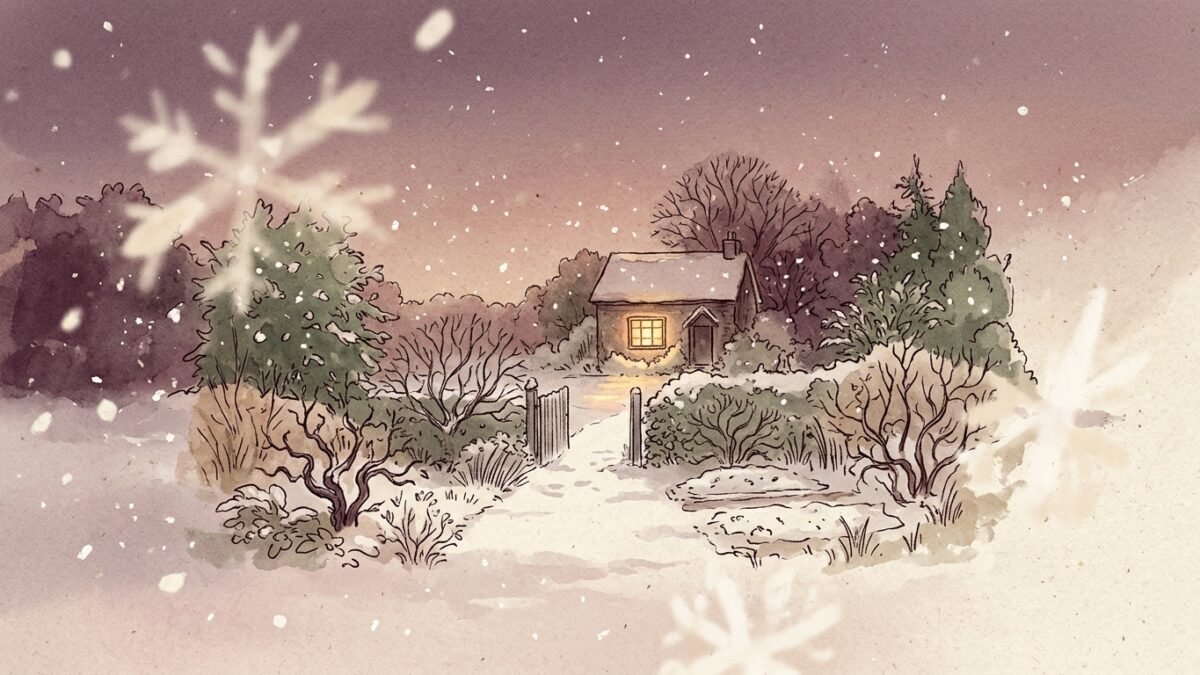
The spiritual meaning of snow is usually read in three ways: a clean page, a time to rest, and a call to be quiet. Snow covers everything evenly, the tidy and the untidy alike, so it has long stood for a fresh start and for forgiveness. It falls on a world that is asleep rather than dead, so it also means rest before a new season. And it hushes sound in a way almost nothing else does, which is why so many people feel it as an invitation to slow down and listen. The first snow of the year is widely treated as a moment to make a wish or begin again, and snow on a day that matters, a birthday, a wedding, a funeral, is often read as a blessing.
None of that requires you to believe snow is sent to you personally. It only asks you to notice what snow does to a day, and what it does to you.
Why snow feels like a message
There is a physical reason snow feels different from rain. Fresh snow is full of tiny air pockets, and it absorbs sound, so a street that roars on an ordinary morning goes soft and close. The light changes too: snow reflects it back up, so a snowy night is brighter than a clear one, and a snowy morning has a pale, even glow with no hard shadows. Your senses are telling you that the world has changed overnight, and the mind, which loves a pattern, reaches for meaning.
That is not a reason to dismiss it. It is the reason snow has carried meaning in so many places. When everything outside goes still, it is easier to hear what is going on inside, and that, more than any omen, is usually what the snow brings.
What snow has meant in different places
In Japan, yukimi, snow viewing, is an old pleasure in its own right: you sit somewhere warm and watch the garden fill up, and the beauty is partly that it will not last. Stone lanterns built to hold a cap of snow, yukimi-doro, still stand in many gardens. The meaning there is impermanence, held gently: this is lovely because it is passing.
In the Bible, snow is the picture of being made clean again: wash me, and I shall be whiter than snow, in the fifty first Psalm. A lot of the Western reading of snow as forgiveness and a fresh start comes from that line.
In Norse stories, winter belongs to Skadi, the goddess of mountains, skiing and the cold, who chose to live where the snow stays. Snow there is not punishment but a landscape with its own strength, and the long dark months were the time for stories by the fire. Farming communities across Europe kept a more practical faith in it, in the old saying a year of snow, a year of plenty: a deep snow protects the ground and feeds the spring.
In Korea, the first snow of the year, cheot-nun, is romantic. People hope to spend it with someone they love, and an old custom says that if the balsam flower colour you painted on your nails in summer lasts until the first snow, your first love will come true.
The first snow of the year
Almost everywhere it falls, the first snow is treated as a small threshold. Some people make a wish on the first flake that lands on them. Some write the date down, the way you might mark a first frost or the first swallow. Some simply go outside, because the first snow is never quite like the others.
If you want to give it meaning, give it a simple one: the first snow is a natural point to close a chapter. The garden is covered, the year is turning, and you are allowed to decide that something is finished, a worry, a habit, an argument you keep rehearsing, and that whatever comes up in spring can be new.
Snow on a day that matters
On a birthday, snow is usually read as a quiet blessing on the year ahead, a clean page to write on.
On a wedding day, many families call it lucky, and the photographs tend to agree. The meaning people reach for is a marriage that starts fresh and stays warm while it is cold outside.
At a funeral or on an anniversary of a death, snow is often felt as gentleness: the world softening, everything covered, a hush that feels like being held. If snow comes on a day like that and brings you comfort, you do not need anyone’s permission to keep it. You can read more about the signs people notice after a loss in signs from loved ones who have passed.
Snow in love, work and the year ahead
In love, snow asks for patience. Not every relationship needs to be growing visibly all the time. Some things are quietly putting down roots under the cover, and a slower season is not the same as an ending.
At work, snow is the reminder that rest is part of the work. Fields lie fallow so that they can produce again. If you have been pushing hard, a snowy week is permission to do less without feeling that you are falling behind.
For the year ahead, snow is a clean page. It is a good moment to choose one thing you want the next season to hold, and to write it down where you will find it again in spring.
When snow is just snow
It is worth saying plainly: most snow is weather. If you live somewhere it snows every winter, a snowfall on an ordinary Tuesday is not a sign that you have missed. The meaning is not in the snow arriving but in whether it catches you at a moment when you needed to stop. If it does, take it. If it does not, enjoy it, or grumble about the drive, and let it be a normal winter day. Both are fine.
The card that sits with it
In tarot, snow belongs most naturally to the Hermit, the old figure standing alone on a cold mountain peak with a lantern. He has not gone up there to escape, but to see clearly. The Hermit is the card of going quiet on purpose, of letting the noise settle until you can hear your own answer, and that is exactly the invitation of a snowy day.
If snow arrives when you are exhausted rather than reflective, the card is closer to the Four of Swords: a figure lying still in a quiet chapel, resting so that they can stand up again later. Snow gives you a reason. The card gives you permission.
Questions people ask
What does snow symbolize spiritually?
Snow is most often read as a fresh start and forgiveness, because it covers everything evenly; as rest, because it falls on a world that is asleep rather than dead; and as quiet, because it hushes sound. Many traditions also see its beauty as a lesson in impermanence.
What does the first snow of the year mean?
The first snow is widely treated as a threshold: a moment to make a wish, close a chapter or begin again. In Korea it is especially romantic, and people hope to spend it with someone they love.
Is snow a sign from someone who has died?
Many people feel snow on a funeral day or an anniversary as gentleness and comfort, and that feeling is real. Whether you read it as a message or as the world being kind for a moment is up to you; both are honest ways to hold it.
What does it mean when it snows on your birthday or wedding day?
It is usually read as a blessing: a clean page for the year ahead, or a marriage that starts fresh and stays warm while it is cold outside.
What tarot card is connected to snow?
The Hermit, who stands alone on a cold mountain peak with his lantern, is the card closest to the quiet that snow brings. For snow that arrives when you are worn out, the Four of Swords, the card of rest, fits too.