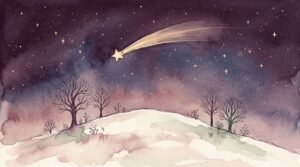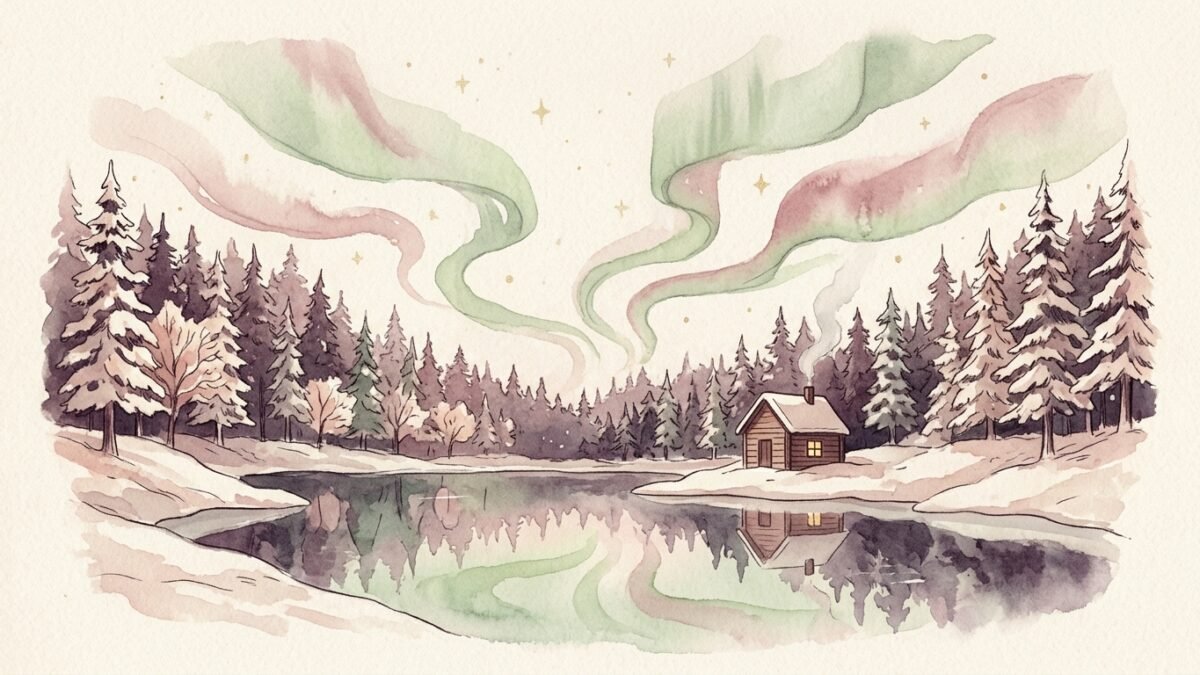
The northern lights are usually read as a sign of wonder, of hope in the dark, and of closeness to those who have gone before. In many of the cultures that live under them, the lights were the spirits of the dead, dancing, playing or watching, and they were treated with a mixture of awe and respect. Today most people who see the aurora describe it as a turning point or a reminder that the world is larger and stranger than their worries: a once in a lifetime moment that arrived exactly when they needed to look up.
The science does not take any of that away. If anything, it makes it more remarkable.
What you are actually seeing
The Sun throws out a constant stream of charged particles, and now and then a much larger burst. When those particles reach Earth, our magnetic field steers them toward the poles, where they collide with the thin air a hundred kilometres and more above the ground. Oxygen glows green, and at greater heights red; nitrogen adds blue and violet. The curtains and ripples you see are the shape of the magnetic field itself, made visible for a few minutes.
The Sun runs in roughly eleven year cycles, and the current one reached its most active period around 2024. That is why so many people far from the Arctic, in southern England, the Netherlands, northern Italy and even parts of Mexico, saw the lights in 2024 and 2025, and why the next few winters are still a good time to watch. In the southern hemisphere the same thing happens as the aurora australis, the southern lights.
What the lights have meant to the people who live under them
In Finnish the aurora is revontulet, fox fires, after an old story of a fox running across the snowfields so fast that its tail swept sparks into the sky. It is one of the loveliest names anyone has given the lights, and it says something true about them: they look alive.
Among the Sámi of northern Scandinavia, the lights were traditionally treated with caution. Many families taught children not to wave, whistle or sing at them, so as not to draw them down, and some understood them as the souls of the dead. The respect is the meaning there: something powerful is passing overhead, and you do not mock it.
In some Inuit stories the lights are the spirits of people who have died, playing a ball game across the sky, and the crackle some people say they hear is their footsteps on the snow. In Shetland and Orkney the aurora was called the Mirrie Dancers, the merry dancers. You will often read online that the Vikings saw the lights as the armour of the Valkyries; it is a beautiful idea, but the old Norse sources say very little about the aurora, so treat it as a modern story rather than an ancient one.
What almost all these traditions share is the sense that the lights are not empty. Something is moving there, and it has to do with the people we have lost and the world beyond the everyday.
What it can mean when you see them
Hope in the darkest season. The aurora is strongest in the long nights of winter. Seeing light dance in the darkest part of the year is the plainest message it carries: dark seasons are not empty, and they do not last.
A presence. If the lights come on a night when you are thinking of someone who has died, you are in very old company if you feel them close. That reading has been part of the aurora for as long as people have told stories about it.
A turning point. Many people who see the lights for the first time describe it as the moment something shifted: a decision made, a grief eased, a sense of being small in a good way. The aurora is rare enough that it tends to mark a life, and it is worth asking what you want it to mark in yours.
Being in the right place. You cannot summon the lights. They come when the Sun, the sky and the clouds all allow it. If you saw them, you were there at the right time, which is a quiet kind of luck.
An honest note about photographs
If you saw the lights through your phone more clearly than with your eyes, you are not imagining it. Phone cameras take long, sensitive exposures and pick up colour that the human eye, in the dark, often sees only as a pale grey glow. That does not make your sighting less real. It does mean that the vivid pink and green photographs online are not quite what most people see standing in a cold field, and that a faint, silvery arc is still the real thing.
The card that sits with it
In tarot, the northern lights belong to the Star: a woman kneeling by water under a sky full of light, pouring out what she carries, calm after the storm of the Tower that comes before her. The Star is the card of hope that returns quietly, of healing that does not need to be loud, and of guidance in the dark. That is very close to what people feel under the aurora.
Read for this sign, the Star asks one gentle question: what are you still hoping for, underneath the tiredness? Whatever the answer is, it is allowed to be true again.
Questions people ask
What do the northern lights symbolize spiritually?
Most often hope in the dark, wonder, and closeness to those who have died. Many northern peoples saw the lights as spirits of the dead, and today people often describe seeing them as a turning point in their lives.
Is seeing the northern lights good luck?
Many people treat it that way, partly because the lights are rare and you cannot make them appear. If you saw them, the conditions, the Sun, the sky and the weather, all lined up while you were there to look.
Why should you not whistle at the northern lights?
In Sámi and some other northern traditions, children were taught not to wave, whistle or sing at the lights, so as not to draw them down. It comes from respect for something powerful rather than fear of a real danger.
Why do the northern lights look brighter on my phone?
Phone cameras take long exposures and are more sensitive to colour in the dark than human eyes, so they often show greens and pinks that look grey or white to the naked eye.
What tarot card is connected to the northern lights?
The Star, the card of quiet hope, healing after a hard time and guidance in the dark.