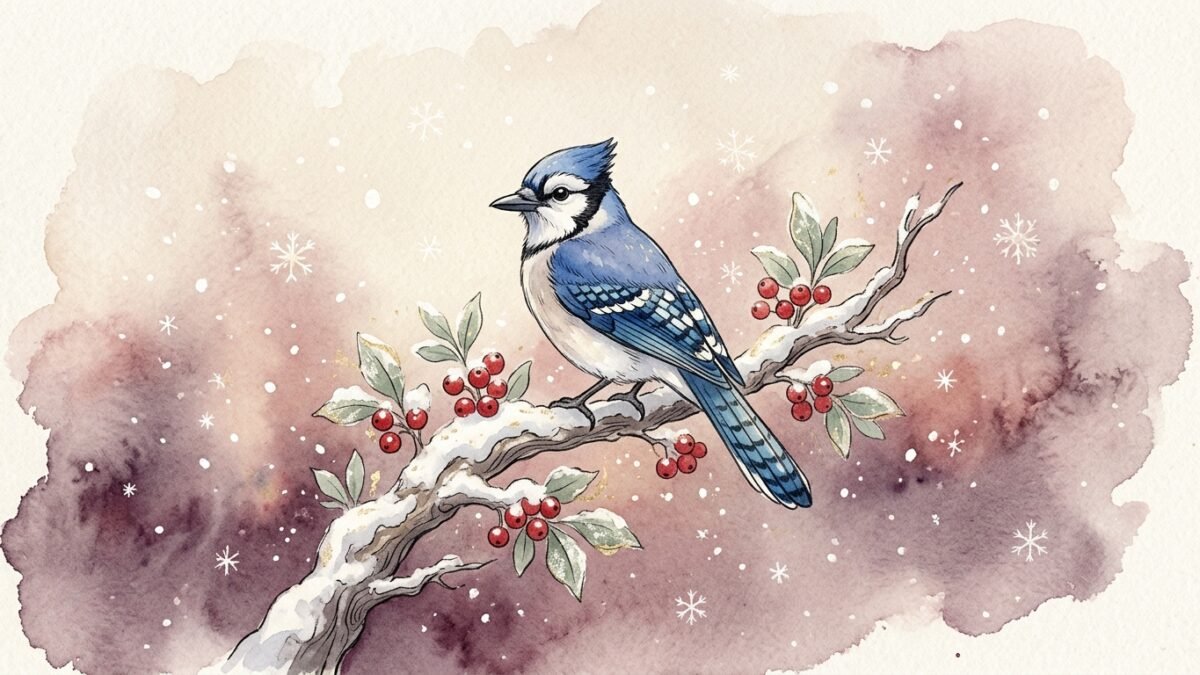
A blue jay is usually read as a sign to speak up, to stay alert and to use your wits: a loud, clever bird turning up to remind you that your voice is allowed to take up a little room. It is one of the few signs people notice with their ears before their eyes, and that says a lot about its meaning. Below you will find where that reading comes from, what a blue jay can say about love, work and missing someone, and the honest truth that in late autumn a blue jay in your garden is often a bird very busy with acorns.
Why the blue jay gets noticed
Most birds that people take as signs are quiet ones: a white dove, a robin on a fence, a feather on the path. The blue jay is the opposite. It shouts. It scolds cats, it chases larger birds off the feeder, and it can copy the call of a red-shouldered hawk so well that other birds scatter. It is also very bright. Jays remember where they have hidden thousands of acorns, and the ones they forget grow into oak trees, which is why people who study forests sometimes call them gardeners.
So when a blue jay catches your attention, the meaning usually comes from what the bird actually does. It is bold without being cruel, it uses its voice, it protects its own, and it plans ahead. Those four things carry most of the spiritual meaning people give it.
What the old stories say
In the stories of several peoples of the Pacific Northwest, Blue Jay is a trickster: quick, talkative, a little vain, often too clever for his own good and still somehow lovable. He is the one who rushes in, talks too much and learns something on the way out. That is a kind reading of a loud personality, and it is worth keeping.
In parts of the American South there was an old folk saying that you never see a jay on a Friday, because that is the day it carries a twig of kindling somewhere it should not go. It is a piece of folklore, told half as a joke, and nobody needs to fear a jay on a Friday. Elsewhere in folk belief the jay’s blue has been tied to clear skies and truthfulness, the color of saying plainly what you see.
What you will notice is that the jay is never a quiet omen in these stories. It is a character, with a voice and opinions. That is the heart of it.
Three things a blue jay tends to point at
When people tell me a blue jay keeps showing up, the conversation tends to land in one of three places.
The first is your voice. Maybe there is something you have been rehearsing in your head for weeks: a no, a request, a small truth. The blue jay is a bird that does not rehearse. It is an invitation to say the thing kindly and plainly, and to let it be heard.
The second is alertness. Jays are the alarm system of the woods. Seeing one can be a prompt to pay attention to something you have been half noticing, a pattern at work or a feeling in a friendship. That is not a reason to worry. It is a reason to look.
The third is preparation. A jay in November is burying food for February. If you have been putting off a practical thing, a plan, a savings habit, a conversation that sets up the spring, the jay is a fond nudge to start storing a few acorns of your own.
A blue jay and love
In love, the blue jay is a bird of honest communication. It can come when you are tiptoeing around what you want: waiting to be asked instead of saying it, or smoothing things over when you would rather talk them through. The sign is not about the other person and it does not tell you what they feel. It speaks to your side: you are allowed to be clear.
Jays also pair for a long time and both partners defend the nest. If you are in a steady relationship, a jay can be a pleasant mirror of what you are building together, loud days included.
A blue jay and work
At work, the blue jay is the colleague who says in the meeting what everyone was thinking afterward. If you have an idea you have kept small because you were not sure it was your place, this is a good sign to bring it up. The jay’s cleverness also points at resourcefulness: using what you already have, borrowing a trick from somewhere else, the way a jay borrows a hawk’s call.
When you are missing someone
Some people feel that a loved one who has died comes close as a blue jay, especially someone who was loud, funny, a bit bossy and impossible to ignore. If a jay landing on your railing brings a person to mind like that, let it. There is no way to prove what a bird means, and you do not need proof to feel comforted. The cardinal is the bird most often linked with this, and the page on seeing a cardinal and the gentler guide to signs from loved ones who have passed may help if this is where you are.
When it is just a jay
An honest note, because it matters. Blue jays are common across much of North America, and autumn is their busiest season. From September to November they fly back and forth all day carrying acorns and beechnuts to hide, which means they turn up more often and much more loudly than in summer. A jay at your feeder every morning is usually a jay that has found your feeder.
If you live in Europe, the bird you see is likely the Eurasian jay, a shy pinkish bird with a flash of bright blue on the wing. It carries the same meaning for many readers, and it is also, quite simply, burying acorns.
None of this cancels the sign. It just means the meaning lives in the moment it caught you, not in the bird’s schedule. If you saw a jay and thought of a conversation you have been avoiding, that thought is the useful part.
The card that sits with it
In tarot the blue jay belongs with the Page of Swords, the young watcher on a windy hill with a sword raised, alert, curious and ready to speak. It is a card of a quick mind and a fresh voice, which is the jay exactly. If the jay arrived with a feeling of confidence rather than vigilance, the Queen of Wands is its second card: warm, bold and entirely comfortable being noticed.
Questions people ask
What does it mean when a blue jay visits you?
Most often it is read as encouragement to speak up, stay alert and use your wits. It is a sign about your own voice and your own clear thinking, and it is a cheerful one rather than a worrying one.
Is a blue jay a good omen?
In most readings, yes. Its old trickster stories are fond ones, and its main meanings are honesty, courage and preparation. The odd bit of folklore about jays and Fridays is a joke from long ago, not something to fear.
What does a blue jay mean spiritually after a death?
Some people feel a loved one near when a blue jay appears, often someone with a big personality. There is no way to know for sure, and you are free to take comfort in it if it helps. The feeling it brings you is what matters.
Why do I keep seeing blue jays in the fall?
Autumn is when blue jays gather and hide acorns, so they are far more visible and noisy from September to November. If one still stops you in your tracks, notice what you were thinking about at that moment. That is where the meaning sits.
Other birds that people often read as signs: the robin, the crow, the raven and the hawk, whose call the blue jay likes to borrow. You can find every sign we have written about on the signs page.